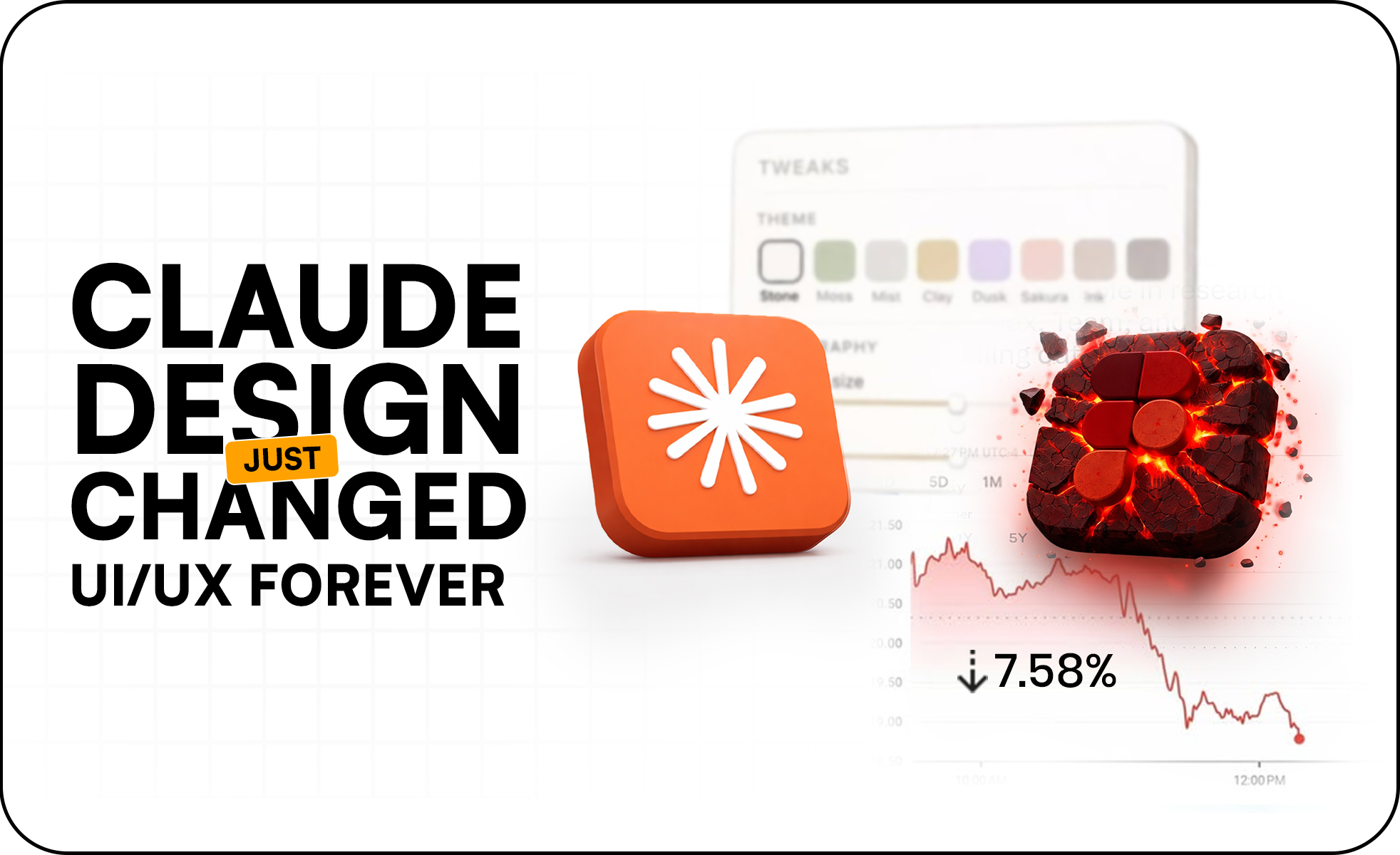
This Is Not Just a New Design Tool – It’s a New Starting Point
On April 17, 2026, Anthropic launched Claude Design – a conversational AI-powered visual editor embedded directly inside Claude. And within hours, the design software market felt the shock.
- Figma stock dropped 7.28% in a single trading day
- Adobe, Wix, and GoDaddy also saw significant declines
- AI-native design tools gained sudden investor attention globally
But this was not just a market reaction to a new product launch.
It was a signal that UI/UX design workflows – prototyping, ideation, and product development – are undergoing a structural transformation in the age of AI design tools.
We are no longer talking about better tools. We are talking about replacing the starting point of design itself.
What Is Claude Design? (AI Visual Editor Explained)
Claude Design is a generative AI visual editor that allows users to create complete user interfaces through natural language prompts – no canvas, no drag-and-drop, no manual component building required.
Unlike traditional UI/UX design tools like Figma, Sketch, or Adobe XD, Claude Design operates entirely through conversational UI generation.
Key Capabilities of the Claude AI Visual Editor
- Generate full UI layouts from simple text prompts
- Create responsive web pages and dashboards instantly
- Auto-build design systems from existing codebases
- Automatically understand brand guidelines – colors, typography, spacing
- Iterate and refine designs in real time through conversation
- Export outputs to Figma, Canva, PowerPoint, or production-ready code
This positions Claude Design in a brand-new category: AI-native UI/UX design tools – not just another AI plugin on top of existing software.
Claude Design vs Figma: The Core Difference in Design Philosophy
Figma – Traditional UI/UX Design
Figma is built around manual design creation, component-based UI systems, pixel-level control, and team collaboration. Its core assumption is simple: the designer is the primary builder.
Claude Design – AI-First Design System
Claude Design is built around prompt-driven UI generation, automated design system interpretation, and instant prototyping from raw ideas. Its core assumption is fundamentally different: the idea itself is enough to generate the interface.
Claude Design vs Figma vs Canva: Side-by-Side Comparison
|
Capability |
Claude Design |
Figma |
Canva |
|
Design experience required |
None |
High |
Low |
|
UI generation method |
AI prompt-based |
Manual |
Template-based |
|
Prototyping speed |
Instant |
Medium |
Fast (limited) |
|
Design system handling |
AI auto-detected |
Manual setup |
Basic templates |
|
Developer handoff |
Direct code export |
Plugin-based |
Limited |
|
Collaboration |
Basic |
Advanced |
Moderate |
|
Best use case |
AI products & MVPs |
Full product UI design |
Marketing visuals |
Why Claude Design Is Disrupting UI/UX Design Workflows
1. From Manual UI Design to AI-Generated Interfaces
Traditional UI/UX workflows involve wireframing, layout structuring, component building, iteration cycles, and developer handoff – a process that often takes days to weeks.
Claude Design compresses this entire flow into: Prompt → UI generation → refinement → export. For MVP development and early-stage product prototyping, this is a fundamental acceleration.
2. Non-Designers Can Now Create Professional UI
Claude Design opens up interface creation to anyone who can describe what they want:
- Product managers can prototype independently
- Developers can skip early design bottlenecks
- Startups can validate product ideas faster than ever
- Non-technical founders can generate MVPs without a design hire
3. Why Figma Stock Dropped 7.28%
The market reaction reflects three legitimate concerns:
- Workflow disruption: AI tools are reducing dependency on manual UI design software
- Early-stage replacement: Claude Design directly targets the idea-to-prototype stage where Figma dominates
- End-to-end AI pipeline: Claude + Claude Code creates a full product development workflow without traditional tooling
Real-World Workflow Comparison: Traditional vs AI-Powered Design
|
Traditional Figma Workflow |
Claude Design Workflow |
|
1. Requirement gathering |
1. Describe your product idea |
|
2. Wireframing |
2. Generate UI via prompt |
|
3. UI design in Figma |
3. Refine through conversation |
|
4. Component structuring |
4. Export to code or design tool |
|
5. Feedback and revision cycles |
|
|
6. Developer handoff |
|
Impact on UI/UX Designers: What Changes and What Grows in Value
This shift does not eliminate the need for skilled designers. It changes what designers are expected to be skilled at.
Skills Decreasing in Value
- Basic UI layout creation
- Template-based design execution
- Repetitive screen building across similar patterns
Skills Increasing in Value
- UX strategy and user research
- Product thinking and systems design
- AI-assisted design supervision and quality control
- Complex stakeholder-driven design decisions
The shift is clear: designers are evolving from “tool operators” to “experience architects.”
What This Means for Businesses, Startups, and Product Teams
For MVP Development
- Faster product validation cycles
- Reduced prototyping time and initial development cost
- Lower barrier for non-technical founders to build early-stage products
For Product Teams
- Faster experimentation and iteration
- Reduced dependency on design bottlenecks in sprints
- Rapid testing of ideas before committing to full design execution
For Agencies and SaaS Companies
- Client expectations for delivery speed have shifted – permanently
- Pressure to adopt AI design workflows to remain competitive
- Pricing models shifting from effort-based to outcome-based
The Rise of AI Design Tools in 2026: A Broader Ecosystem Shift
Claude Design is not an isolated product launch. It is part of a much larger transformation in how digital products are built.
Emerging categories in AI-native design:
- AI UI generators
- Prompt-based UI/UX design systems
- No-code + AI hybrid platforms
- AI-assisted prototyping tools
- Conversational product design environments
The industry direction is clear: design is moving from software-driven creation to intent-driven generation.
Limitations of Claude Design: An Honest Reality Check
Despite its power, Claude Design is still maturing. It cannot yet fully replace:
- Deep UX research and human behavioral analysis
- Complex stakeholder-driven design decisions in enterprise contexts
- Mature, large-scale design systems built over years
- Nuanced emotional design judgment rooted in user psychology
For now, the most effective approach combines Claude Design’s speed with a skilled designer’s strategic thinking – not one replacing the other.
Industry Insight: How GeekSSort Views This Shift
At GeekSSort, we see this as a workflow compression revolution – not just a speed upgrade.
The fundamental change is the removal of friction between an idea and its interface.
For real-world teams and clients, this means:
- Clients now expect faster MVPs – and they are right to expect them
- Design becomes real-time, not staged across weeks
- Early prototypes reach production quality much sooner
- Competitive advantage shifts from execution speed to clarity of thinking
Frequently Asked Questions
What is Claude Design?
Claude Design is an AI-powered visual editor launched by Anthropic on April 17, 2026. It generates complete user interfaces through natural language prompts, without requiring any manual design work.
Will Claude Design replace Figma?
Not entirely – at least not immediately. Claude Design targets the idea-to-prototype stage, where it significantly reduces the role of manual tools like Figma. For complex enterprise design systems and advanced collaboration, Figma still holds clear advantages.
Can non-designers use Claude Design to build UI?
Yes. Claude Design is built specifically so that anyone who can describe what they want – in plain language – can generate professional-quality user interfaces without prior design experience.
Why did Figma stock drop after Claude Design launched?
Figma dropped 7.28% in a single trading session because Claude Design directly competes with the early-stage prototyping and design workflow that Figma currently dominates, raising legitimate concerns about long-term platform dependency.
Is Claude Design free?
Claude Design is embedded within Claude (Anthropic’s AI platform). Availability and pricing depend on your Claude subscription plan. Check Anthropic’s official site for current access details.
Final Thought: The First Step of Design Has Changed
The biggest transformation here is not Claude Design versus Figma as competing products.
It is this:
The first step of design is no longer opening a tool – it is expressing an idea.
This changes UI/UX design workflows, MVP development speed, product validation cycles, and the entry barrier to digital creation – permanently.
The teams that adapt fastest will not just save time. They will build better products, with greater clarity, at a speed that was simply not possible before.