
Shopify Limitations: When Your Store Stops Scaling
Shopify limitations can slow growing retailers. Learn when a SaaS store is enough and when custom commerce systems make more sense.


 By Ebrahim Khan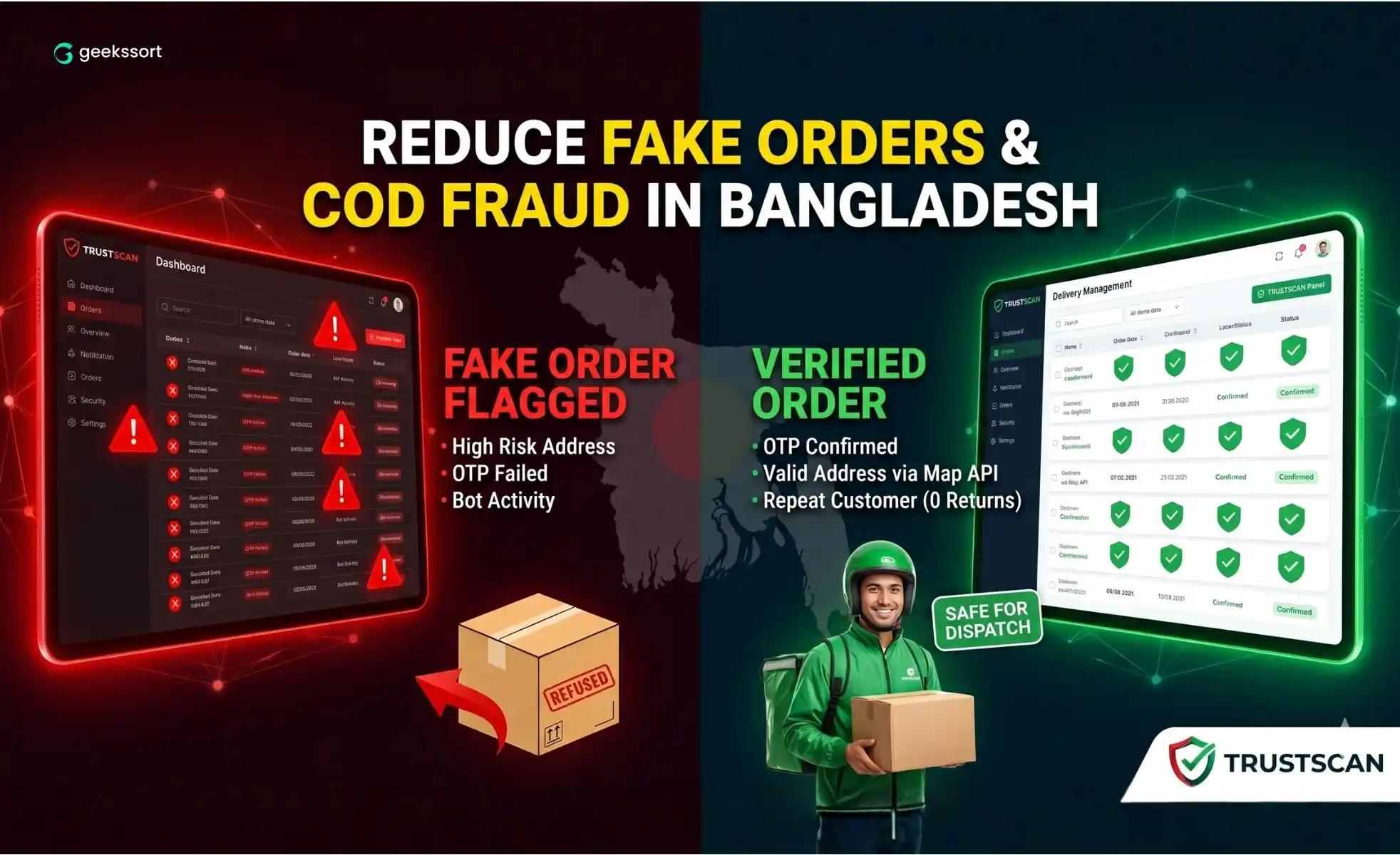
13 min read
Quick Summary
Ask any Bangladeshi online store owner about their biggest operational problem and the answer is almost always the same. Not traffic. Not marketing costs. Fake orders.
A customer places a Cash on Delivery order. The store packs the product, dispatches it with a courier, the rider travels to the address — and nobody answers the door. Or the customer answers, says they placed no such order, and turns the rider away. The product returns. The delivery fee is still charged. The inventory is tied up for another three to five days during return processing. And the genuine customer who wanted that product could not get it because stock was reserved for a fraudulent order.
This happens dozens of times a week at scale for growing Bangladeshi online stores — and most owners are underestimating how much it costs them. This guide covers nine proven strategies to reduce fake COD orders and protect your store’s revenue, starting with the ones that deliver the fastest results.
| 15–30% Average COD fake/failed delivery rate in BD without verification | 3–5×Delivery cost wasted per fake order vs revenue generated | <10% Target failed delivery rate with OTP verification active |
Most store owners track their COD cancellation rate — but very few calculate the true cost of each failed delivery. Consequently, the real impact of fake orders is consistently underestimated.
Consider a straightforward example. A store processes BDT 100,000 in COD orders per month with a 25% fake or refused delivery rate. That means BDT 25,000 worth of orders never result in payment. But the direct cost is actually higher than that lost revenue number alone.
| Cost Component | What It Actually Costs Per Fake Order |
| Delivery fee (non-refundable) | BDT 70 to BDT 150 per attempted delivery — charged even on failed deliveries by most couriers |
| Return shipping fee | BDT 50 to BDT 100 additional to bring the product back to the warehouse |
| Packaging and labour | BDT 30 to BDT 80 for packing materials and staff time spent preparing the order |
| Restocking and inspection | BDT 20 to BDT 50 to inspect, repackage, and return the product to available stock |
| Inventory lock-up cost | Product unavailable for genuine customers for 3 to 7 days during dispatch and return cycle |
| Marketing cost already spent | If the fraudulent customer came from a paid ad, the acquisition cost is fully wasted |
| Opportunity cost | A genuine buyer may have ordered the same product and been unable to — because stock was reserved for a fake order |
| Real calculation: A BDT 800 product ordered COD, refused at delivery, costs the store approximately BDT 300 to BDT 500 in direct expenses — on top of the BDT 800 revenue that was not received. A 20% fake order rate is not just a 20% revenue loss. It is often a 35% to 50% total impact when all costs are included. |
Furthermore, repeated fake order attempts from the same addresses or phone numbers suggest organised fraud — not isolated customer mistakes. Consequently, stores that do not implement systematic prevention are actively training fraudsters that their platform is a safe target.
| Step 1: Measure Your Actual Fake Order Rate FirstYou cannot fix what you have not measured. Before implementing any strategy, calculate your baseline COD cancellation and failed delivery rate: (Failed + Refused COD deliveries ÷ Total COD orders dispatched) × 100. This gives you the exact percentage to improve against and lets you measure the impact of every change you make. |
Additionally, segment your data by product category, delivery zone, and new vs returning customer. Fake orders are rarely evenly distributed — they tend to cluster around specific product types (high-demand, low-price items), specific geographic areas, and first-time buyers with no prior order history. Understanding where your fake orders are concentrated helps you apply solutions to the highest-impact areas first.
OTP (One-Time Password) confirmation is the single highest-impact fraud prevention tool available to Bangladeshi e-commerce stores. The mechanism is simple: after a COD order is placed, an automated SMS is sent to the customer’s phone number with a unique 4 or 6 digit code. The order is only released for dispatch when the customer replies with or enters the correct OTP.
Fraudulent orders — placed with fake phone numbers, random contact details, or by someone targeting your store — almost never pass OTP verification. The fraudster cannot verify a phone number they do not control. Consequently, a high percentage of fake orders are filtered automatically before any courier cost is incurred.
| OTP Verification Outcome | What It Means for Your Store |
| Customer verifies OTP correctly | Order is genuine — dispatch confirmed. Fraud risk is very low. |
| Customer does not respond within X hours | Order is held and a follow-up SMS is sent. Non-response is a strong fraud signal. |
| OTP expires with no response | Order is cancelled automatically. No dispatch cost. No rider trip. No return fee. |
| Customer contacts support saying they did not place the order | Confirms fraud attempt. Phone number added to blacklist immediately. |
OTP confirmation typically reduces fake COD order rates by 40% to 60% within the first month of implementation. It requires SMS gateway integration — providers available in Bangladesh include SSL Wireless, Mir Tech, and Twilio. A custom WooCommerce or e-commerce platform can have OTP confirmation built in as a checkout and post-order workflow.
| Step 3: Require Phone Number Verification at Checkout for New CustomersFirst-time buyers with unverified phone numbers represent the highest fake order risk. Add a phone verification step at checkout — before an order can be submitted, the customer’s phone number must be verified with a one-time SMS code. This adds 30 seconds to the checkout process for genuine buyers and creates an insurmountable barrier for fraudsters using fake numbers. |
Furthermore, a verified phone number becomes a permanent identifier linked to the customer account. Subsequent orders from the same verified number do not require reverification — reducing friction for returning customers while maintaining protection for new ones. Additionally, verified phone numbers are significantly more useful for your customer blacklist, since you know the number is real and belongs to the person who placed the order.
Every store that processes COD orders in Bangladesh needs a customer blacklist. A blacklist is a database of phone numbers, email addresses, and delivery addresses associated with previous fake orders, refused deliveries, or confirmed fraud. Any future order matching a blacklisted identifier is automatically flagged, held, or blocked before processing.
• Phone number: The most reliable identifier. Flag the exact number and add it to a blocked list. Fraudsters frequently reuse numbers across multiple stores.
• Delivery address: Some fraudsters use the same address repeatedly. Flag exact addresses and also the name of the area or building if multiple fake orders originate from the same location.
• Email address: Less reliable since fraudsters create disposable emails easily — but still worth including for completeness.
• Full name: Use as a secondary signal alongside phone number — not sufficient on its own since names are easily varied.
• Courier reference number: Log the courier’s reference for refused deliveries so you can dispute non-refundable fees where your courier agreement permits.
| Industry note:Several Bangladeshi e-commerce communities maintain shared blacklists of known fake-order phone numbers and addresses. Connect with the e-Commerce Association of Bangladesh (e-cab.net) and relevant Facebook groups for store owners — shared intelligence dramatically improves blacklist effectiveness. |
The most sustainable long-term solution to COD fraud is reducing your store’s dependency on COD by converting genuine buyers to prepaid. A customer who has already paid via bKash or Nagad has zero incentive to reject delivery. Consequently, their order is a confirmed sale from the moment the payment is received — no fake order risk, no failed delivery risk, no return fraud.
The mechanism is simple: offer a small discount — typically 3% to 7% — for any order paid via bKash or Nagad at checkout. This costs less than your average fake order handling cost and immediately shifts price-sensitive but genuine buyers from COD to prepaid.
| Incentive Type | How to Implement | Expected Impact |
| Percentage discount for prepaid (bKash/Nagad) | Coupon code or automatic checkout discount for bKash/Nagad payment selection | Reduces COD rate by 15% to 30% over 60 days — higher for price-sensitive product categories |
| Free shipping on prepaid orders | Remove delivery charge for prepaid while keeping it for COD | Especially effective for low-to-mid price point products where delivery fee is a significant percentage of order value |
| Priority dispatch for prepaid | Offer same-day or next-day dispatch guarantee for prepaid orders, vs 2-day for COD | Appeals to buyers who want fast delivery — converts urgency-driven COD buyers to prepaid |
| Loyalty points for prepaid payment | Award double loyalty points for prepaid orders | Long-term retention mechanism that makes prepaid the naturally preferred behaviour for returning customers |
Furthermore, prominently displaying the prepaid discount option during the checkout process — not buried in a terms page — is critical for conversion. The discount must be visible at the payment step, clearly labelled, and automatically applied when the customer selects bKash or Nagad.
| Step 6: Use Agent Call Confirmation for High-Value COD OrdersFor orders above a defined value threshold — typically BDT 1,500 to BDT 2,500 depending on your average order value — implement a mandatory agent call confirmation before dispatch. A customer support team member calls the phone number provided, confirms the order details and delivery address, and releases the order only after verbal confirmation. This adds one to two minutes of staff time per high-value order and eliminates the vast majority of high-value fake orders. |
Additionally, the call itself provides valuable customer service — it signals to genuine buyers that your store verifies orders before shipping, which builds trust. Customers who receive a confirmation call before a significant purchase consistently rate their experience higher than those who do not. Consequently, this fraud prevention step doubles as a customer experience improvement.
New customers — particularly those placing their first order with no account history — represent the majority of fake COD orders on most Bangladesh stores. Consequently, limiting the maximum COD order value for customers with no prior successful delivery history is one of the most targeted fraud prevention measures available.
A practical implementation: new customers can place COD orders up to BDT 800 only. Once they have one successful delivery on record, the limit increases to BDT 2,000. After three successful deliveries, they are treated as a trusted customer with no COD limit. This approach does not block genuine new buyers — it simply limits the risk until they demonstrate their legitimacy through successful order completion.
| Customer Tier | COD Order Limit | Trigger to Advance |
| New (0 orders) | BDT 800 maximum COD | First successful COD delivery accepted and completed |
| Established (1–2 orders) | BDT 2,000 maximum COD | Two successful COD deliveries with no refused or fake flags |
| Trusted (3+ orders, clean history) | No COD limit | Three or more successful orders with no fraud signals |
| Flagged (any fake order on record) | COD blocked — prepaid only | Must contact support for reinstatement review |

An automated risk scoring system evaluates each incoming COD order against a set of fraud signals and assigns a risk score. Orders above a defined risk threshold are held for manual review — or automatically rejected — before any dispatch action is taken.
• Phone number match on blacklist: Highest weight signal — immediate flag or block
• Delivery address match on blacklist: High weight — hold for review
• New customer + high COD value: Medium-high weight — flag if first order exceeds your COD limit threshold
• Multiple orders to same address in short period: Medium weight — unusual ordering pattern
• Order placed at unusual hours (2AM to 5AM): Low-medium weight — not definitive but worth flagging for review
• Product category is high-demand and frequently faked: Category-specific weight based on your historical data
• Name variations on same phone number: Medium weight — same number used with different names across orders is a fraud signal
• Delivery area has high historical fake order rate: Weight based on your zone-level cancellation data
Risk scoring can be implemented in custom-built WooCommerce installations or purpose-built e-commerce platforms. Additionally, simple versions can be implemented manually using a spreadsheet-based order review process for stores that are not yet on a custom platform — the logic is the same even if the execution is manual.
| Step 9: Review, Analyse, and Tighten Your Fraud Rules Every MonthFraud patterns evolve. Fraudsters adapt to whatever prevention measures you implement. Consequently, fraud prevention is not a one-time setup — it is a monthly operational practice. Review your COD cancellation rate, your OTP verification pass rate, your blacklist growth, and your risk score flag rate every month. Adjust your thresholds based on what you find. Share new phone numbers and addresses with your e-commerce community. Update your blacklist. And track whether your fake order rate is trending down. |
| Priority | Strategy | Effort to Implement | Expected Impact |
| 1 — Do First | OTP SMS confirmation before dispatch | Medium (SMS gateway integration required) | 40–60% reduction in fake orders immediately |
| 2 — Do First | Customer blacklist creation | Low (manual or simple database) | Prevents repeat fraudsters with zero ongoing cost |
| 3 — Do Next | Prepaid discount for bKash / Nagad | Low (coupon or checkout setting) | 15–30% reduction in COD share over 60 days |
| 4 — Do Next | COD limit for new customers | Low (WooCommerce rule or policy) | Eliminates high-value new-customer fraud immediately |
| 5 — Do Next | Agent call for high-value orders | Low (staff process only) | Near-zero fake orders above your threshold |
| 6 — Do Later | Phone verification at checkout | Medium (requires dev work) | Prevents fake numbers being used to place orders |
| 7 — Do Later | Automated risk scoring | High (custom development required) | Scalable, systematic fraud detection at volume |
| 8 — Ongoing | Monthly fraud rate review | Low (30 min per month) | Compounding improvement as patterns are identified |
| 9 — Ongoing | Community blacklist sharing | Low | Network effect — shared intelligence multiplies blacklist value |
| ⚠️ One thing to avoid:Do not remove COD entirely in response to fraud. COD is the preferred payment method for the majority of Bangladeshi online shoppers — particularly first-time buyers and buyers outside Dhaka. Removing it will cost you more in lost genuine sales than the fraud it prevents. The goal is to make COD safer — not to eliminate it. |
COD fraud occurs when a customer places a Cash on Delivery order with no intention of accepting it. The store prepares and ships the order, the delivery agent attempts delivery, and the customer either does not answer, refuses the parcel, or gave a false address. The store absorbs the delivery cost, handling cost, restocking cost, and the opportunity cost of inventory held for a fraudulent order.
The most effective methods are OTP SMS confirmation before dispatch, phone number verification at checkout, a customer blacklist, prepaid incentives via bKash or Nagad, agent call confirmation for high-value orders, and COD limits for new customers. Implementing OTP confirmation and a blacklist first will produce the fastest results.
A failed delivery rate of 15% to 25% is common for stores without verification. Stores with OTP confirmation and prepaid incentives typically reduce this to 5% to 10%. The target for a well-managed Bangladesh e-commerce operation is below 10% failed delivery rate on COD orders.
No. COD is the preferred payment method for the majority of Bangladeshi online shoppers, particularly first-time buyers and buyers outside major cities. Removing COD would cost more in lost genuine sales than the fraud it prevents. Implement verification strategies to manage fraud while keeping COD available.
Yes. Maintaining a blacklist of phone numbers, addresses, and emails associated with fake or refused orders is one of the most effective tools available. Most e-commerce platforms allow you to block orders from specific identifiers. Custom-built platforms can automate this with a risk-scoring system that flags and holds orders from blacklisted data automatically.
Fake orders and COD fraud are not inevitable costs of running a Bangladeshi online store. They are operational problems with specific, solvable causes — and the stores that treat them systematically, with the right verification and incentive infrastructure in place, consistently reduce their fake order rate to under 10% within 60 to 90 days of implementation.
Start with OTP confirmation and a customer blacklist — these two strategies alone will produce an immediate, measurable improvement. Furthermore, add prepaid incentives and COD limits for new customers as your next priority. Consequently, each layer of protection compounds the last.
The stores that lose the most to COD fraud are those that accept it as a market reality and absorb the cost. The stores that win are those that treat it as a solvable operational problem and invest in the systems to solve it.
| Need a Custom Platform With Fraud Prevention Built In? Geekssort builds custom e-commerce platforms for Bangladeshi online stores with OTP order confirmation, customer blacklist management, prepaid discount automation, and risk scoring, all integrated into a single system built for your exact operation. Schedule your free spot now! Already on WooCommerce? We also build fraud prevention plugins and integrations for existing WordPress stores. Ask us how. |

Shopify limitations can slow growing retailers. Learn when a SaaS store is enough and when custom commerce systems make more sense.

The quote on your desk is not the price of the software. This guide splits the real cost of custom software into CapEx vs OpEx treatment, annual maintenance benchmarks by software type, and a 3-year TCO model to build before a CFO signs off.

Dedicated development teams let startups build faster, preserve runway, and scale engineering capacity without committing to permanent in-house headcount. The model uses an external team that works exclusively on the company’s product as an extension of the internal team.

Ebrahim KhanFounder & CEO
 We’re happy to sign an NDA upon request.