


 ChatGPT
 Claude
 Perplexity
 Gemini
 Grok
Grok
AI-Powered Software Development Services Explained
AI-powered software development can significantly increase development speed, but AI-generated code introduces security, licensing, IP, and testing risks that require explicit governance.


 By Ebrahim Khan
14 min read
Quick Summary
A dedicated development team typically costs between $8,000 and $50,000 per month, depending on team size, location, seniority, technology stack, and service scope, and can reduce engineering expenditure by 40 to 70 percent compared with equivalent US in-house hiring. A comparable five-person team may run approximately $12,000 to $28,000 monthly in South Asia against $55,000 to $85,000 in the United States, before broader business overhead is even included. For CFOs and CEOs, the quoted monthly rate is only one component of the actual financial decision — the meaningful comparison is total cost of ownership, spanning compensation, recruitment, benefits, management, infrastructure, compliance, attrition, idle capacity, rework, and the cost of delayed delivery, evaluated together rather than in isolation.
A dedicated development team costs between $8,000 and $50,000 per month in 2026, with offshore teams generally costing less than nearshore or US-based teams — a small South Asian team may run $8,000 to $18,000 monthly, while a comparable US team may run $25,000 to $45,000 monthly.
A dedicated team is a group of engineers, designers, QA specialists, DevOps professionals, and technical leaders assigned to one client for an extended period. Unlike a fixed-price project, the client typically pays a recurring monthly fee for reserved capacity and receives greater control over priorities, architecture, technology choices, and sprint planning in return. The cost depends primarily on team composition and seniority, geographic market and local labor costs, full-time or part-time capacity, vendor responsibility for recruitment and administration, security and compliance requirements, client-side product and engineering management, required time-zone overlap, and support and on-call expectations.
Monthly Team Cost = SUM(Role Rate x Allocated FTE)
                    + Management Fees
                    + Platform or Infrastructure Fees
For example, a team consisting of three software engineers, one QA engineer, one UX designer, and a part-time technical lead may cost $14,000 to $28,000 per month in South Asia, $28,000 to $50,000 in Eastern Europe, $30,000 to $55,000 in Latin America, or $55,000 to $85,000 in the United States. These figures are directional rather than universal — a senior cloud architect, cybersecurity engineer, or AI specialist may command rates above the regional average, while a team composed mainly of junior developers may appear cheaper but require additional supervision, rework, and quality-control investment that erodes the apparent saving.
Offshore team costs commonly range from $15 to $35 an hour in South Asia, $30 to $70 in Latin America and Eastern Europe, and more than $90 an hour for fully loaded US engineering — a meaningful discount, but one that should be measured against fully loaded employment costs rather than salary alone.
| Cost Dimension | US In-House | Nearshore (LatAm) | Eastern Europe | Offshore (South Asia) |
| Junior engineer, hourly | $55–$85 | $25–$45 | $25–$45 | $15–$30 |
| Mid-level engineer, hourly | $75–$115 | $35–$65 | $35–$60 | $20–$40 |
| Senior engineer, hourly | $100–$160 | $50–$85 | $50–$90 | $25–$60 |
| Monthly cost per engineer | $14,000–$24,000 | $5,500–$12,000 | $6,000–$13,000 | $3,000–$8,000 |
| Five-person team, monthly | $55,000–$85,000 | $30,000–$55,000 | $28,000–$55,000 | $12,000–$28,000 |
| Annual five-person cost | $660,000–$1.02M | $360,000–$660,000 | $336,000–$660,000 | $144,000–$336,000 |
| Typical US time-zone overlap | 6–10 hrs | 6–8 hrs | 4–8 hrs | 2–5 hrs |
| Employer payroll & benefits | Client-owned | Usually in vendor rate | Usually in vendor rate | Usually in vendor rate |
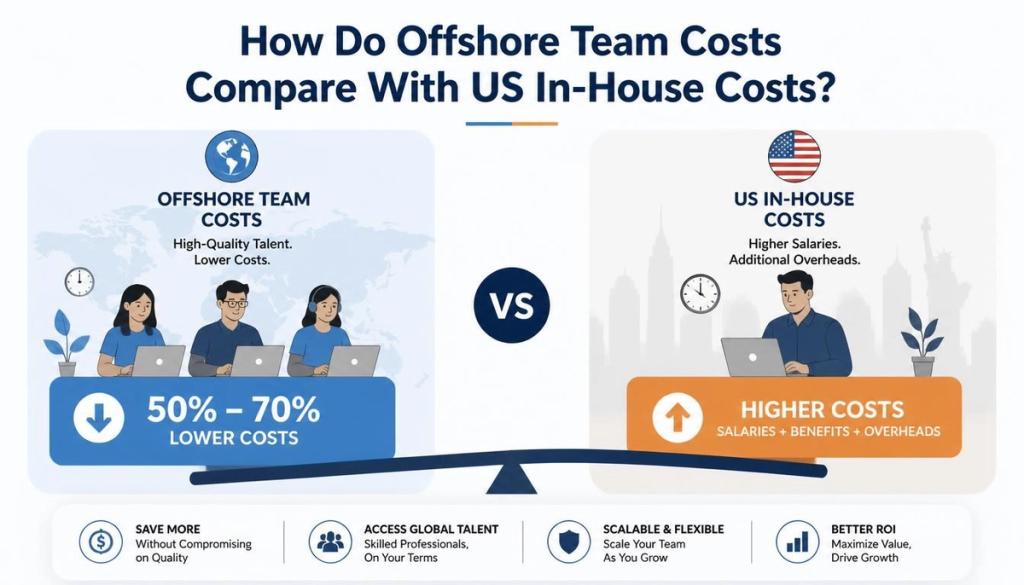
The difference between salary and total employer cost is substantial. A US software engineer with a $140,000 salary may cost significantly more once employer payroll taxes, health insurance, retirement contributions, paid leave, recruiting, equipment, office expenses, management allocation, and professional development are included — a planning model might add $42,000 to $60,000 in payroll taxes and benefits, $10,000 to $25,000 in recruiting and onboarding, $4,000 to $10,000 in equipment and software, $15,000 to $30,000 in management allocation, and $5,000 to $15,000 in office and administrative costs, pushing the resulting annual total cost of ownership past $216,000 before turnover or lost delivery capacity are even considered.
The correct question is not whether an offshore engineer costs less than a US employee — it is whether the offshore team delivers the required output, quality, security, and continuity at a lower risk-adjusted total cost of ownership. A $25-per-hour offshore engineer who requires 30 percent of an internal engineering manager's time may be more expensive than a $40-per-hour provider with strong technical leadership, documentation, automated testing, and independent delivery management. The lower rate is only valuable when the operating model prevents the saving from being consumed by coordination overhead and rework.
The TCO of a development team includes direct payments plus indirect operating costs — recruitment, benefits, management, tools, security, infrastructure, turnover, rework, and productivity loss — minus the residual value of reusable assets and retained knowledge, giving CFOs a single formula for comparing any two staffing options fairly.
TCO = C_delivery + C_recruitment + C_benefits + C_management
      + C_tools + C_security + C_infrastructure
      + C_turnover + C_rework + C_opportunity
      - V_residual

  C_delivery      = vendor invoice or employee salary
  C_recruitment   = sourcing, interviews, hiring admin, onboarding
  C_benefits      = insurance, retirement, paid leave, payroll tax, bonuses
  C_management    = engineering managers, product owners, architects
  C_tools         = IDEs, repos, PM systems, observability, security software
  C_security      = audits, pen testing, identity management, compliance admin
  C_infrastructure= devices, cloud environments, facilities, connectivity
  C_turnover      = replacement hiring and knowledge transfer
  C_rework        = defects, unclear requirements, failed releases
  C_opportunity   = revenue delayed by insufficient capacity
  V_residual      = reusable assets, internal knowledge, retained IP
For US employees, benefits can represent approximately 30 percent of total employer compensation, which is why a developer with a $140,000 salary should never be modeled as a $140,000 employee. For an offshore dedicated team, many of these expenses are consolidated into the vendor rate rather than eliminated — they are transferred to the provider and distributed across its client base, and the buyer should verify exactly what is and is not included before treating the quoted rate as the complete cost.
CFOs should separate recurring delivery costs from one-time transition costs and variable risk costs, since this separation makes it possible to compare a vendor proposal against internal hiring fairly and to identify whether apparent savings reflect genuine efficiency or simply omitted expenses.
Direct delivery costs typically include developer, QA, design, DevOps, and technical-lead capacity; full-time or part-time allocation; monthly minimums; overtime or weekend support; on-call coverage; travel and in-person workshops; and third-party specialist roles. A monthly retainer is easier to forecast than hourly contracting, but the statement of work should explicitly define capacity, working hours, leave coverage, public holidays, and replacement obligations rather than leaving these as assumptions.
Internal oversight costs are frequently underestimated: a dedicated team still needs a client-side operating structure, potentially including a product manager, product owner, solution architect, security reviewer, and engineering manager. A lean arrangement might allocate 0.2 to 0.5 FTE of internal management to a small team, while a regulated or complex program may require considerably more. If a US engineering manager earning $180,000 annually spends 25 percent of their time coordinating an offshore team, that allocation alone is approximately $45,000 a year and must be included in the TCO model rather than treated as a sunk cost that happens outside the vendor relationship.
Tooling and infrastructure costs also frequently sit outside the vendor invoice: cloud hosting and managed databases, CI/CD and artifact repositories, application monitoring and security scanning, SaaS licenses, device management and identity providers, test devices, and backup and disaster recovery are commonly billed separately. A mature contract should identify explicitly whether the vendor uses its own devices and systems or accesses the client's environment — for enterprise work, client-controlled repositories, single sign-on, role-based access, and centralized audit logs are generally the preferable structure.
Quality and rework is one of the most underestimated cost categories of all. A team lacking automated testing, code-review discipline, documentation, or architectural ownership can create defects that become expensive after production release.
C_rework = (Defect Hours x Blended Hourly Cost) + Incident Cost + Delayed Revenue

// Example: 400 hours of rework at $75/hr blended internal cost
// = $30,000 direct rework cost, excluding support and reputational damage
A provider charging 20 percent more but reducing rework by half may still produce a lower total cost of ownership than the cheaper alternative — which is precisely why rework needs to be modeled explicitly rather than assumed away.
The most common hidden fees are recruitment charges, onboarding, management overhead, overtime, replacement costs, infrastructure, travel, currency exposure, contract minimums, and exit assistance — each should be listed explicitly in the commercial proposal rather than inferred from the headline hourly rate.
| Hidden Fee Category | What to Verify Before Signing |
| Recruitment and setup fees | Whether a one-time sourcing, interviewing, and onboarding fee applies to initial team formation, each replacement, additional hires, senior or specialist roles, emergency hiring, or contractor conversion |
| Technical leadership premiums | Adding a senior architect after the initial team is formed can increase monthly costs by 15 to 30 percent — excluding technical leadership from the initial model often creates avoidable architectural debt |
| Overtime and support | Whether standard hours exclude evenings, weekends, holidays, and incident response, and what premium applies to on-call coverage and emergency escalation |
| Attrition and replacement | A replacement guarantee is not equivalent to business continuity — the contract should require documented architecture, source-code access, runbooks, and shared knowledge repositories regardless of any replacement clause |
| Currency and payment exposure | Who carries exchange-rate risk, whether annual rate increases are automatic, and how tax withholding, VAT, bank-transfer fees, and payment timing are handled |
| Travel and collaboration | In-person planning workshops can materially improve alignment on complex products but are rarely included by default — budget separately for flights, accommodation, visas, and paid workshop time |
For a distributed team, quarterly planning or architecture sessions may be more cost-effective than daily synchronous coordination — the goal is not maximum overlap, but predictable collaboration around the specific decisions that actually affect delivery.
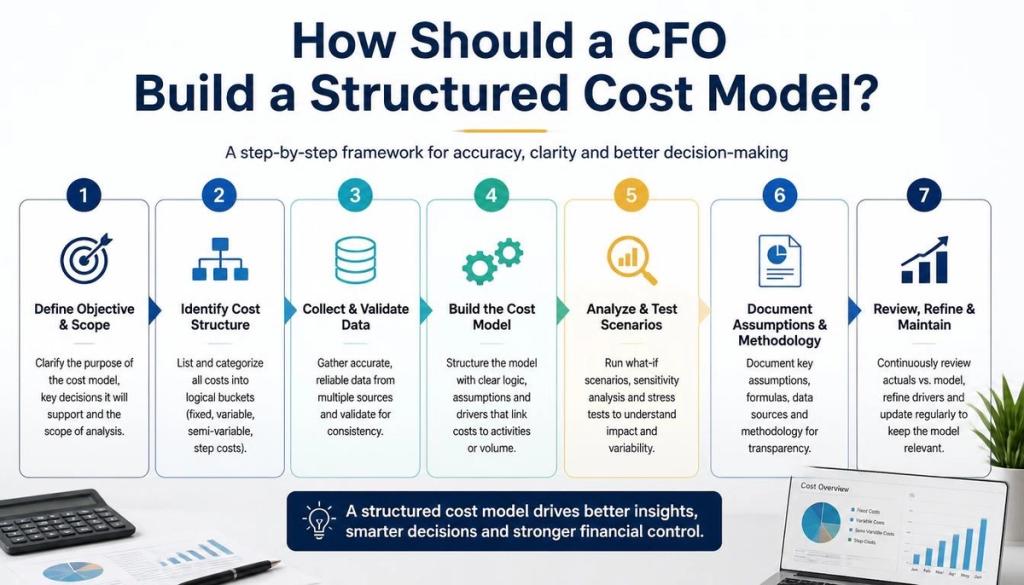
A useful cost model separates assumptions, team composition, TCO calculation, and scenario comparison into distinct sections so decision-makers can change inputs without rebuilding the entire model, comparing monthly cost, annual TCO, effective hourly cost, and delivery capacity across conservative, expected, and optimistic scenarios.
The assumptions section should capture the number of developers, QA and design capacity, technical-lead allocation, monthly working hours, rate by role, internal management allocation, benefits percentage, recruitment cost, attrition rate, tooling and infrastructure, compliance budget, expected productivity factor, and currency and annual escalation. The team composition section then builds one line per role:
| Role | FTE | Monthly Rate | Monthly Subtotal | Annual Subtotal |
| Senior backend engineer | 2.0 | $5,000 | $10,000 | $120,000 |
| Senior frontend engineer | 1.0 | $4,500 | $4,500 | $54,000 |
| QA automation engineer | 1.0 | $3,500 | $3,500 | $42,000 |
| Technical lead | 0.5 | $6,000 | $3,000 | $36,000 |
| Total | 4.5 | — | $21,000 | $252,000 |
This illustrates a South Asian planning model, not a universal price — the same role mix may produce a significantly higher total in the United States or Western Europe. The TCO calculation layer then adds every non-invoice expense on top of the vendor delivery fee:
| Cost Category | Annual Estimate |
| Vendor delivery fees | $252,000 |
| Client-side product management | $30,000 |
| Architecture and security oversight | $20,000 |
| Cloud and development tools | $18,000 |
| Travel and workshops | $8,000 |
| Compliance and security testing | $15,000 |
| Transition and onboarding | $12,000 |
| Risk and contingency reserve | $25,000 |
| Estimated annual TCO | $380,000 |
The contingency reserve should not be treated as guaranteed expenditure — it represents a planning allowance for changes, replacement, rework, and unexpected operational requirements. The final layer models at least three scenarios: conservative (lower productivity, higher rework, slower replacement), expected (normal delivery velocity and stable staffing), and optimistic (strong requirements, low attrition, high automation). A five-person team quoted at $18,000 a month may have a direct annual cost of $216,000; if management, tools, security, transition, and risk add $100,000, the expected TCO becomes $316,000, and if rework adds another $60,000, the effective annual cost reaches $376,000 — still likely attractive against a comparable US team costing $660,000 to $1.02 million annually, but only if scope, capacity, quality, and delivery accountability are genuinely comparable.
Buyers should evaluate offshore value through effective delivery cost, not nominal hourly price — effective delivery cost equals total ownership cost divided by accepted business output, such as production-ready features, completed milestones, or validated releases, rather than raw hours billed.
Effective Delivery Cost = Annual TCO / Accepted Delivery Units

// Delivery units might include: accepted product increments,
// production releases, completed epics, tested API endpoints,
// automated test coverage, migration batches, revenue-generating features
This metric must be applied carefully — counting lines of code or raw tickets encourages the wrong behavior. A better scorecard combines delivery, quality, and business results across several dimensions: predictability (sprint commitment reliability above 85 percent), quality (escaped defect rate and severity), delivery (release frequency and milestone completion), engineering health (automated test coverage and build success), security (vulnerability remediation time), continuity (attrition, replacement time, documentation completeness), and business impact (adoption, conversion, revenue, or operational savings).
A provider charging $35 an hour may be more economical than one charging $20 an hour if it delivers faster, produces fewer defects, and requires less client supervision. CFOs should request historical metrics, sample delivery reports, reference customers, and a transparent explanation of exactly what the quoted rate includes before treating any hourly comparison as decisive.
Compliance and intellectual-property protection should be priced as operating requirements rather than optional extras — GDPR, HIPAA, SOC 2, ISO 27001, data residency, access controls, and contractual IP assignment add real cost, but omitting them creates materially greater financial and legal exposure than the savings they appear to offer.
For GDPR-regulated work, the contract should address data-processing roles, subprocessors, international data transfers, data minimization, breach notification, data-subject rights, and retention and deletion. For HIPAA-related systems, buyers may require a business associate agreement, access logging, encryption, workforce controls, and evidence of incident response procedures. SOC 2 and ISO 27001 are not substitutes for secure engineering, but they can provide evidence of defined controls — the buyer should verify the actual scope, audit period, covered systems, and any exceptions rather than accepting a certification logo or general marketing statement at face value.
The contract should also explicitly specify exclusive ownership of source code and deliverables, assignment of inventions and work product, confidentiality and trade-secret controls, open-source license governance, third-party component approval, repository ownership and administrative access, secure return or destruction of data, and exit support and transition assistance. A low offshore team cost is not a genuine saving if the buyer later pays for a security incident, an IP dispute, a regulatory investigation, or an emergency re-platforming effort that a properly scoped contract would have prevented.
The right commercial model depends on the level of scope uncertainty, required control, and internal management capacity — dedicated monthly teams are generally appropriate for evolving product roadmaps, while fixed-price contracts are better suited to stable, clearly specified deliverables with a defined end date.
A dedicated model is usually appropriate when the product roadmap will change, the buyer needs direct priority control, the work requires continuous product knowledge, the engagement is expected to last at least six months, the client can provide product and technical direction, and engineering capacity must scale without permanent hiring. Staff augmentation may be sufficient when the client already has strong architecture, delivery management, security, and QA functions in place. A managed delivery model may be preferable when the vendor is expected to own planning, execution, quality, and release outcomes end to end.
The contract should include a ramp-up plan, role definitions, replacement policy, service-level expectations, security controls, IP clauses, rate-adjustment rules, termination notice, and knowledge-transfer requirements. A 30 to 90 day transition period is common for material engagements, but the specific duration should reflect the system's actual complexity and operational risk rather than a generic default.
The dedicated development team cost is not the monthly invoice — it is the fully loaded cost of obtaining secure, predictable, maintainable engineering output. Offshore team costs can be 40 to 70 percent lower than comparable US in-house costs in many scenarios, but the outcome depends on delivery quality, leadership, compliance, retention, and governance, not price alone. Before selecting a provider, build a three-scenario TCO model, compare equivalent roles and capacity, identify every excluded fee, and calculate effective delivery cost. Require evidence of secure development practices, IP ownership, replacement continuity, documentation, and measurable delivery performance before signing.
Geekssort helps US, UK, and EU companies establish dedicated engineering teams for custom software, multi-tenant SaaS, and secure offshore development, with services also covering headless commerce implementations using Next.js and broader enterprise product engineering. For a CFO-ready business case, requesting a role-by-role rate card, team structure, transition plan, security controls, and a 12-month TCO comparison tailored to a specific roadmap is the right starting point before comparing any vendor proposal against an internal hiring plan.
A dedicated development team commonly costs $8,000 to $50,000 per month, depending on location, size, seniority, and service scope. Small South Asian teams may cost $8,000 to $18,000 monthly, while comparable US teams may cost $25,000 to $45,000 monthly, and larger enterprise teams can exceed $100,000 per month.
Offshore team costs commonly range from $15 to $35 per hour in South Asia, $30 to $70 in Eastern Europe and Latin America, and approximately $25 to $60 for senior South Asian engineers. A four-person offshore team billed at $12,000 per month equates to roughly $37.50 per hour based on standard monthly hours.
Usually, yes, when the comparison includes fully loaded employment costs. A five-person South Asian team may cost $144,000 to $336,000 annually against approximately $660,000 to $1.02 million for a comparable US team — but management, security, communication, travel, and rework costs must be included in the final TCO for the comparison to be fair.
Recruitment and setup, technical leadership, overtime, on-call support, replacement hiring, travel, tools, cloud infrastructure, security audits, compliance, taxes, currency exposure, annual rate adjustments, and exit assistance — the contract should state whether each cost is included, capped, or billed separately.
TCO equals vendor delivery fees plus internal management, recruitment, onboarding, tools, infrastructure, security, compliance, turnover, rework, and opportunity costs, minus the value of reusable assets and retained knowledge. Dividing annual TCO by accepted delivery output gives the effective delivery cost.
A small product team often includes three to five engineers, one QA specialist, and part-time technical leadership. Larger SaaS, commerce, or enterprise platforms may require separate frontend, backend, QA automation, DevOps, security, product, and architecture functions, with the correct size depending on roadmap complex
Prompt copied — paste it into Gemini.

AI-powered software development can significantly increase development speed, but AI-generated code introduces security, licensing, IP, and testing risks that require explicit governance.

Dedicated development teams let startups build faster, preserve runway, and scale engineering capacity without committing to permanent in-house headcount. The model uses an external team that works exclusively on the company’s product as an extension of the internal team.

Multi-tenant SaaS architecture is about securely serving multiple customers from one platform while keeping each tenant’s data, access, resources, and operations isolated.

Ebrahim KhanFounder & CEO
 We’re happy to sign an NDA upon request.