


 ChatGPT
 Claude
 Perplexity
 Gemini
 Grok
Grok
AI-Powered Software Development Services Explained
AI-powered software development can significantly increase development speed, but AI-generated code introduces security, licensing, IP, and testing risks that require explicit governance.


 By Ebrahim Khan
13 min read
Key Takeaways
A multi-tenant SaaS platform must isolate customer data, route every request to the correct tenant context, prevent noisy-neighbor failures, and scale economically as tenants grow — and it must do this across three dominant database isolation patterns and at least nine distinct subsystems, from the control plane down to background jobs and audit logging, each of which can independently become the point where a tenant boundary fails. The foundational choices — pool, bridge, or silo storage; tenant-aware identity; authorization; observability; and migration strategy — determine security posture, operating cost, and future enterprise readiness. This guide covers the full reference architecture a team needs to build multi-tenancy as a genuine security and operating model, not merely a database optimization.
Multi-tenancy is an architecture in which one software product serves multiple customer organizations while maintaining logical or physical separation of data, configuration, access, billing, and operational visibility, with tenant boundaries enforced at every request, query, cache, event, and administrative workflow.
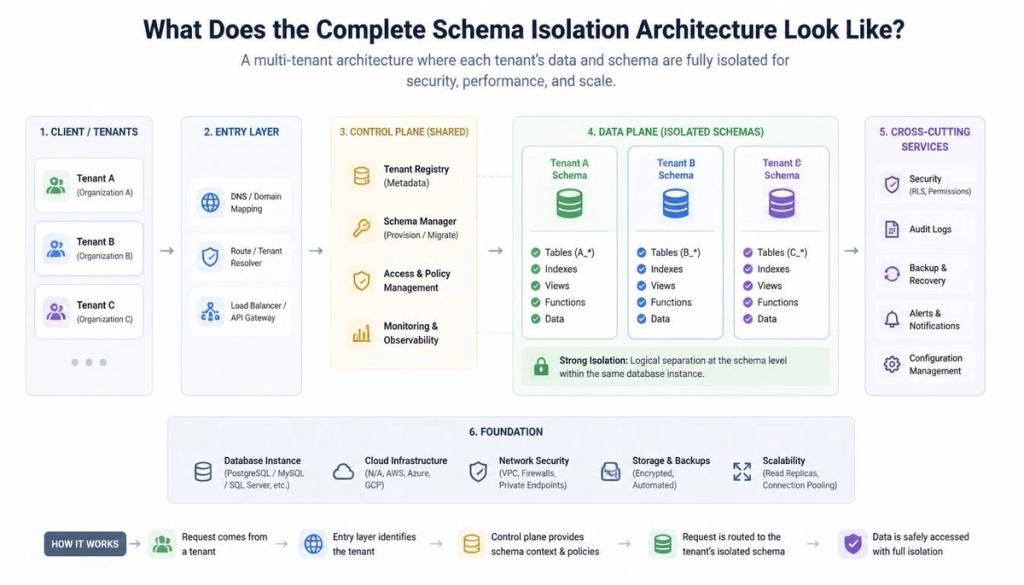
A tenant is typically a customer organization, business unit, account, or legally distinct customer environment, and a single tenant may contain multiple users, teams, locations, roles, and subscription plans. A multi-tenant SaaS platform normally contains a control plane for tenant registration, identity, billing, configuration, and lifecycle; a data plane for tenant business transactions; an identity and access layer; a routing layer; shared or isolated databases; background jobs and event processing; observability and audit systems; platform administration; and backup, disaster recovery, and support tooling.
The main architectural advantage of multi-tenancy is economic efficiency — shared infrastructure enables higher utilization and lower operating cost. The main risk is cross-tenant exposure or operational interference, which is why the architecture must treat tenant context as a first-class security boundary rather than an implementation detail left to individual developers to remember on a query-by-query basis.
The three dominant patterns are silo, pool, and bridge — silo assigns a dedicated database or infrastructure boundary to each tenant, pool shares database structures and separates records with tenant identifiers, and bridge uses separate schemas within a shared database, with many enterprise platforms combining all three by tenant tier and risk profile.
| Pattern | Isolation | Cost | Scale | Best Fit |
| Silo | Database or stack per tenant | Highest | Operationally heavier | Regulated, high-value, residency-sensitive tenants |
| Pool | Shared tables with tenant_id and row-level security | Lowest | Efficient at high tenant counts | Standard tenants and cost-sensitive tiers |
| Bridge | Schema per tenant in shared database | Medium | Moderate | Stronger separation without full infrastructure duplication |
In a silo model, each tenant receives a dedicated database, schema, cluster, or complete application stack. Advantages include stronger blast-radius control, easier tenant-specific backup and restore, simpler data residency placement, easier performance isolation, more straightforward tenant-specific encryption keys, and better support for enterprise contractual requirements. The disadvantages are operational complexity and cost, since provisioning, patching, monitoring, migration, backups, and disaster recovery must all operate across many tenant environments. Silo architecture is most useful for healthcare, financial services, government, and enterprise tenants with contractual isolation or residency requirements, and for premium plans where customers are willing to pay for dedicated capacity.
In a pool model, multiple tenants share database tables, with each row carrying a tenant identifier such as tenant_id, and row-level security, service authorization, and query design enforcing separation. Advantages include lower infrastructure cost, efficient utilization, easier global migrations, simpler fleet management, and strong support for large numbers of small tenants. The primary risk is a tenant-boundary failure — a missing filter, unsafe administrative query, incorrect cache key, or background job defect can expose data across customers. Pool architecture requires tenant-aware primary and foreign keys, row-level security, composite indexes beginning with tenant_id, automated cross-tenant access tests, strict database roles, tenant-aware cache keys, tenant-aware exports and reports, and database query observability.
Bridge architecture places each tenant in a separate schema within a shared database cluster, providing more separation than a pooled table model while avoiding the full cost of separate infrastructure. Advantages include better logical isolation, tenant-specific schema migrations, easier tenant-level export and restore, moderate infrastructure cost, and a practical migration path toward silo deployment. The disadvantages include schema-count growth, migration coordination, connection management, and the risk of incorrect schema selection. The bridge model is particularly useful when tenants require stronger logical separation but do not justify independent clusters.
A robust schema begins with a tenant registry covering memberships, plans, regions, isolation mode, encryption metadata, and lifecycle state; business tables then carry tenant identity or reside inside tenant-specific schemas, enforced through PostgreSQL row-level security, restricted database roles, migration controls, and service-level authorization layered together rather than relying on application code alone.
| Control-Plane Field | Purpose |
| tenant_id | Globally unique tenant identifier |
| organization_name | Customer display and administrative identity |
| status | Trial, active, suspended, archived, or deleted |
| plan | Commercial tier and feature entitlements |
| region | Data-residency and routing location |
| isolation_mode | Pool, bridge, or silo |
| database_reference | Approved storage location |
| schema_version | Tenant migration state |
| encryption_key_reference | Key-management association |
| billing_account | Subscription and invoicing relationship |
| retention_policy | Data lifecycle requirements |
| created_at / updated_at | Lifecycle and audit tracking |
The data plane stores business entities such as users, accounts, orders, invoices, documents, projects, and events. In a pooled model, tables include tenant_id, composite indexes beginning with tenant_id, and row-level security policies — the application should never rely exclusively on developers remembering to add a filter to every query. In a bridge model, the connection or search path is selected only after server-side authorization, and the tenant schema must never be selected directly from an untrusted browser parameter. In a silo model, the tenant registry maps a verified tenant to an approved database endpoint, and the service account should receive access only to the relevant tenant database or cluster. Administrative services should use separate roles and audited workflows, and should never bypass controls through shared superuser credentials.
-- Example pooled schema
CREATE TABLE projects (
    id UUID PRIMARY KEY,
    tenant_id UUID NOT NULL,
    name TEXT NOT NULL,
    created_at TIMESTAMPTZ NOT NULL DEFAULT now()
);

CREATE INDEX projects_tenant_id_idx
ON projects (tenant_id);

ALTER TABLE projects ENABLE ROW LEVEL SECURITY;

CREATE POLICY tenant_isolation_policy
ON projects
USING (tenant_id = current_setting('app.tenant_id')::uuid);
The database session must receive the tenant context only after the application has verified the authenticated user's membership and authorization — never before. Every business relationship should also preserve tenant ownership; for example, a task should not be able to reference a project belonging to another tenant. A composite foreign-key strategy reinforces this:
CREATE UNIQUE INDEX projects_tenant_id_id_unique
ON projects (tenant_id, id);

-- A child table can then reference both tenant_id and project_id,
-- ensuring the relationship stays within the same tenant boundaryTenant routing should derive tenant context from a verified identity claim, mapped domain, or trusted platform context — never from an unvalidated request parameter — with the router resolving tenant, region, plan, and isolation mode, then issuing a short-lived context used consistently by authorization, data access, caching, events, logs, and billing.
Common routing strategies include subdomains such as tenant.example.com, custom domains, path prefixes, identity-provider organization claims, API keys mapped to tenant records, and signed internal routing headers. Subdomain routing improves user experience and tenant branding, while identity-provider organization claims are stronger for authenticated APIs because they associate the user with an organization directly in the identity system.
The edge layer should normalize the host and path, resolve the tenant registry, verify the tenant status, determine the tenant region and isolation mode, validate the authenticated identity, confirm user membership, create a signed internal tenant context, pass that context to application services, and record the context in logs and traces. It should never trust a browser-supplied tenant_id without an independent authorization check.
// Signed internal tenant context
{
  "tenant_id": "tenant-123",
  "user_id": "user-456",
  "region": "eu-west-1",
  "isolation_mode": "pool",
  "plan": "enterprise",
  "permissions": ["orders:read", "orders:write"],
  "expires_at": "2026-09-10T18:30:00Z"
}
Services should validate the signature, expiry, issuer, audience, and tenant status before using this context for any authorization decision.
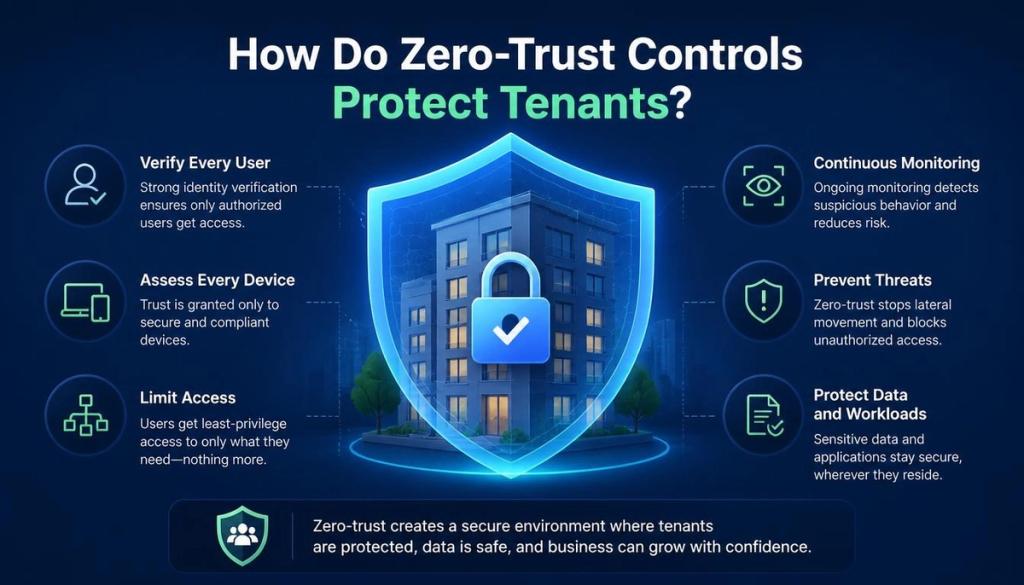
Zero-trust SaaS design assumes no request, service, user, or network location is inherently trusted — each call must authenticate, authorize, minimize privileges, validate tenant context, encrypt sensitive data, and produce an auditable record, with network segmentation useful but application and data authorization remaining mandatory regardless.
Use centralized identity with MFA and short-lived tokens, apply role-based and attribute-based authorization, give every workload a distinct service identity, and store secrets in a managed vault rather than environment files or source code. Security controls should include multi-factor authentication for privileged users, short-lived access tokens, role-based access control, attribute-based policies for tenant, region, role, and data classification, service-to-service authentication, workload identity, encryption in transit and at rest, key rotation, dependency scanning, signed builds and artifact verification, database row-level security, immutable audit logs, rate limiting, web application firewall protection, tenant-aware anomaly detection, and privileged-access review.
Enforce deny-by-default policies throughout: a user should receive only the permissions required for their role and tenant, and a support engineer should not automatically have unrestricted access to customer production data. Scattered authorization logic creates inconsistent security decisions, so policy enforcement points should be defined explicitly at API gateways, application services, database access layers, object storage, background workers, search services, reporting and export systems, and administrative consoles. A request should pass through identity authentication, tenant authorization, object authorization, and action authorization in sequence — permission to read orders, for example, does not necessarily provide permission to export all orders, since export actions may require additional role approval, rate limits, masking, and audit records.
Tenant isolation must extend beyond relational tables — cache keys must include tenant identity, queue messages must carry authenticated tenant context, object-storage prefixes require policy enforcement, and search indexes must prevent cross-tenant queries, since a database can be perfectly isolated while a shared cache silently leaks customer data.
// Cache key must include tenant_id
tenant:{tenant_id}:product:{product_id}

// Avoid keys containing only product_id or user_id,
// since those identifiers may overlap across tenants
Apply separate caching rules for public content, tenant-specific data, user-specific data, session data, pricing and promotion data, and sensitive records. For queue isolation, every message should include tenant_id, a request or correlation ID, actor identity, event type, schema version, data classification, and an idempotency key — workers must authorize the tenant context before processing the event, and a retry mechanism should never accidentally process a message under the wrong tenant configuration.
For object storage, use tenant-specific prefixes or buckets, but never rely on naming alone — enforce bucket policies, signed URLs, object ownership, content-type validation, malware scanning, and retention policies. Search indexes should include tenant_id as a mandatory filter, and for high-risk workloads, separate indexes or clusters are preferable; search results should always be filtered server-side, never only by frontend query construction.
Noisy-neighbor controls combine quotas, workload classification, per-tenant rate limits, queue partitioning, database connection limits, autoscaling, and resource monitoring, tracking CPU, memory, I/O, query time, queue depth, API rate, storage, and error rate by tenant so that one tenant's behavior never degrades service for every other tenant.
A tenant that performs a large import should not make the entire platform unavailable to smaller customers. Use per-tenant API quotas, burst and sustained rate limits, queue partitioning, bulk-job scheduling, database connection pools, query timeouts, maximum export sizes, storage quotas, per-tenant concurrency limits, priority classes, dedicated capacity for premium tenants, and tenant-level circuit breakers. Resource governance should match commercial plans — standard tenants may share pools, while enterprise tenants may receive dedicated databases, higher quotas, private networking, or dedicated worker capacity.
Monitor tenant-level service indicators specifically, including request latency, error rate, background-job delay, search latency, database query time, storage availability, export completion time, webhook delivery success, and recovery time. A global average can hide a serious problem affecting one specific customer — tenant-aware telemetry is what exposes this concentration risk before it becomes a wider incident or a lost account.
Treat tenant placement as a versioned platform capability — provision infrastructure through automation, apply migrations incrementally, validate schema versions, and support dual-read or dual-write only when necessary, with every tenant move idempotent, observable, reversible, and protected by a consistency protocol.
A migration may be required when a pooled tenant moves to a bridge schema, a bridge tenant moves to a silo, a tenant changes region, a customer upgrades to a dedicated plan, storage or performance requirements change, or a database engine or version changes. A safe migration workflow creates the destination, applies the correct schema version, copies data with checksums, synchronizes changes, validates row counts and relationships, runs application-level verification, switches routing atomically, monitors errors and latency, retains rollback capability, and only decommissions the source after the retention period has passed. Migrations should be tested on representative tenant sizes — a migration that works cleanly for a 10 MB tenant may fail operationally for a 2 TB enterprise tenant.
GDPR requires data minimization, purpose limitation, deletion workflows, subprocessor tracking, transfer controls, and demonstrable access governance; HIPAA workloads require appropriate agreements, audit trails, encryption, and workforce controls; and SOC 2 and ISO 27001 require evidence that controls operate over time, not merely that policies exist on paper.
A multi-tenant platform should support tenant-level data export, tenant-level deletion, retention policies, data-subject access requests, purpose limitation, consent or lawful-basis tracking where applicable, subprocessor records, international transfer controls, breach response, and access logs. Deletion workflows must include primary data, backups, caches, search indexes, object storage, analytics systems, and downstream integrations — a deletion that only touches the primary database does not satisfy the actual requirement.
Healthcare tenants may require business associate agreements, protected health information classification, access logging, encryption, workforce authorization, minimum-necessary access, incident response, secure backups, vendor risk assessments, and controlled production support. For SOC 2 and ISO 27001, evidence should include access reviews, change records, vulnerability remediation, incident reports, backup tests, vendor reviews, security training, configuration monitoring, and business-continuity exercises. Data residency should be encoded directly in tenant placement and routing, not maintained as a manual convention someone has to remember to follow.
Every metric, trace, log, alert, deployment, and support action should carry tenant_id, region, service, request_id, and data-classification context where appropriate, enabling usage billing, SLO reporting, anomaly detection, incident scoping, and capacity planning without exposing customer data to unauthorized operators.
Avoid placing sensitive payloads directly in logs — use structured metadata and secure correlation identifiers instead. A mature observability model includes distributed tracing, tenant-level request metrics, database query performance, queue latency, cache hit and miss rates, search latency, storage usage, authentication failures, authorization denials, configuration changes, administrative actions, deployment versions, and error budgets. Support dashboards should reveal operational state without granting unnecessary data access — a support agent may need to know that an order failed, but should not automatically be able to view the customer's complete personal or financial information in the process of diagnosing it.
A mature architecture includes an edge gateway, identity provider, tenant registry, authorization service, application services, pool/bridge/silo data planes, event bus, object storage, search, billing, audit logging, observability, secrets management, backup, and disaster recovery, with the control plane and data plane kept separately privileged.
The control plane governs tenant registration, subscription status, user and organization relationships, region and placement, feature entitlements, isolation mode, encryption references, schema versions, and lifecycle transitions. The data plane serves customer business transactions, tenant-specific configuration, files and documents, search operations, workflows, notifications, and reporting. Platform administration should be separately privileged and audited, and data-plane services should never automatically gain access to control-plane secrets or every tenant's database.
A reference request flow runs as follows: a customer accesses a custom domain; the edge gateway resolves the tenant; the identity provider authenticates the user; the authorization service verifies membership and permissions; the router resolves tenant region and isolation mode; the application service receives a signed tenant context; the data layer enforces tenant isolation; events and logs preserve tenant context throughout; and observability records performance and security outcomes at every step.
Geekssort architects secure multi-tenant SaaS platforms, custom enterprise systems, and dedicated engineering teams for US, UK, and EU clients, building tenant isolation as a security and operating model from the initial design phase rather than retrofitting it after a pooled architecture has already scaled past the point where boundaries are easy to fix. Engaging an architecture team for a threat model, isolation decision, tenant-routing design, schema strategy, and production blueprint is the right starting point before the first line of multi-tenant code is written.
Silo generally provides the strongest blast-radius reduction, but security ultimately depends on identity, authorization, configuration, operations, testing, and monitoring — a poorly managed silo can still be insecure despite its structural isolation advantage.
No — pool architectures can be secure when tenant context, row-level security, authorization, indexing, testing, and operational controls are rigorously and consistently enforced across every subsystem, not just the primary tables.
It may be submitted as a routing hint, but the server must independently verify it against identity, membership, authorization, and tenant status before ever using it to make an access decision.
When regulatory, residency, performance, contractual, or blast-radius requirements justify the additional operating cost — this should be a deliberate, tenant-specific decision rather than a platform-wide default.
An incomplete boundary — tenant-aware tables may exist correctly, but cache keys, background jobs, exports, search, logs, or administrative tools may not enforce the same tenant context, leaving a gap an attacker or a bug
Prompt copied — paste it into Gemini.

AI-powered software development can significantly increase development speed, but AI-generated code introduces security, licensing, IP, and testing risks that require explicit governance.
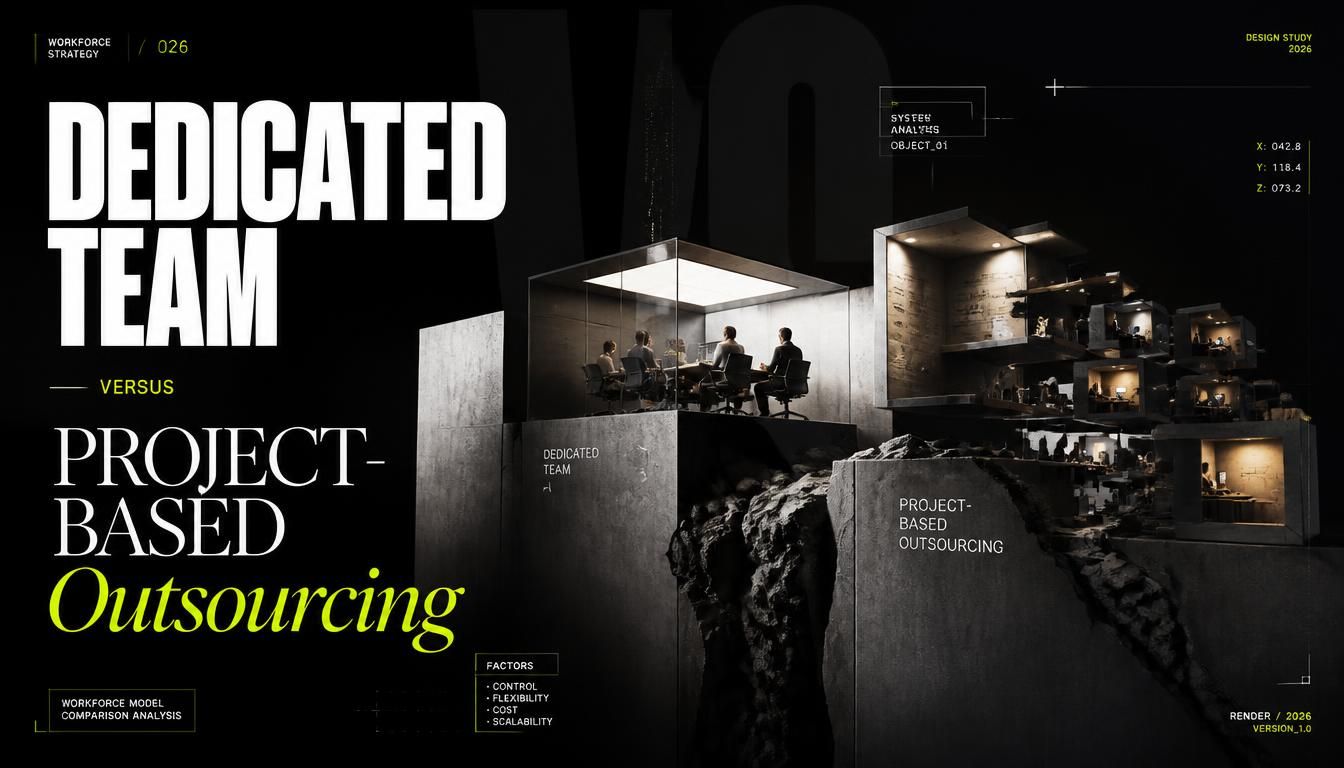
Dedicated development teams let startups build faster, preserve runway, and scale engineering capacity without committing to permanent in-house headcount. The model uses an external team that works exclusively on the company’s product as an extension of the internal team.
Dedicated development teams typically cost $8K–$50K/month, with South Asian teams often costing significantly less than equivalent US teams. For CEOs and CFOs, the real comparison is total cost of ownership (TCO)

Ebrahim KhanFounder & CEO
 We’re happy to sign an NDA upon request.