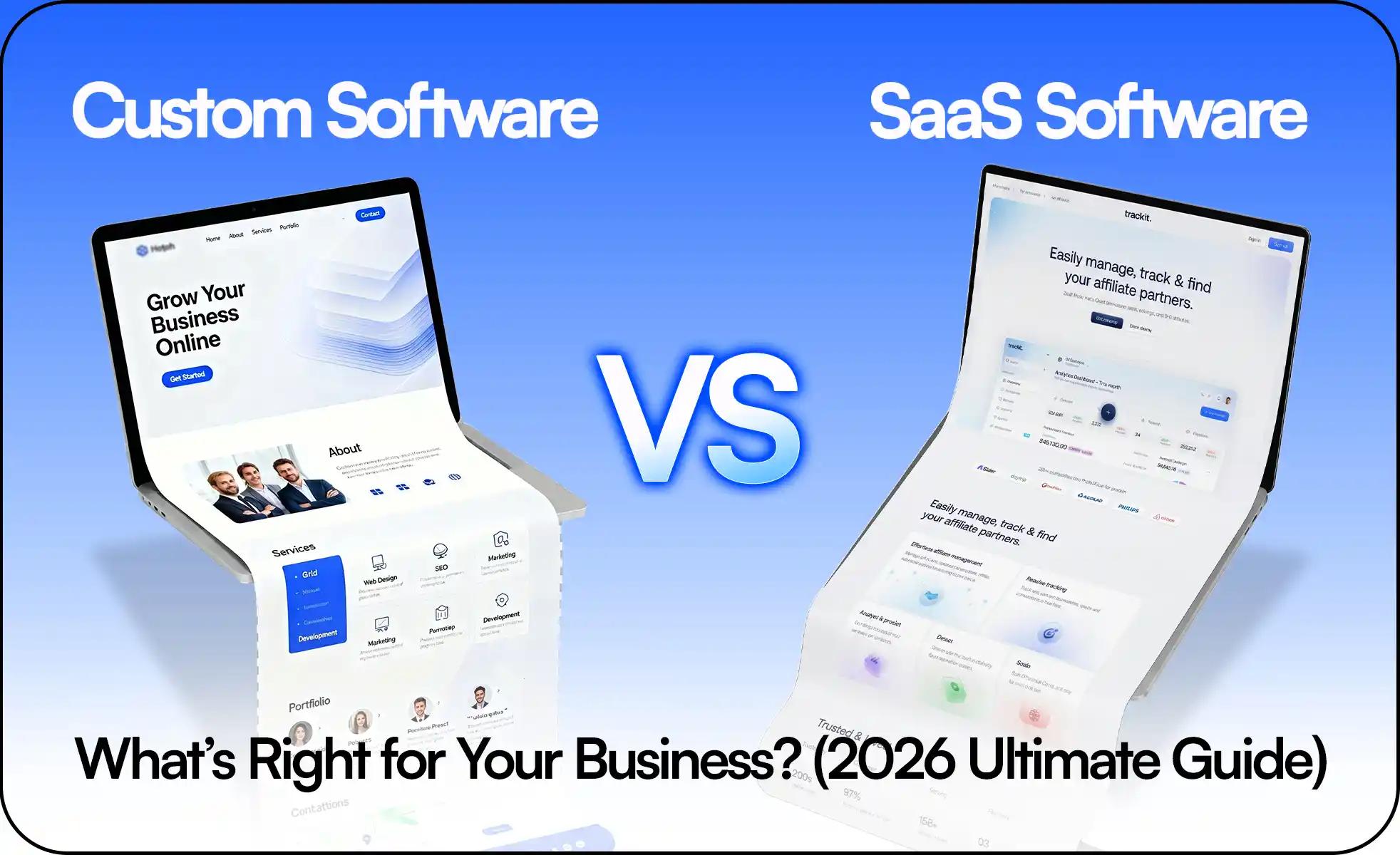
Most businesses start with SaaS because it is fast and affordable. But at some point growth reveals the limits. This guide breaks down custom software vs SaaS across every dimension that matters so you can make the right call for your business stage right now.
When it comes to custom software vs SaaS, most businesses face the same challenge: both options sound reasonable at first, and the wrong choice only becomes obvious after time and money have already been spent.
This decision directly shapes your cost of operations, how well your systems scale, who controls your data, and how much competitive advantage your technology actually gives you. In 2026, with more SaaS tools available than ever and custom development becoming faster and more accessible, the stakes of getting this decision right are higher than before.
This guide breaks down every dimension of the custom software vs SaaS debate in plain language – with real examples, a full comparison, and a clear framework for making the right call for your specific business stage.
What Is Custom Software Development?
Custom software is a fully tailored digital solution built specifically for one business or organization. Unlike off-the-shelf tools, it is designed from the ground up around your workflows, your internal processes, your industry requirements, and your growth strategy.
Because it is built exclusively for you, it does exactly what you need – no more workarounds, no unused feature bloat, no dependency on a vendor’s product roadmap.
Key Characteristics of Custom Software
• Fully customized functionality – every feature is built around your actual business logic
• Scalable architecture – designed to grow with your business from day one
• Full ownership – you own the code, the data, and the system entirely
• No recurring license fees – after development, you are not paying a vendor monthly
• Integration flexibility – connects with any third-party tool or API you choose
Common Custom Software Use Cases
• ERP systems for managing operations across departments
• Logistics and fleet management platforms
• Healthcare management and patient data systems
• Fintech applications requiring custom security and compliance
• Custom SaaS platforms built for other businesses to subscribe to
Custom software is built when your business has outgrown every tool you have tried – or when your competitive advantage depends on doing something no existing tool can do.
What Is SaaS? (Software as a Service Explained)
SaaS (Software as a Service) is a cloud-based software model where users access a ready-made application through a subscription. Instead of building software, you simply sign up for an existing platform and start using it – often within minutes.
The vendor hosts the software, manages the servers, handles updates, and maintains security. You pay a monthly or annual fee and focus entirely on using the tool rather than maintaining it.
Key Characteristics of SaaS
• Subscription-based pricing – pay monthly or annually, no large upfront investment
• Cloud-hosted – accessible from any device with a browser, no installation required
• Instant setup – most SaaS tools are operational within hours
• Vendor-managed maintenance – updates, security, and infrastructure handled by the provider
• No code ownership – you rent access, not the software itself
Well-Known SaaS Examples
• Shopify – e-commerce platform
• HubSpot – CRM and marketing automation
• Zoom – video communication
• Google Workspace – productivity and collaboration
• Slack – team communication
• Trello and Asana – project management
SaaS is designed for speed, simplicity, and low initial cost. It is the right starting point for most businesses – until it is not.
Custom Software vs SaaS: Key Differences Explained
Here is a direct comparison across the six dimensions that matter most when making this decision:
Dimension
Custom Software
SaaS
Ownership
You own the code, system, and data entirely
You rent access – vendor owns everything
Cost Structure
High initial investment, low long-term dependency
Low starting cost, ongoing subscription fees that grow with usage
Scalability
Scales based on your own architecture decisions
Limited by what the vendor’s system supports
Customization
Fully flexible – built around your exact needs
Limited to the features the vendor has built
Time to Launch
Weeks to months depending on scope
Immediate – most tools are live within hours
Data Control
Full control over where data lives and how it is secured
Data stored on vendor’s servers under their policies
Ongoing Cost
Maintenance budget (15-20% of build cost annually)
Subscription fees increase as your team or usage grows
Vendor Dependency
None – you own and control the system
High – subject to pricing changes, feature decisions, shutdowns
Custom Software vs SaaS Cost Comparison: The Real Long-Term Picture
Cost is almost always the first thing businesses compare – and almost always the most misunderstood.
SaaS Cost Reality
SaaS feels affordable because the entry cost is low. However, subscription fees compound as your business grows:
• Most SaaS tools charge per user or per seat – 5 users is affordable, 50 users is expensive
• Premium features are often locked behind higher pricing tiers
• Integrating multiple SaaS tools multiplies your monthly spend significantly
• Price increases happen – and you have no control over them
A business using 8 to 10 SaaS tools with a team of 30 people can easily spend BDT 2,00,000 to 5,00,000 per year in subscription fees alone – for software they do not own.
Custom Software Cost Reality
Custom software has a meaningful upfront investment – but after that, your ongoing costs are largely within your control:
• No per-user fees – add as many team members as needed
• No subscription dependencies – you pay for what you choose to maintain
• Maintenance budget is typically 15 to 20 percent of build cost annually
• Features are added on your timeline, not the vendor’s roadmap
At the 3 to 5 year mark, many businesses find that custom software has a lower total cost of ownership than the SaaS stack it replaced – while delivering significantly more competitive capability.
When Should You Choose Custom Software Development?
Custom software development is the right investment when one or more of the following apply to your business:
• Your workflows are complex and no existing tool covers them fully without significant workarounds
• You are building a product that other businesses or consumers will use – a SaaS or platform play
• Data privacy, compliance, or security requirements mean you cannot store sensitive information on third-party servers
• You have outgrown your current tools and switching between more SaaS products is creating more problems than it solves
• Your competitive advantage depends on doing something differently from your competitors – and a generic tool cannot deliver that
• You are planning for long-term scale and want full architectural control from the start
Industries Where Custom Software Is Typically the Right Choice
• Logistics and supply chain management
• Healthcare and patient data management
• Fintech and financial services with compliance requirements
• Large-scale e-commerce with custom pricing, inventory, or fulfillment logic
• Enterprise operations requiring ERP, CRM, and HR in one integrated system
• Any business building a platform as its core product
When Should You Choose SaaS?
SaaS is absolutely the right choice in the right context. Here is when it makes the most sense:
• You need to move fast and time-to-launch matters more than deep customization right now
• Your requirements are standard and well-served by existing tools
• Your team is small and per-user pricing remains affordable at your current scale
• You are in an early validation stage and do not yet know which features you actually need
• You want to reduce technical overhead and keep the focus on running the business
Business Types Where SaaS Typically Wins
• Small businesses with standard CRM, invoicing, or communication needs
• Freelancers and solopreneurs who need simple productivity tools
• Early-stage startups validating an idea before committing to a custom build
• Marketing agencies using established platforms like HubSpot, Canva, or Semrush
• Teams that need collaboration tools without a dedicated IT setup
SaaS is not the wrong answer – it is often the right starting point. The question is not SaaS or custom. It is: at what stage of growth does SaaS stop being the right answer for your specific business?
Real Business Examples: Custom Software vs SaaS in Practice
Example 1: When Custom Software Is the Clear Answer
A logistics company in Dhaka needs to manage real-time vehicle tracking, route optimization, driver assignments, customer delivery portals, and internal reporting dashboards – all in one place.
They tried three different SaaS combinations. None of them connected properly. Data had to be manually transferred between tools. Reports were inaccurate. Operational delays were increasing.
The solution was a custom-built logistics platform that integrated every function into one system. After launch, delivery efficiency improved by 34 percent and manual data entry dropped to near zero.
No SaaS combination could have delivered that outcome.
Example 2: When SaaS Is the Clear Answer
A marketing agency with a team of eight needs a CRM to track clients, an email automation tool, a project management board, and a reporting dashboard.
HubSpot covers the CRM and email automation. Asana handles project management. Google Data Studio handles reporting. Total monthly cost: under BDT 15,000.
Building custom versions of all four tools would cost BDT 8,00,000 or more and take five months. For this business at this stage, SaaS is obviously the right choice.
The Business Growth Pattern: How Most Companies Move from SaaS to Custom
There is a pattern that plays out consistently across growing businesses. It looks like this:
1. Start with SaaS – fast to launch, low cost, standard features cover early needs
2. Grow into limitations – team expands, workflows become more complex, SaaS gaps appear
3. Stack more SaaS tools – adding tools to cover gaps creates integration problems and rising costs
4. Hit the ceiling – manual workarounds become expensive, data accuracy suffers, scaling slows
5. Transition to custom – a purpose-built system replaces the stack with one integrated platform
This is not a failure of SaaS. It is simply the natural progression. The businesses that plan for this transition proactively make it far more smoothly than those who are forced into it reactively.
The smartest move is not choosing custom software over SaaS from day one. It is knowing in advance at what growth milestone the switch will make sense – and planning your architecture accordingly.
Quick Decision Framework: Custom Software vs SaaS
Use this to identify where your business sits right now:
Choose SaaS If…
Choose Custom Software If…
You need to launch in days or weeks
You need a solution no existing tool covers
Your requirements are standard and well-served
Your workflows are complex or industry-specific
Your team is under 20 people
Your team is growing fast and per-user SaaS costs are rising
You are validating an early-stage idea
You are scaling a proven business model
Budget is limited right now
You are planning for 3 to 5 year ROI
Data privacy is not a primary concern
You need full control over data and security
You are happy with vendor roadmap dependency
You need features built on your timeline
Frequently Asked Questions About Custom Software vs SaaS
Is custom software always more expensive than SaaS?
Upfront, yes – custom software requires a meaningful initial investment. However, over a 3 to 5 year period, many businesses find that custom software has a lower total cost of ownership than a growing SaaS subscription stack, especially once you factor in per-user fees, add-on costs, and the cost of integration workarounds.
How long does it take to build custom software?
Timeline depends on complexity. A simple internal tool can be ready in 5 to 8 weeks. A medium business application typically takes 3 to 5 months. A complex platform or SaaS product takes 5 to 9 months or more. See our custom software development cost guide for full tier breakdowns.
Can I start with SaaS and switch to custom software later?
Yes – and this is actually the most common path. Many businesses start with SaaS to validate their model quickly, then transition to custom software once they have a clear picture of exactly what they need. A good development partner will help you plan for this transition from the start.
What are the risks of relying only on SaaS long-term?
The main risks are: vendor price increases with no alternative, features being deprecated or changed without your input, data stored on third-party servers outside your control, and the inability to build differentiating functionality that sets you apart from competitors using the same tools.
Does GeekSSort help businesses decide between custom software and SaaS?
Yes. Before any project starts, we run a free discovery call where we honestly assess whether custom software is the right answer for your stage. If SaaS tools solve your problem well, we will tell you. If you have genuinely outgrown them, we will show you exactly what a custom build would deliver and what it would cost.
What happens to my data if a SaaS company shuts down?
This is a real risk that is rarely discussed until it is too late. If a SaaS vendor shuts down or discontinues a product, your data access depends entirely on their offboarding policy – which is often limited. With custom software, your data lives where you choose to host it and is entirely under your control at all times.
Final Verdict: Custom Software vs SaaS in 2026
There is no universal winner between custom software and SaaS. The right answer depends entirely on your current business stage, your growth trajectory, your data requirements, and what kind of competitive advantage you are trying to build.
• Choose SaaS if you need speed, simplicity, and low upfront cost at an early or stable stage
• Choose custom software if you need control, scalability, differentiation, and long-term strategic ownership
• Plan the transition in advance if you are currently on SaaS but can see the ceiling approaching
The businesses that make this decision well do not just save money. They build systems that support their growth instead of limiting it.
The Netherlands has near-universal English fluency and a persistent shortage of senior engineers in AI, MLOps and cloud infrastructure. Here is why Dutch companies are moving to remote development teams, and what to verify before committing.
HIPAA and GDPR overlap on security controls but diverge on consent, individual rights and breach notification timing. Here is the technical crosswalk, PHI handling architecture, BAA process and AI governance one dual-compliance HealthTech platform needs.
The quote on your desk is not the price of the software. This guide splits the real cost of custom software into CapEx vs OpEx treatment, annual maintenance benchmarks by software type, and a 3-year TCO model to build before a CFO signs off.



 We’re happy to sign an NDA upon request.