The Dutch shortage is a skills mismatch, not a supply shortage — vacancies are at a high while overall IT unemployment ticks up.
It is concentrated in AI, MLOps and cloud infrastructure, so weight technical specialization over headline rate when choosing a vendor.
With near-universal English fluency, Dutch firms lose the language friction layer that other European markets have to manage.
The 30 percent ruling takes three to six months to clear, so a remote team can be productive in one to two weeks instead.
ASML and Delft's quantum spinouts pull talent out of adjacent sectors, so the scarcity is structural and multi-sector, not temporary.
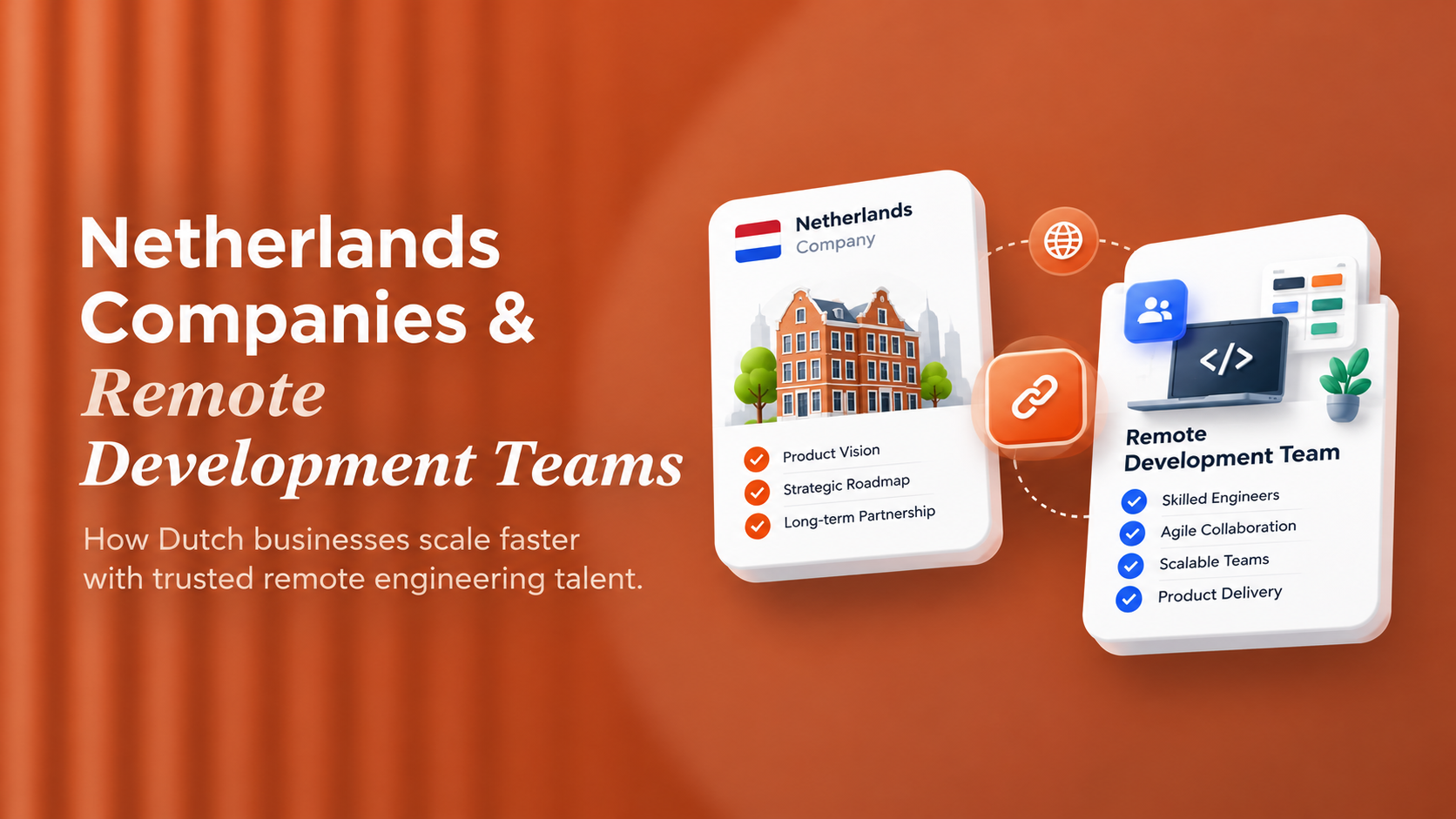
The Netherlands ranks second globally for English proficiency among non-native speakers, with 97 percent of Dutch adults speaking conversational English, while the country's own IT job market sits in what local analysis has termed a genuine paradox: unemployment ticking up to roughly 4.5 percent even as job vacancies for skilled developers remain at an all-time high. For a Dutch tech lead, this combination — a workforce that operates almost entirely in English alongside a persistent, structural shortage of qualified engineering candidates — creates unusually favorable conditions for remote and offshore development team adoption compared to many other European markets, where language friction alone limits how effectively international talent can integrate. This article covers why Dutch companies have moved decisively toward remote development teams, and how Amsterdam's specific startup ecosystem dynamics shape that decision.
Why Is the Netherlands Uniquely Positioned for Remote Team Adoption?
The Netherlands combines near-universal English fluency, a startup ecosystem that already operates entirely in English by default, and one of Europe's most internationally connected talent markets — conditions that remove the language and cultural friction that complicate remote team integration in several neighboring European markets.
More than 90 percent of Dutch people speak English, and Amsterdam's tech hiring market is described by local recruiters as effectively an English-language market by default — most startups operate entirely in English internally, not merely for external client communication. This stands in meaningful contrast to markets like Berlin, which carries more language friction for English-first operations, or Paris, where language complexity compounds with higher operating costs. For a Dutch company integrating a remote or offshore development team, this means the domestic team side of the collaboration already operates in the same working language a remote team would use, removing an entire category of friction that companies in less English-fluent markets need to manage deliberately.
The Netherlands' own domestic talent market reinforces the case for looking beyond purely local hiring. The country employs over 300,000 ICT professionals and consistently ranks among Europe's top three tech talent markets, yet vacancies remain at an all-time high even as unemployment has ticked upward — a genuine skills mismatch rather than a simple supply shortage, concentrated specifically in specialized areas like AI, MLOps, and cloud infrastructure where demand has tripled year over year in recent local market analysis. Backend developers with cloud platform expertise command premium salaries specifically because of this persistent shortage, with senior developers earning €80,000 to €110,000 annually even as broader hiring conditions loosen for less specialized roles.
How Does Amsterdam's Startup Scene Specifically Shape the Decision?
Amsterdam's startup ecosystem — over 11,000 tech companies and €2.64 billion in venture capital raised in a recent year — has become intensely competitive for the specific engineering talent Dutch startups need most, pushing many founders toward remote and offshore team structures as a practical necessity rather than a cost-driven afterthought.
Amsterdam's tech talent pool, while highly skilled, is genuinely limited in absolute size relative to the country's population of roughly 17 million people, and the same properties that make the city attractive — deep venture capital, Schiphol's global connectivity, and the 30 percent ruling tax benefit for international hires — mean every well-funded startup and multinational is fishing in the same relatively small talent pool. This has produced real hiring friction even for well-capitalized companies: Amsterdam salaries sit above Berlin but below London, and companies like Booking.com and Uber pay 20 to 40 percent above standard market ranges for the same roles, making it structurally difficult for an early-stage startup to compete purely on domestic compensation.
The 30 percent ruling itself, while a genuine advantage for attracting international talent to relocate to the Netherlands, introduces its own friction for founders trying to move quickly: the ruling takes three to six months to process, meaning a founder promising a start date without factoring in this processing time risks disappointing a new hire before they've even started. This processing delay is a specific, concrete reason many Dutch founders have found remote or offshore team engagement considerably faster to stand up than a domestic hire dependent on this tax benefit clearing in time — a remote dedicated team can typically be assembled and productive within one to two weeks, against a multi-month timeline for a Netherlands-based international relocation hire to clear the necessary tax and immigration processing.
Housing pressure has compounded this talent dynamic further. Rising rents in Amsterdam specifically have driven a documented pattern of engineers relocating to secondary Dutch tech hubs like Eindhoven, and controversial adjustments to the 30 percent ruling itself have left some highly skilled international migrants questioning their long-term commitment to remaining in the country — both dynamics that add further uncertainty to a purely domestic hiring strategy that a Dutch founder building a resilient engineering team should weigh directly.
How Does Remote Collaboration Efficiency Compare for Dutch Companies Specifically?
Dutch companies benefit from the same near-full CET time zone overlap advantage that other Western and Central European companies enjoy when working with nearby nearshore destinations, while also being well-positioned for offshore destinations further afield given the country's strong existing culture of remote and flexible work arrangements predating the specific rise of offshore staffing.
The Netherlands' strong pre-existing work-life balance culture and comfort with flexible and remote work arrangements — a genuine cultural feature of the Dutch labor market independent of any specific offshore staffing trend — means Dutch companies and their employees are generally well-practiced at the asynchronous communication and structured remote collaboration discipline that any distributed or offshore team relationship depends on. This cultural readiness is a meaningful, if less quantifiable, advantage relative to markets where remote work discipline is a newer adaptation forced by specific offshore hiring decisions rather than an established default way of working.
For time-zone-sensitive collaboration specifically, Dutch companies sit in essentially the same position as German or broader Western European companies discussed elsewhere in this series: near-zero time zone gap with Eastern European nearshore talent, and a workable four-to-six-hour overlap window with South Asian offshore destinations like India and Bangladesh when the offshore team's working hours are structured to create afternoon CET overlap. This flexibility allows a Dutch company to choose its remote sourcing geography based primarily on cost, specialization, and vendor quality, rather than being constrained to a narrow set of destinations by time zone alone.
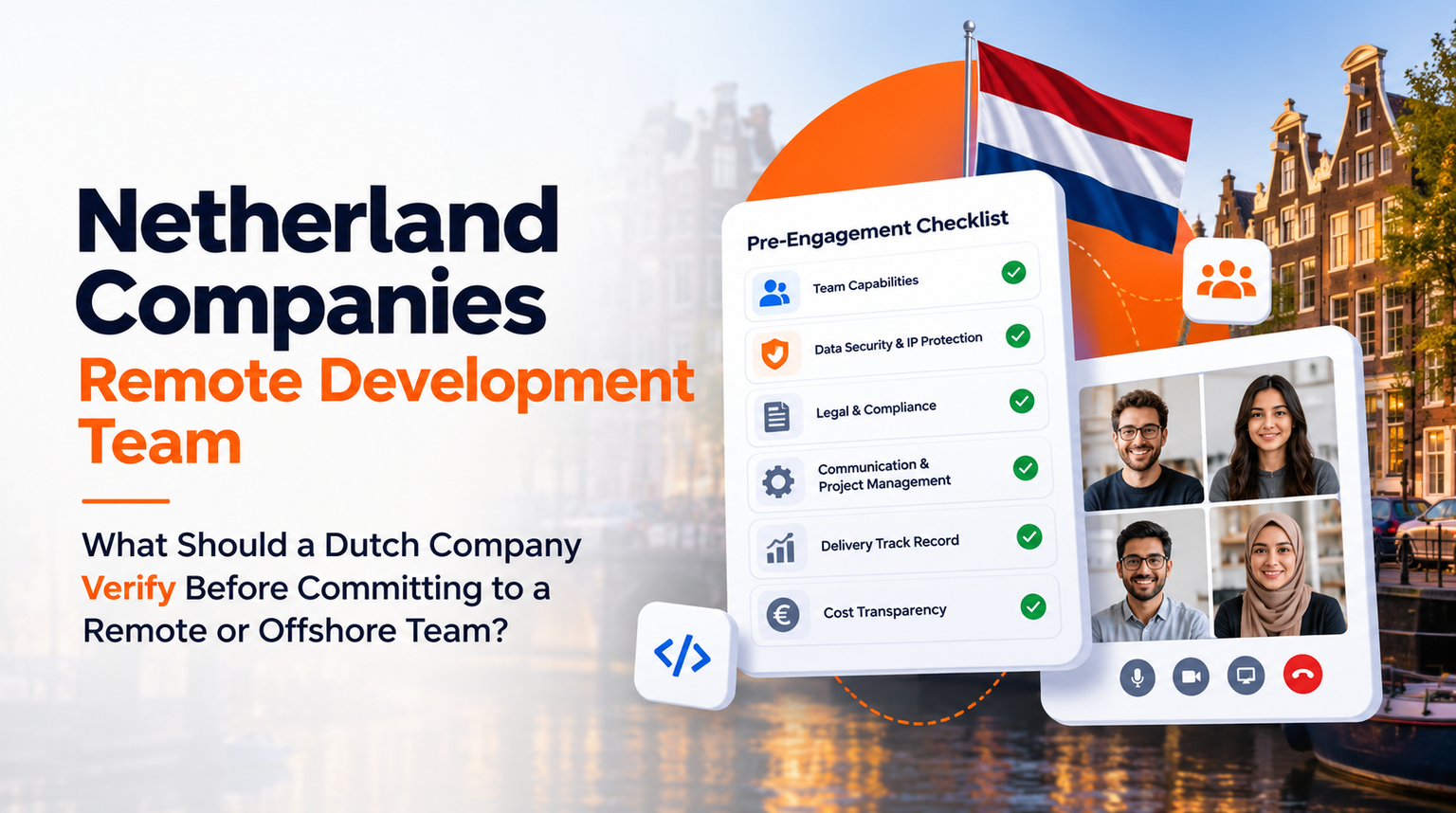
What Should a Dutch Company Verify Before Committing to a Remote or Offshore Team?
Dutch companies should apply the same rigorous vendor evaluation discipline covered elsewhere in this series, with particular attention to whether a prospective remote team can genuinely match the specialized skill areas — AI, MLOps, cloud infrastructure — where the Netherlands' own domestic shortage is most acute, since a generic offshore vendor without this specific specialization does not solve the actual gap a Dutch company is trying to fill.
Given that the Netherlands' domestic talent shortage is concentrated specifically in high-value specialized roles rather than general software development capacity, a Dutch company evaluating remote or offshore teams should weight technical specialization more heavily in its evaluation criteria than cost alone. A vendor with strong general web development capability but limited depth in the specific AI or cloud infrastructure specialization a Dutch company actually needs will not resolve the underlying skills gap driving the decision to look beyond domestic hiring in the first place — the evaluation process should specifically probe for depth in the areas where Netherlands hiring friction is most acute.
What Does the Broader 'Silicon Delta' Trend Mean for Sourcing Strategy?
The Netherlands' emergence as an integrated technology region spanning Amsterdam's software and fintech scene, Eindhoven's deep-tech and semiconductor cluster, and Delft's quantum computing spinouts has concentrated even more specialized demand onto an already limited domestic talent pool, reinforcing rather than easing the case for remote team adoption.
This regional specialization pattern means the competition a Dutch software company faces for engineering talent extends beyond other software startups: companies like ASML are actively recruiting data scientists, AI ethicists, and logistics experts well beyond their traditional semiconductor engineering hiring, effectively drawing talent out of adjacent sectors including software. Quantum computing spinouts from Delft are similarly hiring aggressively for Python developers, FPGA engineers, and systems architects — roles that directly overlap with what a typical SaaS or enterprise software company also needs. A Dutch tech lead evaluating the domestic hiring market should factor in this cross-sector competition for the same skill categories, not just direct competition from other software companies, when assessing how realistic a purely domestic hiring plan actually is.
This dynamic strengthens rather than weakens the case for remote and offshore team adoption specifically, since it means the domestic talent scarcity Dutch companies face is structural and multi-sector in origin, not a temporary or narrowly software-specific supply gap likely to resolve on its own in the near term.
Where Geekssort Fits
Geekssort provides dedicated development teams for Dutch companies looking to complement Amsterdam's talent-constrained local market with cost-efficient, specialized offshore capacity, with English-fluent delivery and CET-overlap-structured working hours built into the engagement from day one. For a Dutch tech lead evaluating remote team options against the specific specialized skill gaps driving domestic hiring friction, a scoping conversation focused on the exact technical specialization needed is the right starting point before committing to a specific vendor or destination.
Frequently Asked Questions
Why is English proficiency such an advantage for Dutch companies adopting remote teams?
97 percent of Dutch adults speak conversational English and most Amsterdam startups already operate entirely in English internally, removing a language friction layer that companies in less English-fluent European markets need to manage deliberately.
Is there really a tech talent shortage in the Netherlands despite rising unemployment?
Yes — job vacancies for skilled developers remain at an all-time high even as overall IT unemployment has ticked up, reflecting a skills mismatch concentrated in specialized areas like AI, MLOps, and cloud infrastructure rather than a broad-based shortage.
How long does the Dutch 30% ruling take to process for international hires?
Typically three to six months, a timeline that has led many founders to consider remote or offshore team engagement, which can be assembled and productive in one to two weeks, as a faster alternative for urgent hiring needs.
What time zone overlap do Dutch companies have with common offshore destinations?
Near-zero gap with Eastern European nearshore talent, and a workable four-to-six-hour overlap with South Asian destinations like India and Bangladesh when the offshore team structures its hours for afternoon CET overlap.
Should a Dutch company prioritize cost or specialization when choosing a remote team?
Specialization, generally — since the Netherlands' domestic shortage is concentrated in high-value specialized roles like AI and cloud infrastructure, a low-cost but generalist offshore vendor may not resolve the actual skills gap driving the decision.
How has Amsterdam's housing market affected local tech hiring?
Rising rents have driven engineers to relocate to secondary hubs like Eindhoven, adding further uncertainty to purely domestic hiring strategies and reinforcing the case for remote team structures that aren't dependent on Amsterdam-specific talent availability.
What makes a formal US-EU collaboration agreement different from a standard vendor contract?
Since each organization employs its own contributing staff, IP ownership, liability, and governing jurisdiction need explicit, itemized treatment rather than the simpler defaults that apply when one party is simply providing labor to the other.
Does GDPR apply differently depending on which collaboration model is used?
The underlying GDPR obligations apply regardless of model whenever EU personal data is processed, but the contractual mechanism differs — a DPA governs a managed services provider's data handling, while staff augmentation and direct employment carry their own distinct compliance layers covered elsewhere in this series.
HIPAA and GDPR overlap on security controls but diverge on consent, individual rights and breach notification timing. Here is the technical crosswalk, PHI handling architecture, BAA process and AI governance one dual-compliance HealthTech platform needs.
The quote on your desk is not the price of the software. This guide splits the real cost of custom software into CapEx vs OpEx treatment, annual maintenance benchmarks by software type, and a 3-year TCO model to build before a CFO signs off.
Most offshore IP disputes trace back to a contract that never transferred ownership in the first place. Here are the clauses that fix it, the enforcement routes that actually cross borders, and the repository controls that make revocation instant.






 We’re happy to sign an NDA upon request.