An NDA protects confidentiality but never establishes ownership — IP assignment has to be a separate clause.
Ownership should transfer in the present tense, the instant work is created, not on final payment.
Work-for-hire is a US-specific legal category; a direct IP assignment clause travels across borders far better.
Most offshore contracts drafted before 2025 are silent on AI-assisted work, which leaves a live ownership gap.
Contracts set the legal position; provisioning through your own SSO is what makes revocation instant.
IP loss in offshore engagements rarely happens because a developer in India, Poland, or the Philippines deliberately steals code — it happens because the contract never actually transferred ownership to the client in the first place, transferred it too late, or transferred it under a jurisdiction where the client has no realistic way to enforce it. Unless a signed written contract specifies otherwise, copyright law in many jurisdictions defaults initial ownership to the creator — the offshore developer or agency — not the company paying for the work. For legal counsel structuring an offshore development relationship, the practical implication is direct: IP protection is a contract-drafting and repository-governance discipline, not a matter of trusting a vendor's good faith, however genuine that good faith may be.
Why Isn't an NDA Alone Sufficient to Protect IP?
A non-disclosure agreement protects confidentiality — preventing a developer from disclosing what they learned but says nothing about who owns the code, designs, and documentation actually produced during the engagement, which is precisely the gap that leaves ownership legally ambiguous even when a strong NDA is in place.
The most common and costly drafting mistake in offshore contracts is a developer agreement with a well-drafted NDA sitting alone, with no accompanying IP assignment clause — this configuration hands the client confidentiality protection while leaving actual ownership of the work product genuinely unresolved. A second closely related mistake is IP assignment language that transfers ownership only 'upon final payment' or 'upon delivery of final deliverables' — in practice, this is functionally equivalent to code held hostage with extra procedural steps, since it creates a window during active development where ownership status is ambiguous and gives a vendor leverage in any payment dispute that a properly drafted contract would not.
What Should NDA and IP Assignment Requirements Actually Cover?
A defensible offshore contract structure uses three layers — a scoped NDA, a master services agreement with explicit work-made-for-hire provisions, and a direct, present-tense IP assignment clause — with ownership transferring the instant work product is created, not after project completion or final payment.
Contract Element
Requirement
NDA scope
A use restriction, not just a disclosure restriction — the developer must be prohibited from using confidential information for any purpose outside the defined engagement, with standard practice in 2026 using 2–3 year survival clauses binding both during and after the engagement
Work-for-hire language
Present-tense transfer: work product belongs to the client the instant it is created, covering source code, documentation, designs, and algorithms — not contingent on project completion or payment
IP assignment clause (not work-for-hire alone)
Work-for-hire is a specific legal category that applies primarily under US law and does not translate consistently to other jurisdictions; a direct IP assignment clause transferring ownership rights is the more portable and generally safer mechanism for cross-border agreements
AI-assisted work coverage
The assignment clause must explicitly cover AI-assisted work product, not only human-typed code — most offshore contracts drafted before 2025 do not address this, creating a live gap given that AI-generated output without human authorship may not be copyrightable in the first place
Moral rights waiver
Some jurisdictions grant creators non-transferable moral rights over their work independent of copyright ownership; where relevant, the contract should include an explicit waiver of these rights to the extent legally permitted
The AI-assisted work gap deserves particular attention given how quickly AI coding tools have become embedded in offshore development workflows. If an offshore developer uses an AI coding assistant to generate a substantial portion of a deliverable, an assignment clause that only covers work the developer personally typed leaves a genuine ownership gap for the AI-assisted portion — closing this requires explicit contract language covering AI-assisted and AI-generated work product as part of the same present-tense assignment that covers human-authored code.
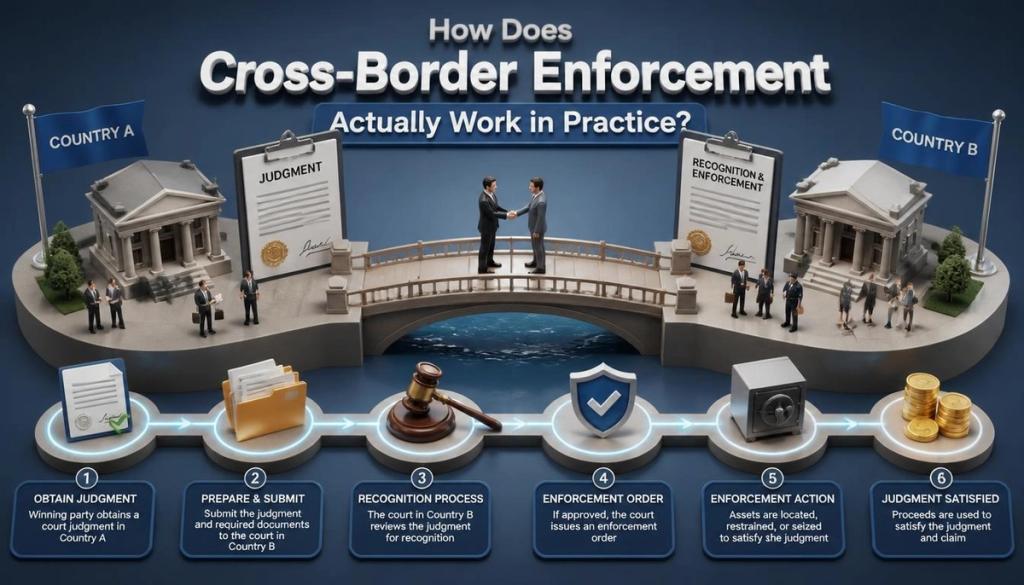
How Does Cross-Border Enforcement Actually Work in Practice?
A contract's IP protections are only as strong as the legal system that will actually enforce them, and a single-jurisdiction NDA or assignment clause referencing only the client's home jurisdiction is frequently unenforceable in the developer's home country without a corresponding local law reference or arbitration clause.
Enforcement Mechanism
Why It Matters
Dual-jurisdiction contract language
A US-only NDA is generally unenforceable in an Indian court, for example, without a corresponding reference to the Indian Contract Act and an Indian arbitration clause — the same principle applies across most common offshore destinations
International arbitration clause (ICC / SIAC / UNCITRAL)
Binding arbitration under a recognized international framework is generally more enforceable across borders than attempting to enforce a foreign court judgment directly in the developer's home jurisdiction
Contracting through a staffing entity with a home-jurisdiction legal presence
Contracting with a US-incorporated staffing partner (rather than directly with an individual overseas) keeps the agreement under home-jurisdiction law with home-jurisdiction enforceability, even though the engineers work from another country entirely
Chain-of-title consolidation
When contracting through a staffing partner, the client signs one master agreement with the company, and the company separately holds enforceable IP assignment agreements with every individual engineer — creating a single, complete chain of title rather than a patchwork of individually negotiated developer agreements
Realistic recourse structures typically layer three tiers rather than relying on one mechanism alone: a direct breach-of-contract claim against the vendor entity, with liquidated-damages and attorney-fee clauses that make a violation an expensive and clear-cut proposition rather than an ambiguous dispute; an errors-and-omissions insurance policy that can pay out without waiting on a full litigation outcome; and, where the vendor itself is the contracting party, any individual developer-level enforcement action becomes the vendor's contractual responsibility and cost to carry, not the client's. The objective of a well-structured framework is making an IP violation a clearly bad decision for every party involved before it happens — well-designed frameworks are reported to rarely if ever require actual invocation across large volumes of offshore placements, precisely because the contractual and financial consequences are unambiguous from the outset.
What Repository Access Isolation Controls Should Be Required?
IP protection does not end at the contract — repository governance, provisioned through the client's own identity system rather than shared credentials, is what makes access revocation instant and complete when an engagement ends, rather than dependent on a vendor's own offboarding discipline.
// Repository access isolation — minimum controls
// 1. Access provisioned through the client's own SSO/identity provider,
//    never through shared credentials or vendor-managed accounts
// 2. Role-based access control (RBAC) — access scoped to the specific
//    repositories and branches a given engineer's work actually requires
// 3. Mandatory MFA on all repository and CI/CD access
// 4. Automated secrets scanning on every commit — catches credentials
//    accidentally committed by an offshore engineer before they persist
//    in version control history
// 5. Access review cadence — quarterly at minimum, immediate upon any
//    change in engagement scope or personnel
// 6. Instant revocation capability tied to the client's own identity
//    system, executable the moment an engagement or individual
//    engineer's involvement ends — not dependent on the vendor
//    remembering to offboard
The specific design principle that makes offboarding reliable is provisioning access correctly on day one through the client's own identity infrastructure — if access was ever granted through shared credentials or a vendor-managed account rather than the client's own SSO, revocation at the end of an engagement becomes dependent on the vendor's own diligence rather than something the client can execute unilaterally and instantly. This is why identity setup at the start of an engagement carries more long-term security weight than almost any individual contract clause: a perfectly drafted IP assignment clause does not compensate for a repository access model that leaves the client unable to immediately and independently revoke access when the relationship ends.
Is Source Code Escrow a Useful Additional Protection?
Source code escrow — depositing a copy of the codebase with a neutral third party, released to the client under specific contractually defined trigger conditions such as vendor bankruptcy or abandonment — addresses a genuinely different risk than IP assignment does, and the two should not be treated as substitutes for one another.
IP assignment establishes who legally owns the code from the moment of creation; escrow addresses a separate, practical continuity risk — what happens if the vendor entity itself disappears, becomes insolvent, or otherwise becomes unable to provide the actual source files even though the client legally owns them. A client that owns the IP outright but has no actual current copy of a critical piece of source code, because the vendor who held it has gone out of business, still faces a real operational crisis despite having done the legal ownership work correctly. Escrow is generally most worth the additional cost and complexity for engagements involving a smaller or less-established vendor, where the continuity risk is genuinely higher than it would be with a larger, more stable development partner.
How Should Contractor Classification Risk Be Managed Alongside IP Protection?
IP protection terms and contractor classification are related but distinct legal exposures, and a contract with strong IP assignment language does not protect a company from misclassification risk if the actual working relationship with an offshore developer functions like an employment relationship rather than a genuine contractor engagement.
The specific test that matters here is behavioral, not contractual: if the contract's language describes a contractor relationship but the actual day-to-day working pattern — fixed hours, exclusive availability, direct integration into internal team structures indistinguishable from an employee — looks like employment, the contractual label does not control how a court or regulator would characterize the relationship. This matters for IP protection specifically because misclassification disputes frequently surface IP ownership as a secondary issue once the primary employment classification dispute is underway, adding legal complexity to what should have been a straightforward, already-resolved ownership question. Structuring the engagement through a staffing partner or agency, as discussed above for enforcement purposes, also generally reduces this classification risk, since the direct contracting relationship is between the client and the staffing entity rather than between the client and the individual developer.
What Ongoing Operational Habits Reinforce Contractual IP Protection?
A well-drafted contract establishes IP protection on paper, but ongoing operational habits — access reviews, exit interviews for departing offshore engineers, and periodic confirmation that repository permissions still match actual current engagement scope — are what keep that protection accurate in practice as an engagement evolves over months or years.
The specific risk this addresses is contractual and operational drift: an engagement that starts with correctly scoped repository access and a clean IP assignment can drift over time as engineers rotate on and off the project, scope expands informally beyond what was originally contracted, or access permissions are granted for a specific task and never revoked once that task is complete. A quarterly access review — confirming that every individual with repository or system access still has an active, current reason to hold that access — catches this drift before it becomes a genuine security or ownership ambiguity, and is a considerably cheaper and less disruptive habit to maintain than discovering the gap during an actual dispute or security incident.
Exit interviews or structured offboarding conversations with departing offshore engineers, while not a legal requirement, provide a practical opportunity to confirm understanding of ongoing confidentiality obligations that survive the engagement — many jurisdictions' NDA survival clauses remain legally binding regardless of whether this conversation happens, but a documented, explicit reminder at the point of departure meaningfully reduces the likelihood of an inadvertent breach by an engineer who has simply moved on to other work and hasn't thought carefully about what obligations continue to apply.
Where Geekssort Fits
Geekssort structures offshore engagements with present-tense IP assignment, dual-jurisdiction-aware contract language, and repository access provisioned through the client's own identity systems from day one, for legal teams and CTOs across the US, UK, UAE, and EU managing IP risk in distributed development relationships. For legal counsel reviewing an existing or prospective offshore contract, checking it against the specific gaps outlined in this article — AI-assisted work coverage, jurisdiction enforceability, and access provisioning — is the fastest way to identify exposure before it becomes a dispute.
Frequently Asked Questions
Is an NDA enough to protect IP when working with offshore developers?
No — an NDA protects confidentiality but does not establish who owns the work product created, which requires a separate, explicit IP assignment clause.
What is the difference between work-for-hire and IP assignment?
Work-for-hire is a specific legal category that applies primarily under US law and doesn't translate consistently to other jurisdictions; a direct IP assignment clause transferring ownership rights is generally the more reliable mechanism for cross-border agreements.
When should IP ownership transfer to the client?
The instant work product is created, not upon project completion or final payment — assignment language contingent on payment creates an ambiguous ownership window and gives the vendor leverage in any payment dispute.
Does a US-only NDA protect a company if their offshore developer is in India?
Not reliably — a single-jurisdiction NDA is often unenforceable in the developer's home country without referencing local contract law and including an appropriate arbitration clause covering that jurisdiction.
Does IP assignment need to explicitly cover AI-generated code?
Yes — most offshore contracts drafted before 2025 don't address this, and AI-generated output without meaningful human authorship may not be copyrightable at all, making explicit contract coverage of AI-assisted work product a live gap to close.
What is the safest way to manage repository access for offshore developers?
Provision access through the client's own SSO and identity system rather than shared credentials or vendor-managed accounts, so access revocation at the end of an engagement is instant and doesn't depend on the vendor's own offboarding process.
The quote on your desk is not the price of the software. This guide splits the real cost of custom software into CapEx vs OpEx treatment, annual maintenance benchmarks by software type, and a 3-year TCO model to build before a CFO signs off.
A COD ecommerce platform should focus beyond checkout: customer confirmation, fraud/risk scoring, courier management, payment verification, SMS, and delivery tracking.
The key goal is to reduce refused deliveries and automate the entire order-to-delivery workflow, using a mobile-first storefront and reliable integrations.
Dedicated development teams let startups build faster, preserve runway, and scale engineering capacity without committing to permanent in-house headcount. The model uses an external team that works exclusively on the company’s product as an extension of the internal team.





 ChatGPT
 Claude
 Perplexity
 Gemini
 Grok
Grok



 We’re happy to sign an NDA upon request.