Automate the full CI/CD pipeline: build, test, security scan, deploy, verify, and rollback.
Manage infrastructure as code through Git, review, and versioning instead of manual changes.
Make monitoring actionable: detect performance, security, and cost issues and trigger automated responses.
Define SLOs, protect secrets, and test rollback and failure recovery on a regular schedule.
Adopt advanced practices like chaos engineering and internal platforms only as the business scales.
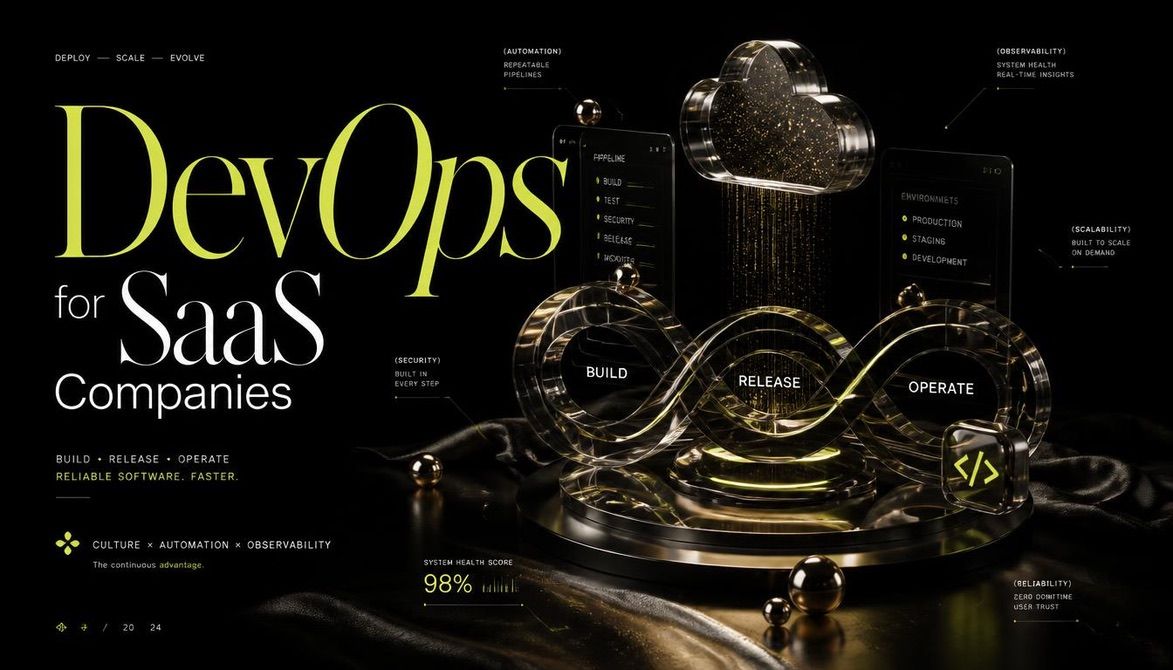
Organizations with mature DevOps practices achieve 46 times more frequent code deployments and recover from failures 96 times faster than organizations without them, according to 2025 industry-wide DevOps analysis — yet nearly 85 percent of organizations have adopted automated testing and 80 percent use continuous integration as a baseline, meaning the gap between elite and average performers is now determined less by whether these practices exist at all and more by whether they're implemented with real operational discipline. For a DevOps lead setting up or maturing a SaaS platform's delivery pipeline, this guide covers the four pillars that determine which side of that gap a platform lands on: CI/CD pipeline architecture, infrastructure as code, the monitoring stack, and rollback strategy.
What Should a Production-Grade CI/CD Pipeline Actually Include?
A dependable CI/CD pipeline needs distinct, explicit phases — build, test, security, artifact generation, deployment, verification, and rollback — rather than a single undifferentiated 'build and deploy' step, and a failed deployment that requires manual SSH intervention to resolve is a clear signal the pipeline has not reached production-grade maturity.
A useful starting discipline for a team building this out is to resist standing up a full internal developer platform before these foundational phases are stable — starting with a full platform before the basics are proven tends to codify inconsistency rather than remove it. A more reliable sequence is one service, one deployment path, and a short, enforced set of gating checks the team will actually maintain, expanding scope only once that single path is genuinely dependable under real production load.
Security specifically can no longer function as a pre-release gate the way it did in earlier delivery models, since in a modern SaaS environment releases happen daily and infrastructure changes are effectively continuous. Security scanning — dependency vulnerability checks, secrets detection, SBOM generation — needs to be embedded directly into the CI/CD pipeline as a blocking stage, not scheduled as a periodic review that happens independently of the deployment cadence.
How Should Infrastructure as Code Be Structured for a SaaS Platform?
Infrastructure as Code turns infrastructure provisioning into a discipline reviewed the same way application code is reviewed — version-controlled, changed through pull requests, and rolled back predictably — and by 2026 GitOps, using Git itself as the single source of truth for both application code and infrastructure, has become the standard pattern for managing this within CI/CD pipelines.
# terraform — minimal example of versioned, reviewable infrastructure
resource "aws_eks_cluster" "saas_cluster" {
  name     = "production-cluster"
  role_arn = aws_iam_role.cluster_role.arn
  version  = "1.29"

  vpc_config {
    subnet_ids = var.private_subnet_ids
  }
}

# Every change to this file goes through:
# 1. Pull request + code review (same as application code)
# 2. terraform plan — reviewed before apply, never applied blind
# 3. Policy checks (e.g., OPA/Sentinel) — blocking non-compliant changes
# 4. Controlled apply — via CI/CD, never a manual terraform apply from a laptop
# 5. Drift detection — scheduled job comparing live state to declared state
The specific mechanism that makes IaC's rollback story reliable is immutability: every artifact — Docker image, VM image, infrastructure state — should be versioned and treated as immutable rather than mutated in place. When an issue arises, the recovery action is deploying a previous, known-good versioned artifact rather than attempting to reverse-engineer and undo a series of in-place changes, which is both slower and considerably more error-prone under incident pressure. If a VPC, IAM role set, or database cluster isn't defined as code and version-controlled, that piece of infrastructure represents an unaudited, unrepeatable configuration that the rest of the pipeline's reliability guarantees don't actually extend to.
A typical implementation for a SaaS platform uses Terraform, Pulumi, or CloudFormation for multi-cloud or single-cloud provisioning, paired with Kubernetes for container orchestration and GitOps tooling such as ArgoCD or Flux to reconcile the live cluster state against what's declared in Git — a pattern that has become particularly common among SaaS startups specifically because it gives a small platform team the same infrastructure discipline larger organizations achieve with dedicated platform engineering headcount.
What Should the Monitoring Stack Actually Measure?
Observability should function as a feedback loop into the deployment pipeline itself, not merely a dashboard engineers glance at after something breaks — performance regressions should be able to block a deployment automatically, security anomalies should trigger investigation without waiting for a human to notice, and cost spikes should trigger scaling adjustments in near real time.
Monitoring Layer
What Feeds Back Into the Pipeline
Application performance monitoring
Latency and error-rate regressions detected post-deploy should be able to trigger an automatic rollback, not just an alert for manual investigation
Infrastructure drift detection
Scheduled comparison between declared IaC state and actual live infrastructure state, flagging manual out-of-band changes that bypass the reviewed pipeline
Security anomaly detection
Unusual access patterns or configuration changes should trigger automated investigation workflows, integrated with the same alerting system as operational incidents
Cost and resource utilization
Per-service or per-tenant resource consumption tracked continuously, with automated scaling adjustments triggered by defined thresholds rather than manual capacity planning alone
A monitoring implementation is genuinely mature when it shortens diagnosis time rather than adding another dashboard nobody consults during an actual incident. The specific failure mode to guard against is instrumenting extensively but failing to route the resulting signal back into automated decision points — a platform with excellent dashboards but no automated rollback trigger on a detected regression has built observability as a reporting tool rather than as the operational feedback loop it needs to be to actually improve the DORA-style metrics discussed elsewhere in this series.
What Deployment Rollback Strategy Should a SaaS Platform Use?
A reliable rollback strategy depends on the same immutability and versioning discipline that makes infrastructure as code trustworthy — deploying a previous, known-good versioned artifact is the primary recovery mechanism, and this should be automated to trigger on a failed post-deployment health check rather than requiring a human to notice the failure and initiate the rollback manually.
Deployment Strategy
How Rollback Works
Best Fit
Rolling deployment
New version replaces old instances gradually; rollback replaces them back in the same gradual pattern
General-purpose default for most services
Blue-green deployment
Entirely separate, parallel environment; rollback is an instant traffic-routing switch back to the previous environment
Services where instant, zero-ambiguity rollback matters most (e.g., checkout, auth)
Canary deployment
New version receives a small percentage of traffic first; rollback halts the rollout before it reaches full traffic
High-risk changes where early detection of a regression at low traffic exposure is the priority
Whichever pattern is used, the rollback path should be exercised regularly as a matter of operational discipline, not left as an untested theoretical capability discovered to be broken for the first time during an actual incident. A pipeline that has never actually executed a real rollback in a production-like environment carries meaningfully more risk than its documentation suggests, regardless of how well-designed the rollback logic appears on paper.
How Should Secrets Be Managed Across a SaaS DevOps Pipeline?
Secrets — API keys, database credentials, signing keys — should never exist as plaintext in source control, CI/CD configuration files, or container images, and a dedicated secrets manager with short-lived, automatically rotated credentials is the standard 2026 baseline rather than long-lived static credentials distributed manually to whoever needs them.
# Anti-pattern — never do this
# .env committed to git with DATABASE_URL=postgres://user:password@host/db

# Correct pattern — secrets injected at runtime from a secrets manager
# CI/CD pipeline step:
- name: Fetch secrets
  run: |
    export DATABASE_URL=$(vault kv get -field=url secret/prod/database)
    export API_KEY=$(vault kv get -field=key secret/prod/external-api)
  # Secrets exist only in the ephemeral pipeline environment, never
  # written to disk or logged
The specific operational discipline that makes this reliable is automatic rotation on a defined schedule combined with short credential lifetimes, so that a leaked or improperly logged secret has a naturally limited window of exposure rather than remaining valid indefinitely until someone notices and manually rotates it. Automated secrets scanning as a blocking CI/CD stage — checking every commit for patterns matching API keys, private keys, and connection strings before they ever reach the main branch — is the complementary control that catches the human error of an engineer accidentally committing a secret despite the correct infrastructure being in place.
What SLOs Should a SaaS Platform Define, and How Do They Connect to the Deployment Pipeline?
Service Level Objectives — specific, measurable reliability targets like 99.9 percent uptime or a defined latency threshold at a given percentile — give a DevOps team an objective basis for deciding when a service is healthy enough to keep shipping features versus when reliability work should take priority, replacing subjective judgment calls with a pre-agreed, quantified threshold.
SLO Type
Example Target
Pipeline Connection
Availability
99.9% successful requests over a rolling 30-day window
Error budget tracked continuously; budget exhaustion can gate non-critical deployments until reliability work restores headroom
Latency
p95 response time under 300ms for core API endpoints
Deployments that regress this metric beyond a defined threshold trigger automatic rollback, as covered in the CI/CD pipeline discussion above
Error rate
Under 1% of requests resulting in a 5xx response
Feeds directly into the change failure rate DORA metric — a spike here is one of the clearest deployment-quality signals available
The specific value of an error budget — the acceptable amount of unreliability implied by an SLO, tracked as a consumable resource rather than a pass/fail threshold — is that it converts an otherwise politically fraught conversation about feature velocity versus reliability into an objective, pre-agreed mechanism. When a service's error budget for the period is exhausted, that is a pre-agreed trigger to prioritize reliability work over new feature deployment, decided in advance rather than negotiated reactively in the middle of an uncomfortable incident review.
What Role Does Chaos Engineering Play in a Mature DevOps Setup?
Chaos engineering — deliberately injecting controlled failures into a production or production-like environment to verify that a system's resilience mechanisms actually work as designed — is what distinguishes a platform that has genuinely tested its rollback and failover capabilities from one that has only ever exercised them accidentally, during a real, uncontrolled incident.
The specific and common gap chaos engineering exposes is a resilience mechanism — a failover, a circuit breaker, a rollback trigger — that was implemented correctly in code but has never actually been exercised end-to-end since it was built, meaning the first real test of whether it works as designed happens during an actual production incident, which is the worst possible time to discover a gap in the implementation. Running scheduled, controlled failure injection — killing a random service instance, simulating a network partition between two dependent services, deliberately triggering the automatic rollback path described earlier in this guide — on a regular cadence converts an untested theoretical safety net into a verified operational capability, and surfaces gaps while there is time to fix them calmly rather than during a live customer-facing outage.
How Should Cross-Functional Collaboration Be Structured in a Modern DevOps Setup?
Breaking down silos between development, operations, and security into genuinely shared responsibility — rather than sequential handoffs between separate teams — is a named, deliberate practice in mature 2026 DevOps organizations, and the specific mechanism that makes this real rather than aspirational is shared tooling and shared on-call responsibility, not just a stated cultural value.
The practical test of whether cross-functional collaboration is genuine or merely aspirational is straightforward: when a production incident occurs, does the on-call engineer have direct access to the infrastructure, deployment, and security tooling needed to diagnose and resolve it, or does resolution require waiting on a separate operations or security team to be looped in and take action on their own tooling. Teams that have genuinely broken down these silos report meaningfully faster incident resolution specifically because the diagnosing engineer isn't blocked waiting on a handoff to a team with different tooling access — this is one of the more concrete, measurable benefits of the collaboration practice beyond its cultural framing.
What Does a Realistic DevOps Maturity Roadmap Look Like for a Growing SaaS Company?
A SaaS company should sequence DevOps maturity investment against its actual current pain points rather than adopting the full stack of 2026 best practices simultaneously — a small team without release-safety problems does not need service mesh adoption, and a team drowning in deployment risk should prioritize CI/CD gating and rollback automation well before investing in chaos engineering.
Company Stage
DevOps Priority
Early-stage, first production deploys
One service, one deployment path, basic automated testing — resist the urge to adopt a full platform-engineering stack before this foundation is solid
Growth stage, deployment risk rising
CI/CD gating with automated rollback, infrastructure as code for core resources, basic monitoring feeding back into deploy decisions
Scaling, multiple teams shipping independently
GitOps-based infrastructure management, defined SLOs with error budgets, cross-functional on-call structure
Mature, high-traffic production environment
Chaos engineering, advanced observability with automated anomaly detection, service mesh where genuinely justified by specific traffic-control or security needs
The common and costly sequencing mistake this roadmap is meant to prevent is adopting sophisticated tooling — service mesh, elaborate chaos engineering programs, complex multi-cluster GitOps — before the foundational CI/CD and IaC discipline covered earlier in this guide is genuinely solid. Sophisticated tooling layered on top of an unreliable foundation tends to add operational complexity without addressing the underlying reliability gap, and teams that skip stages in this progression typically end up maintaining infrastructure more complex than their actual scale justifies, without having first solved the more basic problems that infrastructure was meant to build on.
A useful diagnostic question for any team considering the next stage of DevOps maturity investment is whether the team can point to a specific, recent incident or recurring pain point that the new tooling would have prevented or resolved faster. Tooling adopted in response to a genuine, recently experienced problem tends to be configured correctly and actually used, while tooling adopted because it appeared on a best-practices list tends to be under-configured, poorly integrated with the existing pipeline, and abandoned within a year once the initial adoption enthusiasm fades.
Where Geekssort Fits
Geekssort builds and hardens CI/CD pipelines, infrastructure as code, and monitoring stacks for SaaS platforms across the US, UK, UAE, and EU, with automated rollback and security scanning treated as pipeline requirements from the initial setup rather than additions made after an incident exposes the gap. For a DevOps lead evaluating whether an existing pipeline has reached genuine production-grade maturity, a technical audit against the four pillars in this guide is the fastest way to find out before a failed deployment does.
Frequently Asked Questions
What is the difference between mature and immature DevOps practices?
Organizations with mature DevOps practices deploy 46 times more frequently and recover from failures 96 times faster than those without — the gap is now driven less by tool adoption, which is near-universal, and more by implementation discipline.
Why should security scanning be embedded in CI/CD rather than done as a separate review?
Because modern SaaS releases happen daily and infrastructure changes continuously, making a periodic pre-release security review too infrequent to catch issues before they reach production.
What does GitOps mean for infrastructure management?
Using Git as the single source of truth for both application code and infrastructure, so infrastructure changes go through the same pull-request review, version control, and audit trail as application code.
Should deployment rollback be manual or automatic?
Automatic is strongly preferred — a rollback triggered by a failed post-deployment health check resolves an incident far faster than waiting for a human to notice the failure and initiate rollback manually.
What is the risk of building a full internal developer platform too early?
Standing up a full platform before basic CI/CD and IaC foundations are stable tends to codify existing inconsistency into the platform rather than resolve it.
How should monitoring data be used beyond dashboards?
It should feed back into the pipeline directly — triggering automatic rollbacks on performance regressions, automated investigation on security anomalies, and automated scaling adjustments on cost or resource spikes.
A COD ecommerce platform should focus beyond checkout: customer confirmation, fraud/risk scoring, courier management, payment verification, SMS, and delivery tracking.
The key goal is to reduce refused deliveries and automate the entire order-to-delivery workflow, using a mobile-first storefront and reliable integrations.
Build versus buy is no longer a question about software; it is a question about where a company intends to compete. Off-the-shelf platforms promise speed and usually deliver it, with many configured and live within weeks. Yet SaaS management vendors such as Zylo and Productiv have repeatedly reported that organizations leave roughly half of their…





 ChatGPT
 Claude
 Perplexity
 Gemini
 Grok
Grok


 We’re happy to sign an NDA upon request.