Go from zero to hired as a full stack developer in Bangladesh. A clear 8-phase roadmap with timelines, tools, projects, and BD job tips for 2026.
Full stack development is one of the most in-demand careers in Bangladesh right now. Companies want developers who can build both the frontend and the backend — without handing work off to separate teams.
However, most beginners feel lost. There are too many languages, frameworks, and tools to choose from. As a result, many people learn in circles and never actually get hired.
This roadmap fixes that. It gives you a clear 8-phase path — from writing your first HTML tag to deploying a live application and landing a job or freelancing client. Furthermore, every phase includes a timeline so you know exactly how long each stage should take.
What Is a Full Stack Developer?
A full stack developer works on both sides of a web application. The frontend is what users see — buttons, pages, and layouts. The backend, on the other hand, is the logic, databases, and APIs that make everything work.
Full stack developers are highly valued because they reduce team overhead. One person can take a feature from design to deployment. As a result, startups especially love hiring full stack developers.
In Bangladesh, the demand for full stack developers is growing fast. According to BASIS, Bangladesh’s software export revenue grew 54% in 2025-26. Additionally, most of that growth came from web and application development projects — exactly the space full stack developers occupy.
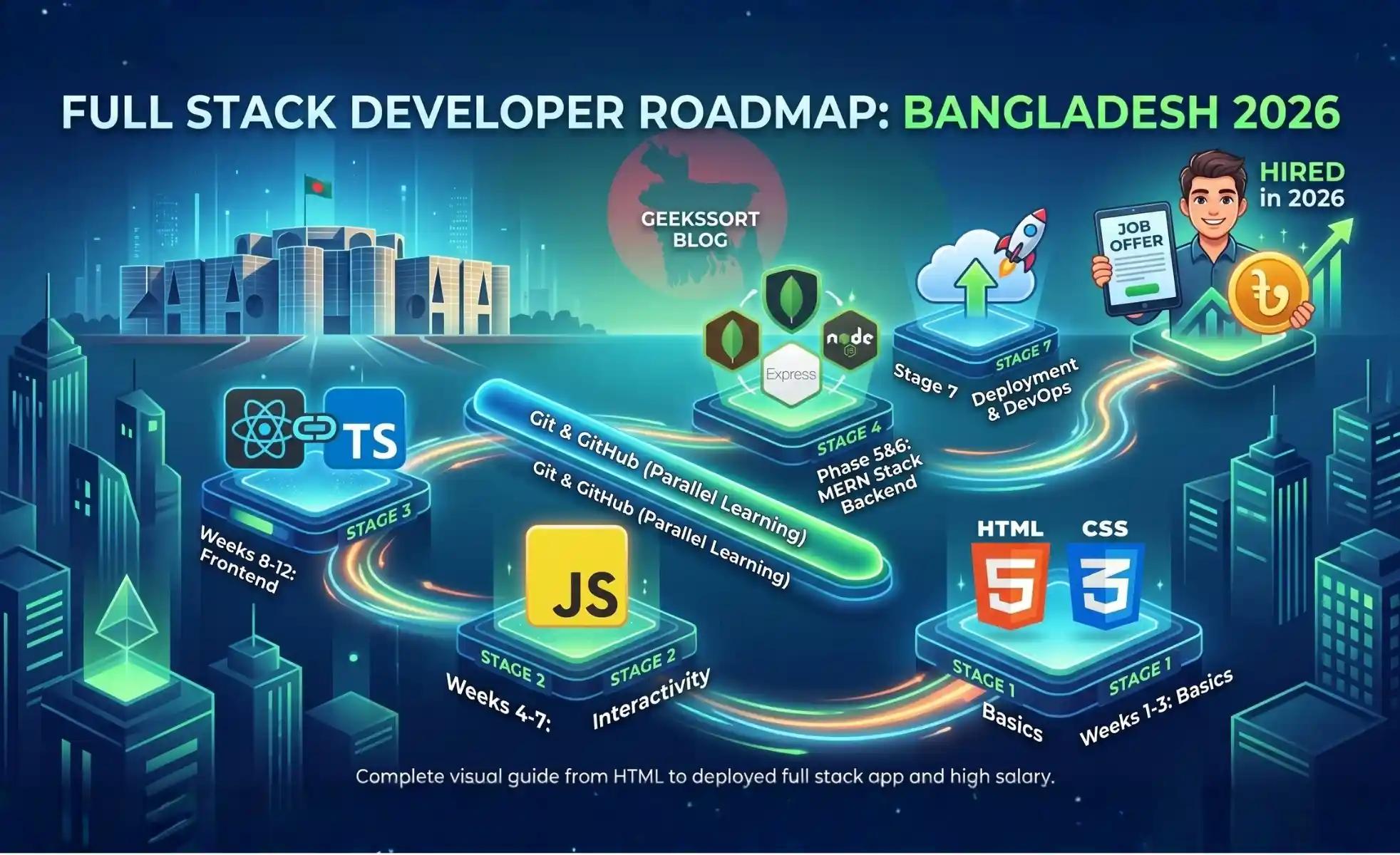
The 8-Phase Roadmap at a Glance
Here is the complete roadmap from zero to hired:
Phase
Skills
Timeline
HTML & CSS Basics
HTML structure, CSS styling, Flexbox, Grid, responsive design
Vercel, Railway, Docker basics, CI/CD with GitHub Actions
Weeks 20–24
AI Tools + Portfolio
Use Copilot/Cursor, build 3-4 projects, apply for jobs
Weeks 24–36
Important: You do not have to finish one phase completely before starting the next. For example, start using Git from Week 4 — not after you finish JavaScript. Parallel learning saves time.
Phase 1: HTML and CSS — Weeks 1 to 3
Every web developer starts here. HTML creates the structure of a page. CSS makes it look good.
In these three weeks, focus on building real pages — not just reading theory. For example, build a simple personal profile page. Additionally, learn responsive design so your pages look good on mobile. This matters greatly in Bangladesh, where over 85% of users browse on phones.
Your milestone:
Build a personal portfolio page using only HTML and CSS. Make it mobile-friendly and push it to GitHub.
Phase 2: JavaScript — Weeks 4 to 7
JavaScript makes websites interactive. It is the most important skill on this entire roadmap.
However, many beginners rush this phase. That is a mistake. Strong JavaScript fundamentals will make everything else easier. For example, React, Node.js, and TypeScript all build on core JavaScript concepts.
Focus on: variables, functions, arrays, objects, DOM manipulation, fetch API, and async/await. Furthermore, practice solving small problems daily on platforms like HackerRank or LeetCode.
Your milestone:
Build a weather app that fetches data from a free public API and displays it. Deploy it on GitHub Pages.
Phase 3: TypeScript and React — Weeks 8 to 12
React is the most popular frontend framework in 2026. Most job listings for frontend or full stack roles require it. Additionally, TypeScript is now expected at most product companies.
Learn TypeScript basics first — it takes about 1 week if you already know JavaScript. After that, move to React. Focus on components, props, useState, useEffect, React Router, and Context API.
Your milestone:
Build a multi-page web app — for example, a movie search tool using a public API. Use React and TypeScript together.
Phase 4: Git and GitHub — Start Week 4
Git is not optional. Every professional developer uses it. Furthermore, recruiters in Bangladesh and abroad check your GitHub profile before offering an interview.
Start using Git from Week 4 — as soon as you begin JavaScript. Consequently, by the time you apply for jobs, you will have months of commit history showing real work.
• Build your GitHub profile — add a clear README to every project
• Aim for at least 3-4 public repositories before applying for jobs
Phase 5: Backend with Node.js and Express — Weeks 13 to 17
The backend handles your app’s logic, user authentication, and database connections. Node.js with Express is the most popular choice for JavaScript developers.
In this phase, learn to build REST APIs. Additionally, learn how to handle authentication using JWT (JSON Web Tokens). You should also cover middleware, error handling, and environment variables.
Your milestone:
Build a full REST API for a todo application — with user registration, login, and protected routes.
Phase 6: Databases — Weeks 16 to 20
Every real application needs a database. Two options dominate for full stack developers:
• MongoDB — a document database. Great for flexible data structures. Works naturally with Node.js.
• PostgreSQL — a relational database. More structured. Better for complex data relationships.
Start with MongoDB if you chose the MERN stack. However, learn at least the basics of SQL — because many Bangladeshi IT company jobs require it.
The MERN stack (MongoDB + Express + React + Node.js) is the most recommended starting combination for Bangladeshi developers. It uses JavaScript across the entire app. As a result, you only need to master one language to build full applications.
Phase 7: Deployment and DevOps — Weeks 20 to 24
Building an app is only half the job. Deploying it so others can use it is the other half — and most tutorials skip this part entirely.
Fortunately, deployment in 2026 is much simpler than it used to be. Start with these tools:
• Vercel — free hosting for React frontends. Deploy in 2 minutes by connecting GitHub.
• Railway or Render — free backend hosting for Node.js and Express apps.
• Docker basics — understand containerization. More Bangladeshi companies now require this.
• GitHub Actions — set up CI/CD so your app auto-deploys every time you push code.
Your milestone:
Deploy a full stack app with a live URL. Frontend on Vercel, backend on Railway, database on MongoDB Atlas.
Phase 8: Portfolio and Job Applications — Weeks 24 to 36
Courses and certifications do not get you hired. Projects do. Therefore, your final phase is building a strong portfolio.
Aim for 3-4 complete projects. Each project should have a live URL, a clean GitHub repo, and a README explaining what it does and the tech stack used.
Strong portfolio project ideas for Bangladeshi developers:
Here is what full stack developers earn in Bangladesh in 2026:
Level
Monthly Salary (BDT)
Upwork Rate (USD/hr)
Experience
Junior
৳25,000–৳45,000
$10–$20/hr
0–1 year
Mid-Level
৳50,000–৳90,000
$20–$40/hr
1–3 years
Senior
৳1,00,000–৳1,80,000
$40–$80/hr
3–5+ years
Freelance (Remote)
$800–$3,000/month
$20–$60/hr
Portfolio-based
These figures are based on current Dhaka IT company job listings and Upwork profiles from Bangladeshi developers. Senior developers working remotely for US or European companies earn significantly more in USD.
AI Tools Every BD Developer Should Use in 2026
AI coding tools have changed how developers work. In 2026, knowing how to use them is no longer optional — it is expected.
• GitHub Copilot — autocompletes code as you type. Available for students for free.
• Cursor AI — an AI-powered code editor. Extremely popular among Bangladeshi developers right now.
• ChatGPT or Claude — use for debugging, explaining error messages, and writing documentation.
However, do not rely on AI to write your code entirely. Instead, use it to accelerate work you already understand. Employers can tell the difference.
Common Mistakes Bangladeshi Developers Make
• Switching languages too often — pick one stack and stick with it for 6+ months
• Watching tutorials without building — watching is not learning. Build after every lesson.
• Not using Git from day one — start Git in Week 4, not after you finish the roadmap
• Skipping deployment — a project without a live URL does not impress employers
• Building too many small projects — fewer, bigger, complete projects beat 20 tiny demos
Frequently Asked Questions
Q: How long does it take to become a full stack developer in Bangladesh?
With 2-4 hours of daily practice, most beginners are job-ready in 6-9 months. Full-time learners studying 6-8 hours per day can reach a hireable standard in 4-6 months. The key variable is building real projects consistently — not just watching tutorials.
Q: What is the salary of a full stack developer in Bangladesh in 2026?
Junior full stack developers in Dhaka earn ৳25,000–৳45,000 per month. Mid-level developers earn ৳50,000–৳90,000. Senior developers earn ৳1,00,000 or more. Freelancers on international platforms earn $20–$60 per hour depending on experience and portfolio quality.
Q: Do I need a CS degree to become a full stack developer in Bangladesh?
No. Most software agencies and startups in Dhaka hire based on your portfolio and practical skills. A strong GitHub profile with 3-4 completed projects carries more weight than a degree in most cases. However, a CS degree still helps at some corporate IT departments.
Q: What stack should a Bangladeshi developer learn first?
The MERN stack (MongoDB, Express, React, Node.js) is the most recommended starting point. It uses JavaScript across the full stack, has the largest global community, and covers most job requirements in both local Dhaka companies and international freelancing platforms.
Conclusion
Becoming a full stack developer in Bangladesh is absolutely achievable in 2026. The roadmap is clear. The tools are free. The demand is real.
However, the path requires consistency. Start with HTML and JavaScript. Build projects at every stage. Use Git from day one. Deploy your work so the world can see it.
The developers getting hired right now in Dhaka and on international platforms are not the ones who finished the most courses — they are the ones who built the most things. Your roadmap starts today.
🚀 Ready to Work With Geekssort? Want to build real web projects or start your tech career? Geekssort works with developers and businesses to build production-grade applications.
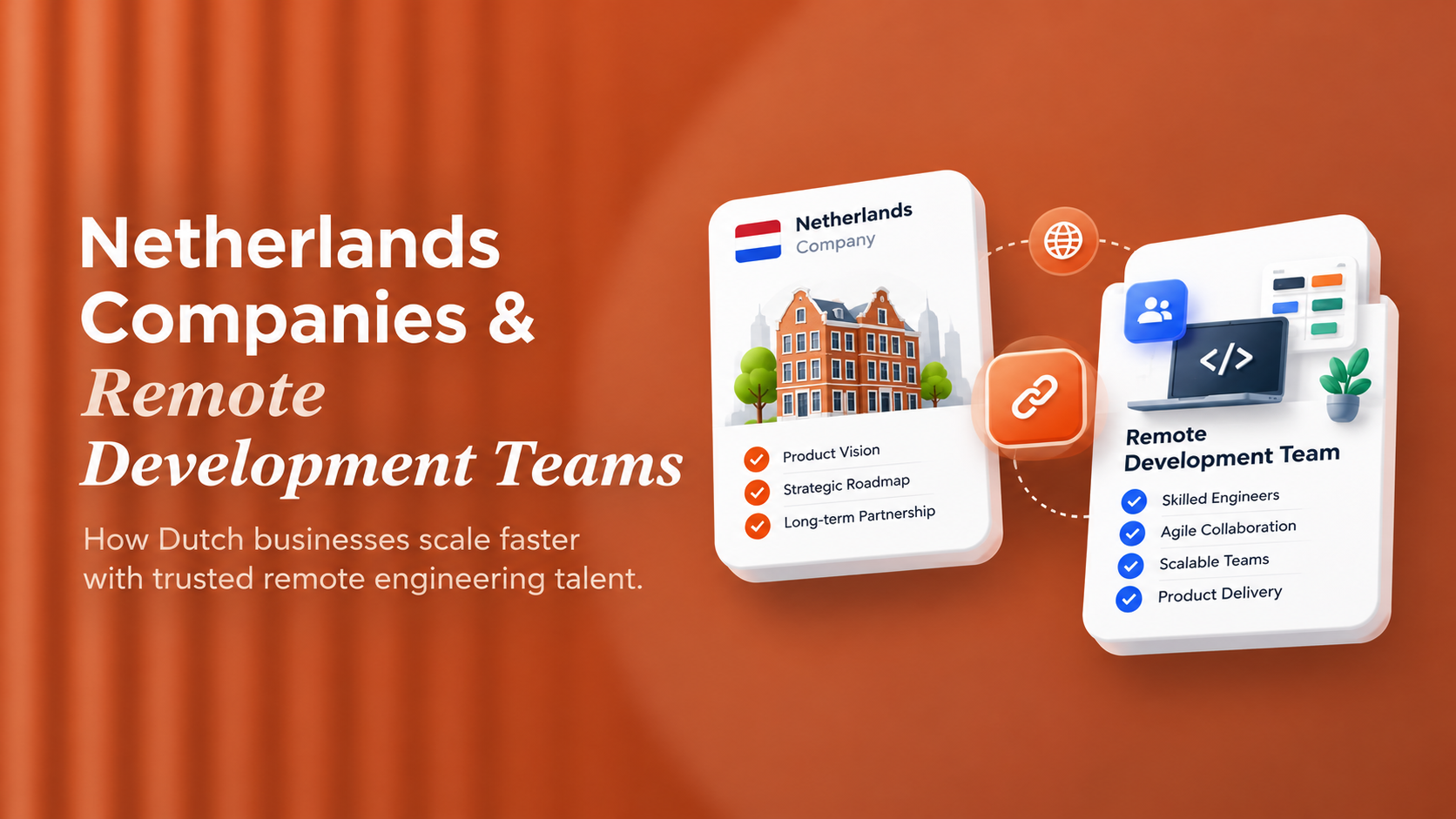
The Netherlands has near-universal English fluency and a persistent shortage of senior engineers in AI, MLOps and cloud infrastructure. Here is why Dutch companies are moving to remote development teams, and what to verify before committing.
HIPAA and GDPR overlap on security controls but diverge on consent, individual rights and breach notification timing. Here is the technical crosswalk, PHI handling architecture, BAA process and AI governance one dual-compliance HealthTech platform needs.
The quote on your desk is not the price of the software. This guide splits the real cost of custom software into CapEx vs OpEx treatment, annual maintenance benchmarks by software type, and a 3-year TCO model to build before a CFO signs off.





 We’re happy to sign an NDA upon request.