A GDPR-ready SaaS product needs four things in place before it processes a single EU user’s data: a documented lawful basis for every data flow, working data subject rights (access, correction, deletion, and portability), a tested 72-hour breach notification plan, and technical safeguards like encryption and tenant isolation built into the architecture itself. Most engineering teams treat GDPR as a legal checkbox: ship a privacy policy, add a cookie banner, call it done. That is exactly the gap regulators are punishing in 2026, because enforcement now focuses on runtime behavior — trackers firing before consent, missing Data Processing Agreements, and delete requests that quietly don’t delete anything.
Why GDPR-Ready SaaS Means More Than a Privacy Policy
Fines under GDPR can reach 20 million euros or 4% of global annual turnover, whichever is higher, and regulators have shown they will use the larger number. But the bigger day-to-day risk for a SaaS company is quieter: enterprise buyers now ask for a Data Processing Agreement, a sub-processor list, and proof of tenant-level data controls before they’ll sign a contract. A product that isn’t a GDPR-ready SaaS build from the ground up loses those deals in procurement, long before legal ever gets involved. Becoming GDPR-ready SaaS from day one is, in practice, a sales enabler as much as a compliance requirement.
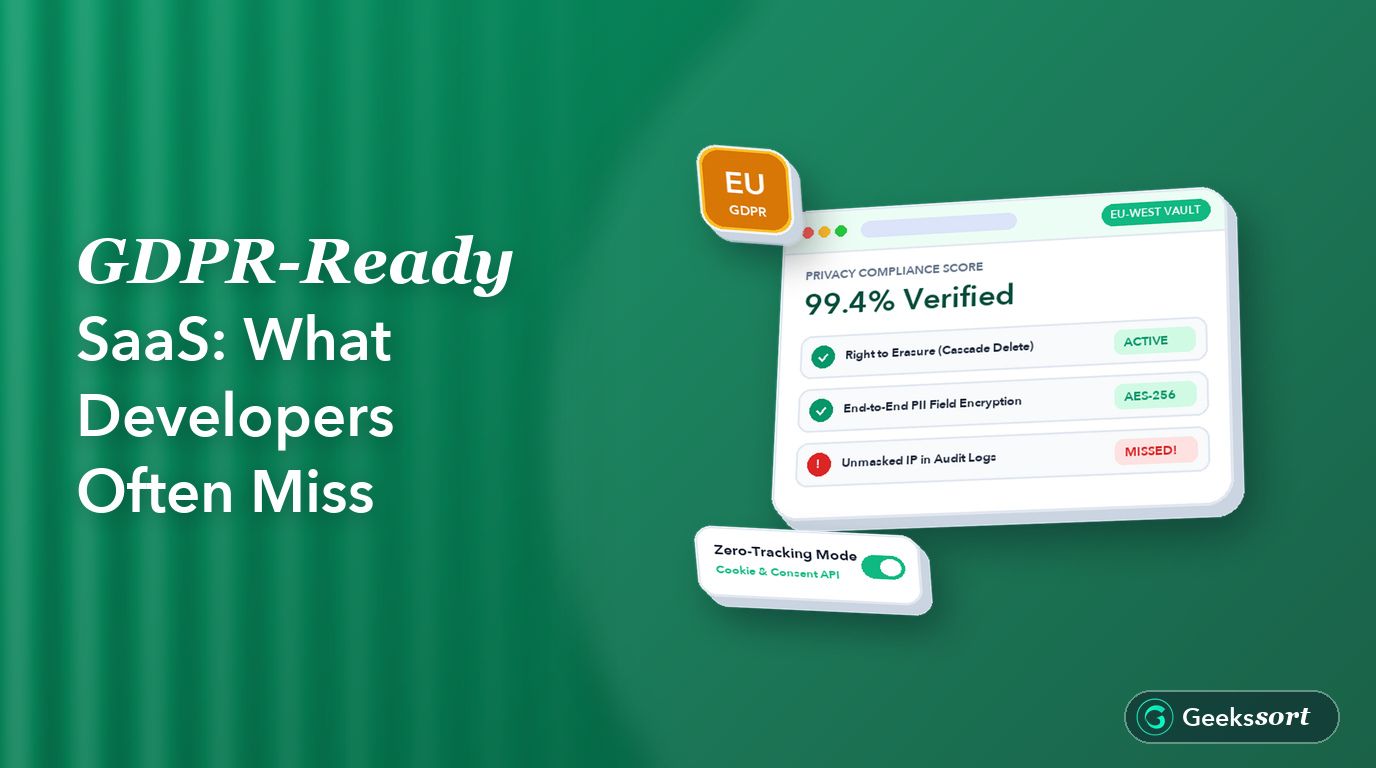
The pattern shows up in almost every audit: the privacy policy is accurate, the cookie banner exists, and the marketing site looks compliant. Then a runtime check reveals analytics scripts firing before a user clicks ‘accept,’ or a support tool storing customer emails with no documented legal basis. Documentation without matching runtime behavior is the single most common way SaaS teams fail an audit.
The Technical Gaps That Keep Showing Up
Across dozens of SaaS audits, five gaps repeat more than any others.
1. Trackers firing before consent
Analytics, session-replay, and ad-pixel scripts often load on page render instead of after explicit consent. Tag managers make this easy to miss because the script is ‘installed correctly’ — it just isn’t gated.
2. No Data Processing Agreement with sub-processors
Every third-party service that touches personal data — email delivery, error monitoring, customer support tooling — needs a signed DPA under Article 28. Teams frequently have this for payment processors and forget it for the smaller tools.
3. Deletion requests that don’t cascade
A user clicks ‘delete my account,’ and the primary record disappears — but their data lingers in backups, analytics warehouses, and third-party CRMs. Article 17 doesn’t carve out an exception for secondary systems.
4. Missing lawful basis mapping
GDPR requires a documented legal basis (consent, contract, legitimate interest, or legal obligation) for every processing activity, not a single blanket justification for the whole product.
5. No breach notification runbook
Article 33 gives you 72 hours to notify the relevant authority after becoming aware of a breach. Most teams have never rehearsed this timeline under pressure.
Data Subject Rights: What Your GDPR-Ready SaaS API Actually Has to Support
GDPR’s data subject rights aren’t abstract legal language — they translate directly into API endpoints and database operations. Access requests mean you need a way to compile every record tied to a user across production, analytics, and support systems within roughly one month. Rectification means a change to a user’s profile has to propagate everywhere that data is duplicated. Erasure means a cascading delete job that actually reaches backups and third-party processors, not just the primary table. Portability means an export in a structured, machine-readable format, not a support ticket that gets handled manually.
For multi-tenant architectures specifically, this gets harder: a deletion or export request has to be scoped precisely to one tenant’s data without leaking or touching another tenant’s records, which is where isolation architecture and compliance obligations start to overlap directly.
Building a Breach Notification Workflow That Survives a Real Incident
A breach response plan that only exists as a document nobody has tested is close to useless at 2am during an actual incident. A workable process needs: a clear internal escalation path with named owners, a pre-drafted notification template for the supervisory authority, a decision tree for when affected users must be notified directly (high risk to their rights and freedoms), and a containment checklist that engineering can execute without waiting on legal sign-off for every step. Run a tabletop exercise at least twice a year — treat it the same way you’d treat a disaster-recovery drill.
A Practical GDPR-Ready SaaS Checklist for Engineering Teams
Turning all of this into something a team can actually execute against, a genuinely GDPR-ready SaaS checklist looks like this: map every data flow and document its lawful basis; sign DPAs with every sub-processor, not just the obvious ones; implement consent gating that blocks trackers until explicit opt-in; build cascading deletion that reaches backups and third-party tools; support data export in a structured format; encrypt data at rest and in transit; enforce tenant-level isolation for multi-tenant products; and rehearse the 72-hour breach notification workflow before you need it for real.
Becoming a GDPR-ready SaaS product isn’t a one-time project you finish before launch and forget — it’s an operating discipline that has to match your actual runtime behavior to your documented policies, checklist item by checklist item. The teams that get burned are rarely the ones with no privacy policy; they’re the ones whose privacy policy describes a product that doesn’t match what’s actually running in production. Start with the lawful-basis mapping and the deletion cascade, since those two gaps cause the most enforcement action, and build the rest of the checklist out from there.
NEED A GDPR-READY SAAS BUILD? GeeksSort helps SaaS teams close the gap between their privacy policy and their production code — from consent architecture to tenant-level data controls.📞+880 1341-869125 🌐 geekssort.com
FREQUENTLY ASKED QUESTIONS
Does GDPR apply to my SaaS if my company isn’t based in the EU?
Yes. GDPR applies based on where your data subjects are located, not where your company is incorporated or where your servers sit. If you offer services to EU residents, monitor their behavior, or process their personal data on behalf of an EU customer, GDPR applies to that processing.
How long do I have to notify authorities after a data breach?
Article 33 requires notification to the relevant supervisory authority within 72 hours of becoming aware of a breach, unless the breach is unlikely to result in a risk to individuals’ rights and freedoms. If there’s a high risk to affected users, you must also notify them directly and without undue delay.
What’s the difference between a data controller and a data processor under GDPR?
A controller decides why and how personal data is processed; a processor handles data on the controller’s behalf under a documented agreement. Most B2B SaaS companies act as processors for their business customers’ end-user data and need a Data Processing Agreement in place with each one.
Do small startups really get audited or fined under GDPR?
Enforcement isn’t limited to large companies. Regulators have issued fines against small businesses over specific violations like missing consent mechanisms or absent DPAs. More commonly for early-stage SaaS, the practical cost is losing enterprise deals in procurement when a prospect’s legal team can’t get comfortable with your compliance posture.






 We’re happy to sign an NDA upon request.