Headless ecommerce separates the customer facing experience from commerce back office systems, allowing teams to release faster, personalize journeys, and optimize every device without replacing the core commerce engine.
Headless ecommerce separates the customer facing experience from commerce back office systems, allowing teams to release faster, personalize journeys, and optimize every device without replacing the core commerce engine.
The architecture is most valuable when conversion, content velocity, internationalization, marketplace integration, or omnichannel consistency matters more than a simple templated storefront.
A well-designed headless commerce platform can support web, mobile, marketplaces, kiosks, in-store interfaces, and customer-service tools through reusable APIs. However, it also introduces additional integration, observability, deployment, and ownership requirements.
What Is Headless Ecommerce?
Headless ecommerce uses APIs to connect a commerce engine with independently developed frontends, content systems, search, payments, customer data, promotions, and operational services.
The presentation layer can evolve without rewriting the commerce core, while an orchestration layer coordinates product, pricing, inventory, cart, checkout, content, and customer workflows.
In a traditional commerce architecture, the storefront and commerce engine are often tightly coupled. Templates, product data, checkout logic, promotions, and content are managed within one platform.
In a headless model, the frontend is separated from the commerce engine. The frontend may be built with Next.js, React, Vue, Nuxt, or another framework. It retrieves commerce data through APIs and presents the experience according to the brand’s requirements.
A typical headless platform includes:
Commerce engine.
Storefront frontend.
Headless CMS.
Search and merchandising.
Product information management.
Customer data platform.
Payment service provider.
Tax and shipping services.
Inventory and order-management systems.
API gateway.
Orchestration layer.
Analytics and experimentation.
Identity and customer account services.
This separation allows each system to evolve independently, but it also means the organization must manage the contracts and failure modes between systems.
How Does an API-First Architecture Work?
An API first architecture exposes commerce capabilities through documented, versioned interfaces.
A frontend requests products, prices, availability, promotions, customer context, and checkout operations through APIs rather than depending on server-rendered templates inside the commerce platform.
Core API domains commonly include:
Catalog.
Product information.
Categories.
Search.
Pricing.
Promotions.
Inventory.
Cart.
Checkout.
Orders.
Customer accounts.
Content.
Reviews.
Payments.
Shipping.
Tax.
Recommendations.
The API design should distinguish between read and write operations.
Product browsing may use cached, highly available read models. Checkout requires stronger consistency, idempotency, authorization, and server-side validation.
A versioned API protects the frontend from uncontrolled backend changes.
Use explicit schemas, contract tests, backward-compatibility rules, error standards, pagination, rate limits, and correlation identifiers.
The commerce system should remain authoritative for price and availability. The frontend should not assume that a cached product response is sufficient for final checkout validation.
What Is the Reference Headless Commerce Architecture?
The storefront may use Next.js with server-side rendering, static generation, incremental regeneration, edge delivery, and client-side interaction. A commerce engine manages catalog, cart, promotions, orders, and checkout. A headless CMS manages editorial content.
The orchestration layer provides:
A canonical product model.
Response aggregation.
Backend business rules.
Retry and timeout policies.
Caching.
Authentication and authorization.
Rate limiting.
Vendor abstraction.
Event publication.
Observability.
Error normalization.
The architecture may follow this request flow:
A customer requests a product page.
The frontend resolves the route.
The orchestration layer requests product, pricing, inventory, content, recommendations, and reviews.
The orchestration layer applies business rules and cache policies.
The frontend renders the page.
Analytics records page and product interactions.
The customer adds an item to the cart.
The server validates product, price, and availability.
The cart service updates the cart using an idempotency key.
Checkout revalidates price, promotions, inventory, tax, shipping, and payment state.
The goal is not to make every page call every backend directly. Direct frontend-to-vendor integrations create duplicated business logic, inconsistent authentication, difficult testing, and excessive coupling.
Why Is an API Orchestration Layer Important?
An orchestration layer reduces frontend complexity, centralizes business composition, protects backend systems from uncontrolled traffic, and prevents every channel from implementing inconsistent rules.
It also creates an abstraction boundary that allows teams to change commerce, search, CMS, payment, or personalization vendors without rebuilding every customer experience.
The orchestration layer can aggregate product and inventory responses, normalize schemas, calculate availability, apply promotion rules, coordinate checkout calls, cache safe reads, enforce rate limits, handle retries, publish events, and record correlation identifiers.
It should not become an undocumented monolith. Keep domain boundaries explicit, version APIs, and test contract behavior.
Example orchestration response
Instead of asking the frontend to call six services, the orchestration layer can provide:
The frontend receives a stable experience model while backend systems can evolve independently.
Orchestration controls
Important controls include:
Timeouts.
Circuit breakers.
Retries with backoff.
Fallback responses.
Cache policies.
Request deduplication.
Rate limits.
Idempotency.
Schema validation.
Correlation IDs.
Vendor health checks.
Structured error handling.
For example, a recommendation service may fail without blocking the product page. A payment service failure, by contrast, should block checkout and provide a clear recovery path.
Which Frontend Options Are Available?
Next.js is a strong option for content-rich commerce because it supports server rendering, static generation, incremental regeneration, routing, image optimization, and edge deployment. React, Vue, Nuxt, mobile-native clients, progressive web applications, and in-store interfaces are also viable.
The selection should follow:
Team capability.
SEO requirements.
Performance targets.
Content architecture.
Personalization needs.
Internationalization.
Deployment model.
Experimentation strategy.
Mobile and omnichannel requirements.
Next.js
Next.js supports several rendering approaches:
Static generation for stable pages.
Incremental regeneration for product and content updates.
Server-side rendering for dynamic pages.
Client-side interaction for cart, account, and filtering.
Edge execution for low-latency delivery.
API route or server-action patterns where appropriate.
Product listing pages may use cached server rendering, while checkout should use dynamic and authenticated requests.
Progressive web applications
PWAs can support app-like functionality, offline patterns, push notifications, and device-aware experiences. They require careful treatment of cached customer data, authentication expiration, and payment interactions.
Mobile and in-store channels
A headless commerce API can support native mobile apps, kiosks, sales-associate tools, and customer-service portals. The shared API model improves consistency, but each channel may require different latency, authentication, and interaction patterns.
How Should CMS Integrations Be Designed?
The CMS should own editorial content, landing pages, campaign modules, structured content, localization, and publishing workflow, while the commerce engine remains authoritative for price, stock, cart, order, and checkout data.
Webhooks or event-driven revalidation keep content and commerce experiences synchronized.
A structured content model may include:
Product storytelling.
Buying guides.
Campaign pages.
Brand content.
Editorial modules.
SEO metadata.
Localized copy.
Media assets.
Merchandising slots.
Promotional banners.
The CMS should not be treated as the source of truth for live inventory or transactional pricing. Product descriptions can be managed editorially, but price and availability must come from systems that enforce current business rules.
Preview workflows
A headless CMS should support:
Draft preview.
Scheduled publishing.
Localization review.
Approval workflows.
Version history.
Rollback.
Webhook-triggered revalidation.
Content validation.
Permission management.
A preview environment should display draft content alongside realistic commerce data without exposing real customer information.
Event-driven synchronization
CMS events can trigger:
Cache invalidation.
Static page regeneration.
Search reindexing.
Sitemap updates.
Analytics metadata updates.
Personalization refresh.
The event should be idempotent so that repeated webhook delivery does not create duplicate processing.
How Does Headless Improve Conversion Potential?
Headless architecture may help to achieve better conversion rates due to its ability to provide fast pages, seamless experience, testing, personalization, and channel-specific experience, but that does not mean that there will be an increase in conversions.
The effectiveness of performance and experience improvements needs to be evaluated through experiments conducted for page speed, add to cart rate, checkout rate, and revenue per visit.
Track the following metrics:
Metric
What it indicates
Core Web Vitals
Technical experience and responsiveness
Product-detail engagement
Product content effectiveness
Search success rate
Findability and relevance
Add-to-cart rate
Product and merchandising performance
Cart abandonment
Friction before checkout
Checkout completion
Transaction usability
Payment failure rate
Payment reliability
Repeat purchase
Retention and customer value
Revenue per visitor
Overall commercial outcome
Customer-service contacts
Clarity and operational friction
A two-second improvement in perceived responsiveness may be valuable, but the commercial result depends on assortment, pricing, trust, delivery promises, payment usability, and customer intent.
Use A/B testing rather than attributing every gain to architecture. Compare page templates, content modules, checkout steps, search behavior, recommendations, and promotional treatments.
Performance engineering
Performance improvements may include:
Static generation for stable content.
Edge caching.
Image optimization.
Responsive images.
Font optimization.
Code splitting.
Streaming rendering.
Prefetching.
API response caching.
Search index optimization.
Reduced JavaScript execution.
Third-party script governance.
The platform should measure real-user performance rather than relying only on synthetic tests. Test across mobile devices, geographic regions, network conditions, and authenticated experiences.
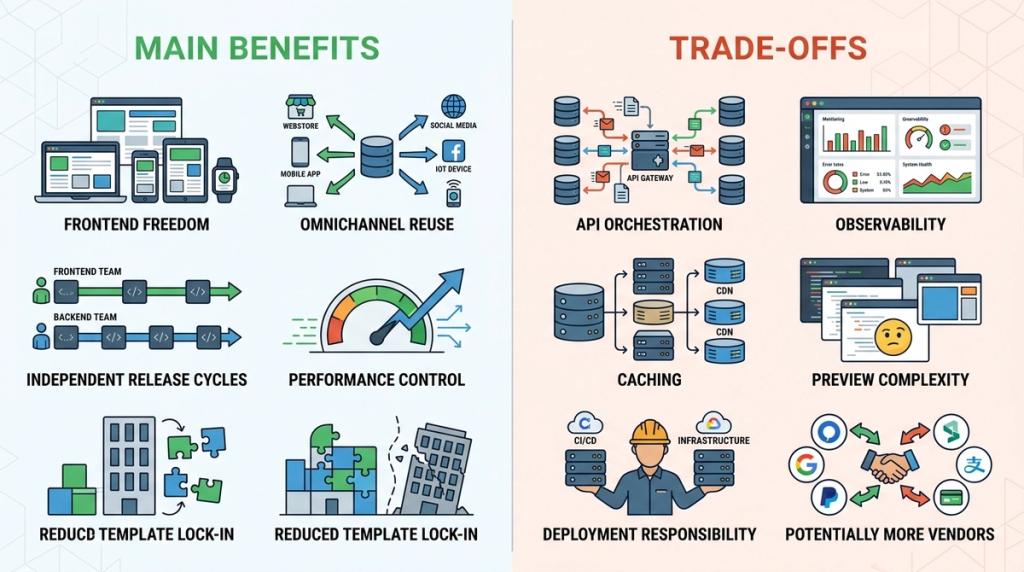
It also introduces API orchestration, observability, caching, preview complexity, deployment responsibility, and potentially more vendors.
Dimension
Headless impact
Required control
Experience
High design and interaction freedom
Design system and UX governance
Performance
Strong potential for optimized delivery
Real-user monitoring and caching discipline
Content
Flexible editorial composition
Preview and publishing integration
Omnichannel
Reusable APIs across channels
Canonical models and contract testing
Operations
Independent deployments
Distributed tracing and incident ownership
Cost
More engineering and integration effort
TCO and vendor governance
SEO
Strong control over rendering and metadata
Technical SEO standards and testing
The architecture is not automatically better than a traditional platform. A small organization with a simple catalog and standard storefront may achieve better economics through a well-configured commerce platform.
Headless is most compelling when the organization needs:
A differentiated customer experience.
Multiple sales channels.
Frequent experimentation.
Complex content and commerce relationships.
Internationalization.
Marketplace and third-party integration.
Advanced personalization.
High control over performance.
Flexible migration away from a commerce vendor.
How Should Search, Inventory, and Pricing Be Integrated?
Search should use an indexed read model rather than querying the transactional commerce database for every keystroke.
Inventory should distinguish available-to-sell, reserved, and in-transit quantities. Pricing and promotions should remain authoritative in a controlled service, with clear caching rules and final server-side validation before order submission.
Search
Search should support:
Full-text search.
Typo tolerance.
Synonyms.
Facets.
Category filtering.
Availability filtering.
Merchandising rules.
Personalized ranking.
Regional inventory.
Search analytics.
Search indexes should be updated through events or scheduled synchronization. A failed indexing job should be visible and recoverable.
Inventory
Inventory states may include:
On hand.
Available to sell.
Reserved.
Allocated.
In transit.
Backordered.
Unavailable.
The storefront can display a cached availability status, but the checkout service must revalidate availability before creating an order.
Pricing
Pricing may depend on:
Customer segment.
Region.
Currency.
Tax jurisdiction.
Quantity.
Contract.
Promotion.
Subscription status.
Channel.
Time period.
Pricing logic should be centralized rather than implemented separately in each frontend.
How Should Checkout and Payments Be Protected?
Checkout should be treated as a stateful, failure-sensitive workflow.
Use idempotency keys, server-side price and inventory validation, tokenized payment data, webhook signature verification, fraud controls, structured error handling, and audit logs.
Do not trust cart totals, product availability, discount values, or shipping calculations received from the browser.
A secure checkout flow includes:
Validate the authenticated customer.
Retrieve the authoritative cart.
Recalculate prices and promotions.
Validate inventory.
Calculate shipping and tax.
Create an idempotent payment request.
Confirm payment status.
Create the order.
Reserve or decrement inventory.
Publish order events.
Send confirmation.
Reconcile asynchronous payment webhooks.
Payment webhooks may arrive more than once or out of sequence. Process them idempotently, verify signatures, and maintain a clear payment state machine.
Example payment states include:
Created.
Pending.
Authorized.
Captured.
Failed.
Refunded.
Partially refunded.
Disputed.
What Security and Compliance Controls Are Required?
Use least-privilege service accounts, secret management, TLS, dependency scanning, WAF protection, rate limits, content security policies, secure cookies, signed webhooks, audit trails, and centralized monitoring.
PCI scope can be reduced through hosted payment fields or tokenization, but the merchant remains responsible for appropriate security controls and provider oversight.
SOC 2 and ISO 27001-aligned practices can help demonstrate operational governance. Relevant controls include:
Privileged-access reviews.
Secure software development.
Vulnerability management.
Incident response.
Change management.
Vendor risk assessment.
Backup testing.
Logging and monitoring.
Security training.
Business continuity.
Customer accounts should use secure authentication, MFA where appropriate, secure cookies, session expiration, account-recovery controls, and protection against credential stuffing.
How Should the Platform Be Delivered?
Separate storefront, orchestration, commerce configuration, CMS, search, and infrastructure deployment pipelines.
Use contract tests for vendor APIs, preview environments for content, feature flags for releases, synthetic checkout tests, and rollback procedures.
Define ownership for incidents that cross multiple vendors. Distributed systems often fail at integration boundaries rather than inside isolated components.
A delivery pipeline may include:
Pull-request checks.
Unit and integration tests.
API contract tests.
Dependency scanning.
Infrastructure validation.
Preview deployment.
Accessibility testing.
Synthetic product and checkout tests.
Performance testing.
Security review.
Canary or staged deployment.
Post-release monitoring.
The team should maintain runbooks for:
Commerce API failure.
Payment-provider outage.
Inventory synchronization failure.
Search-index delay.
CMS webhook failure.
CDN or edge outage.
Order duplication.
Tax-service failure.
Shipping-service failure.
Data inconsistency.
What Is a Practical Implementation Roadmap?
Begin with customer journeys, KPIs, product and content domains, integration inventory, and non-functional requirements.
Establish the canonical model and orchestration boundary. Deliver search, product detail, cart, and checkout vertically. Add CMS composition, personalization, internationalization, subscriptions, marketplaces, and in-store capabilities only after instrumentation and operational reliability are established.
Phase 1: Discovery and architecture
Define:
Business objectives.
Customer segments.
Current platform limitations.
Catalog complexity.
Product data ownership.
Content workflows.
Checkout requirements.
Payment and tax providers.
Inventory sources.
Shipping logic.
Regional requirements.
Compliance obligations.
Performance targets.
Phase 2: Foundation
Build:
Identity.
Design system.
API gateway.
Orchestration service.
Canonical product model.
Observability.
CI/CD.
Environment strategy.
Commerce integration.
CMS integration.
Phase 3: Core commerce journey
Deliver:
Category pages.
Search.
Product detail.
Product variants.
Cart.
Checkout.
Customer account.
Order confirmation.
Analytics events.
Phase 4: Optimization
Add:
Personalization.
Recommendations.
Merchandising.
A/B testing.
Internationalization.
Subscriptions.
Loyalty.
Marketplaces.
Mobile applications.
In-store capabilities.
Phase 5: Scale and governance
Establish:
API lifecycle governance.
Vendor reviews.
Performance budgets.
Security audits.
Disaster recovery tests.
Data-quality monitoring.
Cost optimization.
Platform documentation.
Engineering ownership.
Conclusion and Next Steps
Headless ecommerce is an operating architecture for faster experience innovation, not simply a way to replace templates.
Success requires API contracts, orchestration discipline, performance measurement, secure checkout, content governance, and ownership across vendor boundaries.
Geekssort builds Next.js headless commerce, custom integrations, SaaS platforms, and dedicated engineering teams for global commerce organizations.
Request a commerce architecture assessment covering channels, APIs, TCO, performance targets, security controls, and migration sequencing.
Frequently Asked Questions
Is headless ecommerce suitable for every business?
No. It is most valuable when experience differentiation, omnichannel delivery, content velocity, or integration complexity justifies the additional engineering and operating model.
Does headless automatically improve conversion rates?
No. It creates more control over performance and customer journeys; conversion gains must be demonstrated through analytics and controlled experiments.
Why use Next.js for headless commerce?
Next.js supports multiple rendering strategies, strong routing, performance optimization, and a large React ecosystem, making it suitable for content-rich, SEO-sensitive storefronts.
What is the role of an orchestration layer?
It combines backend capabilities, normalizes vendor APIs, applies business rules, manages caching and retries, and gives channels a stable integration boundary.
How long does a headless migration take?
A focused storefront can take several months. Enterprise migrations commonly require 6–18 months, depending on catalog complexity, integrations, regions, checkout, data migration, and operational constraints.
Build versus buy is no longer a question about software; it is a question about where a company intends to compete. Off-the-shelf platforms promise speed and usually deliver it, with many configured and live within weeks. Yet SaaS management vendors such as Zylo and Productiv have repeatedly reported that organizations leave roughly half of their…
Usage-based pricing aligns cost with value but makes revenue hard to forecast. Where it fits, why a hybrid base fee plus overages usually wins, and how to pick a metering unit.
As your SaaS business grows, billing complexity grows with it. Learn how scalable billing systems handle subscriptions, prorations, failed payments, and usage-based pricing while protecting revenue and customer trust.





 ChatGPT
 Claude
 Perplexity
 Gemini
 Grok
Grok



 We’re happy to sign an NDA upon request.