The FCA's statutory deadline for a complete new firm authorisation is now four months, down from six. Here is what a UK fintech development partner must get right across compliance, Open Banking, data residency and secure coding.
In May 2026, HM Treasury confirmed reforms cutting the FCA's statutory deadline for a complete new firm authorisation from six months to four — targets the FCA has measured against since January 2026 — and the cost of remediating a fintech product built without regulatory considerations baked into its architecture consistently runs three to ten times higher than the cost of building it correctly from the start. For a UK fintech leader selecting a software development partner, these two facts together define the actual stakes of the decision: a compressed regulatory timeline rewards a partner who understands FCA expectations from day one, while the remediation cost multiplier makes a partner's fintech-specific architectural judgment — not just its general engineering competence — the single highest-leverage factor in the selection process. This guide covers what UK fintech leaders should require from a development partner across FCA compliance, Open Banking API architecture, data sovereignty, and secure coding discipline.
Why Does FCA Compliance Need to Shape Architecture From Day One?
Regulatory compliance in UK fintech is an architectural requirement that determines system design decisions before a single feature is built, not a checklist applied after development — and a development partner without direct FCA-regulated project experience will systematically underestimate this, treating compliance as documentation to add later rather than a constraint that shapes the technology stack itself.
The practical test of whether a prospective development partner genuinely understands this is straightforward: a partner with real fintech experience will ask about a company's regulatory status and permissions in its first substantive conversation, and will have informed, specific views on how that status affects architecture decisions — data residency, audit logging granularity, transaction reversibility design — before any code is written. A partner that treats this as a downstream legal question separate from engineering has not built for a regulated environment before, regardless of what its general portfolio suggests. Fintech-specific delivery experience does not transfer cleanly from general web or SaaS development, and a partner's ability to name specific past FCA-regulated clients whose compliance sign-off it navigated successfully is a far more reliable signal than a generic claim of 'fintech experience' on a sales page.
The current UK regulatory environment also demands a partner who tracks change actively rather than working from a static compliance checklist. The FCA has been explicit that it intends to become a highly data-driven regulator, and 2026 alone has brought a new cryptoasset authorisation regime with an application window opening in September, alongside the FCA's continued focus on operational resilience and the Consumer Duty framework's ongoing enforcement. A development partner whose compliance awareness reflects 2023 or 2024 regulatory guidance rather than the current framework introduces real risk into a product's launch timeline, since a compliance review — which should be conducted by a qualified compliance consultant, not the development team itself, but which the development team's architecture must support — will surface gaps that require costly rework if the underlying system wasn't designed with current requirements in mind.
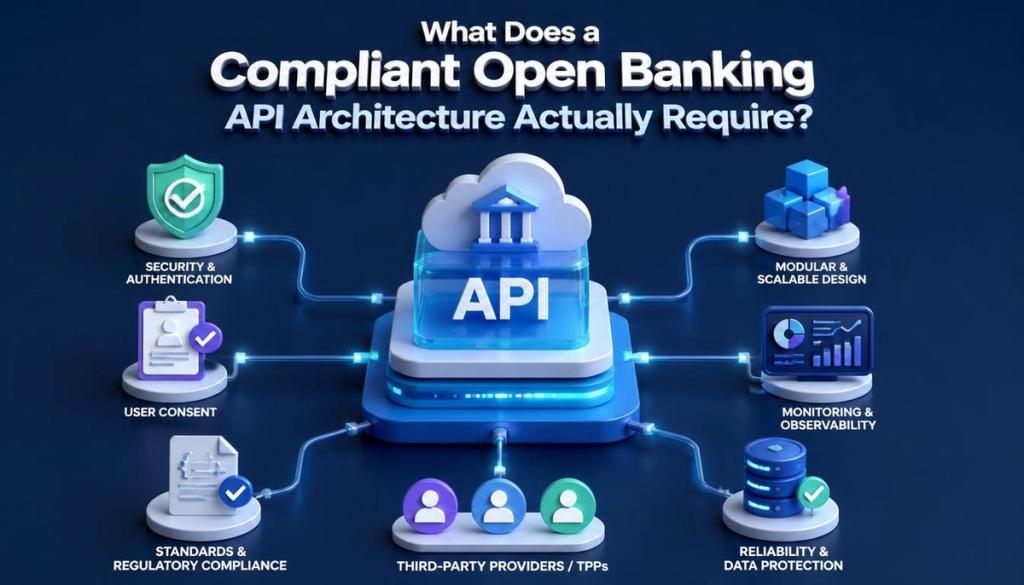
What Does a Compliant Open Banking API Architecture Actually Require?
A PSD2 and UK Open Banking-compliant API architecture requires strong customer authentication with genuine multi-factor design, OAuth 2.0-based consent flows aligned to the Financial-grade API security profile, and a security perimeter built on mutual TLS and certificate validation — treating the API as a first-class external product, not internal plumbing bolted onto an existing system.
Architecture Layer
Requirement
Strong Customer Authentication (SCA)
Two of three factors — knowledge, possession, inherence — with dynamic linking that ties each authentication token to a specific payment amount and payee, not a generic session-level authentication
Consent and authorization
OAuth 2.0 and OIDC-based flows aligned to FAPI 2.0, the OpenID Foundation's Financial-grade API profile, using Pushed Authorization Requests and PKCE for every client, not just public clients
Token security
Sender-constrained tokens via mutual TLS or DPoP, preventing a stolen bearer token from being replayed by an attacker without also possessing the legitimate client's private key
Perimeter security
An API gateway handling mTLS termination, token validation, rate limiting, and schema enforcement in front of dedicated microservices — not a single monolithic service handling both perimeter and business logic
Third-party provider (TPP) verification
eIDAS-qualified certificates for TPP identification, with regulatory authorization status actively tracked and re-verified on an ongoing basis, not confirmed once at initial integration
A specific architectural nuance UK fintech leaders should confirm their development partner understands is the regulatory asymmetry built into the Open Banking framework: once a TPP receives regulatory authorization, a bank or account-holding institution must grant API access, and cannot make that access contingent on independently testing the TPP's own security posture. This has a direct architectural implication — a bank-side or account-servicing platform's own API security cannot depend on assumptions about a connecting TPP's security maturity, since a thinly capitalized TPP may have identical data access rights to a large, well-resourced institution without a comparable security budget. Continuous monitoring of TPP behavior at the gateway level, rather than one-time integration testing, is the practical mitigation, and a development partner should be able to describe this pattern specifically rather than treating TPP integration as a one-time technical exercise.
Forward-looking architecture should also account for PSD3, expected to formalize during 2026, which is set to mandate permission dashboards giving consumers ongoing visibility into which TPPs hold access to their data, eliminate remaining screen-scraping fallbacks entirely, and require payee verification for credit transfers. A development partner building an Open Banking integration today without designing for these near-term requirements is building a system that will need meaningful rework within the product's first year or two of production use.
What Data Sovereignty Requirements Apply to UK Fintech Platforms?
UK fintech platforms handling customer financial data must satisfy both UK GDPR's data protection requirements and, increasingly, explicit data residency expectations from institutional customers and regulators, meaning a development partner's proposed hosting and data architecture needs to specify exactly where data is stored and processed, not merely reference generic cloud infrastructure.
The UK's departure from the EU has created a genuinely distinct compliance landscape from EU-based fintech development, even though UK GDPR and EU GDPR remain closely aligned in substance. A development partner should be able to speak specifically to how the platform's architecture handles cross-border data transfer if any component of the infrastructure — a cloud region, a subprocessor, an analytics tool — sits outside the UK, since the UK's International Data Transfer Agreement and adequacy arrangements with specific jurisdictions operate as a genuinely separate legal mechanism from the EU's own Standard Contractual Clauses framework, requiring its own compliance review rather than an assumption that EU GDPR compliance automatically satisfies UK requirements.
For fintech specifically, data sovereignty expectations frequently extend beyond the regulatory minimum due to institutional customer requirements. A UK fintech platform selling into banking or insurance institutional clients should expect those clients' own security and vendor risk teams to require explicit confirmation of data residency — UK-only hosting, in many cases — as a condition of the commercial relationship, independent of what UK GDPR itself strictly mandates. A development partner unprepared to architect for UK-only data residency as a configurable requirement, rather than a fixed global cloud deployment, will struggle to support this class of institutional sales conversation once it arises.
What Secure Coding Practices Should Be Non-Negotiable for a Fintech Build?
A UK fintech development partner should apply secure coding discipline equivalent to the SSDLC practices covered elsewhere in this series — but with fintech-specific additions around transaction integrity, audit logging granularity, and encryption of financial data both at rest and in transit — treated as launch-blocking requirements rather than a post-launch hardening pass.
Practice
Fintech-Specific Requirement
Audit logging
Every transaction-affecting action logged with sufficient granularity to reconstruct exactly what happened, when, and under whose authorization — a requirement that goes beyond typical application logging and should be designed as a first-class system component
Transaction integrity
Idempotency keys on every payment-initiating API call, preventing duplicate transaction execution from a network retry or a client-side double-submission
Encryption of financial data
Field-level encryption for the most sensitive data elements (account numbers, payment credentials), not only transport-level TLS, so that a database-layer compromise does not expose raw financial data
Reconciliation processes
Automated, scheduled reconciliation between the platform's internal ledger and any connected payment rail or banking partner's records, surfacing discrepancies before they compound
Independent security testing
Regular, qualified penetration testing specifically covering payment flows and authentication — not a generic web application security scan — given the significantly higher consequence of a vulnerability in a financial transaction path
This level of secure coding discipline should be verifiable, not merely claimed. A UK fintech leader evaluating a development partner should request evidence of prior penetration test remediation on a comparable financial product, and should treat a partner's willingness to walk through a specific past security finding and its remediation — rather than offering only a generic statement about following best practices — as a meaningful positive signal during vendor selection.
How Should a UK Fintech Structure the Vendor Selection Process Itself?
UK fintech companies should run vendor selection as a structured, comparative evaluation against a defined scorecard covering regulatory experience, Open Banking integration history, and security certification — rather than a single-vendor conversation driven primarily by cost or a referral — given how much the wrong choice can cost in remediation once compliance gaps surface post-launch.
A useful practical filter early in the process is asking a prospective partner to describe, in specific technical terms, how they would architect a single concrete regulatory requirement relevant to the business — SCA dynamic linking for a specific payment flow, for instance, or audit logging design for a lending decision engine. A partner with genuine fintech depth will answer with architectural specificity; a partner without it will answer in generalities about 'following best practices' or will need to defer the question to a compliance specialist they don't have in-house. This single diagnostic question, asked consistently across every vendor being evaluated, tends to separate genuine fintech development experience from adjacent general software development experience more reliably than a portfolio review or reference check alone.
Given the FCA's compressed authorisation timelines discussed earlier, vendor selection speed itself has become a genuine competitive factor. A fintech company that spends three months evaluating development partners before a build even starts has meaningfully compressed its own runway to hit a four-month FCA authorisation window once the product is ready for regulatory review. Structuring vendor evaluation as a time-boxed, parallel comparison — running several qualified candidates through the same scorecard and technical diagnostic simultaneously, rather than serially — is generally the more time-efficient approach for a fintech company operating under real regulatory deadline pressure.
Where Geekssort Fits
Geekssort builds secure, compliant software for fintech clients navigating FCA regulatory requirements, Open Banking integration, and UK data sovereignty expectations, with architecture decisions made with full awareness of how they affect a client's regulatory posture, not as an afterthought discovered during compliance review. For a UK fintech leader evaluating a development partner ahead of a build or a major platform expansion, a technical scoping conversation covering the specific regulatory permissions and Open Banking integrations in scope is the fastest way to confirm genuine fintech-specific readiness before committing to a build. Given the compressed FCA authorisation timelines now in effect, that early confirmation is worth the extra diligence time it takes relative to the cost of discovering a gap after a build is already underway.
Frequently Asked Questions
Does every UK fintech company need FCA authorisation before building its product?
Not necessarily — authorisation requirements depend on the specific regulated activities involved, but any product touching payments, e-money, or consumer credit should have its regulatory status assessed by a qualified compliance consultant before architecture decisions are finalized.
What is Strong Customer Authentication and why does it matter for architecture?
SCA requires two of three authentication factors — knowledge, possession, inherence — with dynamic linking to specific payments, and it must be designed into the authentication architecture from the start rather than layered on afterward.
Can a UK fintech platform host data outside the UK?
It's legally possible with appropriate cross-border transfer mechanisms, but many institutional customers require UK-only data residency as a commercial condition independent of the regulatory minimum, so architecture should support this as a configurable option.
How is UK Open Banking different from EU PSD2 compliance?
The UK's Open Banking Implementation Entity standard is generally considered more prescriptive and standardized than the broader pan-European PSD2 framework, and UK-specific requirements should be verified independently rather than assumed to be identical to EU PSD2 compliance.
What should a fintech company look for in a development partner's past experience?
Specific, verifiable case studies of FCA-regulated products in production with contactable client references — general web development experience or a claim of "fintech experience" without concrete detail is not an adequate substitute.
Why is the cost of fixing compliance issues after launch so much higher than building correctly upfront?
Because compliance requirements shape core architectural decisions — data residency, audit logging, transaction design — that are expensive and disruptive to retrofit into a system already in production, commonly costing three to ten times more than addressing them during initial design.
Europe's engineering talent shortage is concentrated at the senior end, and nearshore rates have risen as demand caught up with supply. Here is how European companies are solving it in 2026 with blended sourcing and the cross-border compliance framework that now applies.
The quote on your desk is not the price of the software. This guide splits the real cost of custom software into CapEx vs OpEx treatment, annual maintenance benchmarks by software type, and a 3-year TCO model to build before a CFO signs off.
Most offshore IP disputes trace back to a contract that never transferred ownership in the first place. Here are the clauses that fix it, the enforcement routes that actually cross borders, and the repository controls that make revocation instant.







 We’re happy to sign an NDA upon request.