


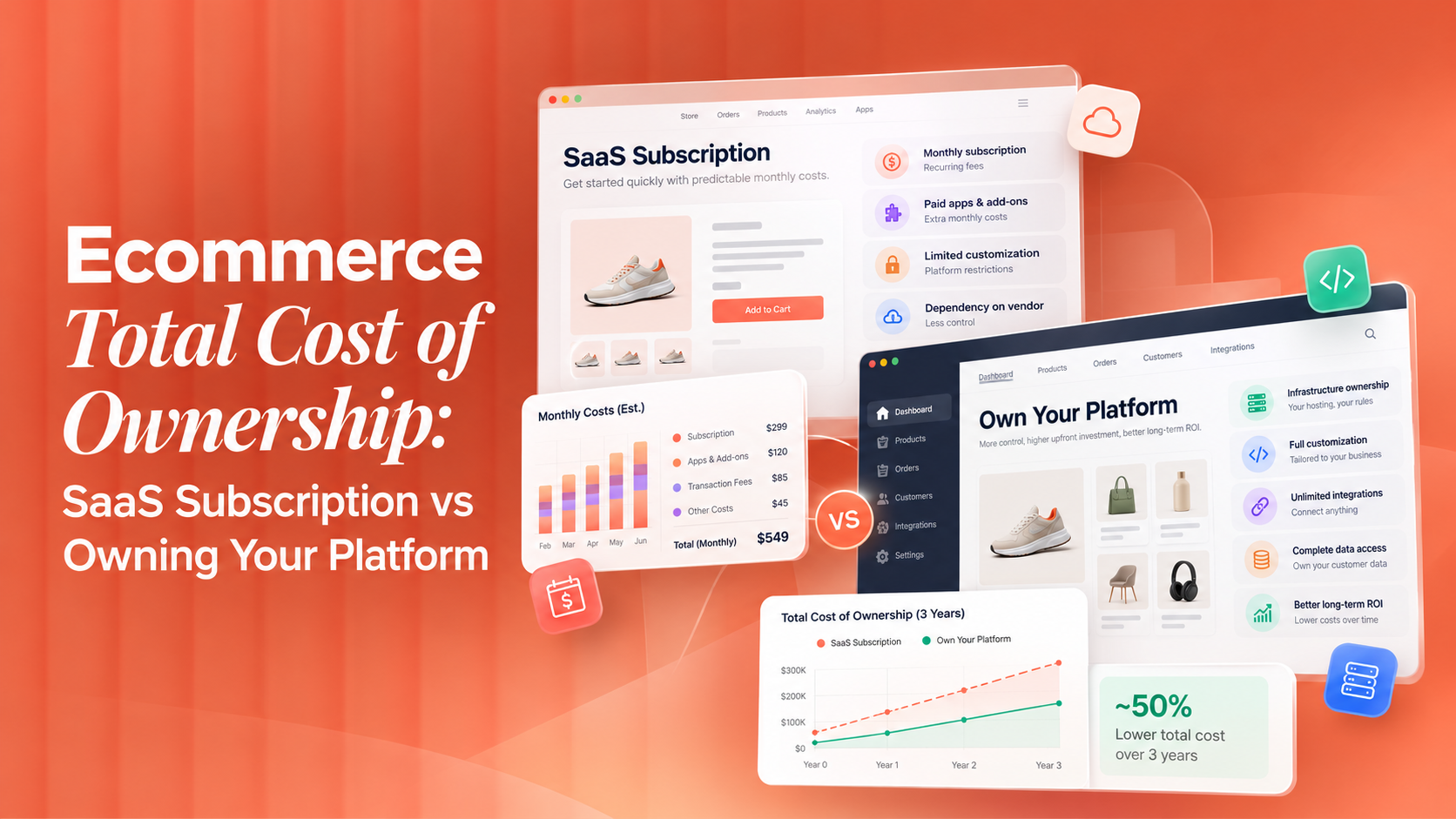
Ecommerce Total Cost of Ownership: SaaS Subscription vs Owning Your Platform
Ecommerce total cost of ownership includes more than subscription fees. Compare SaaS and custom platform costs before you choose.


8 min read
Key Takeaways
Choosing between custom ecommerce vs SaaS is one of the most important technology decisions for a retail business. The wrong choice can limit growth, increase costs, and create operational problems.
The right choice depends on your business model. It depends on how you sell, where you sell, and how complex your operations are.
SaaS platforms such as Shopify help businesses launch quickly. Custom ecommerce systems give businesses more control over workflows, data, and customer experience.
This article explains the differences in practical terms. You will learn when SaaS is the better option. You will also learn when a custom platform becomes the smarter investment.
SaaS stands for Software as a Service. In ecommerce, it means you rent a ready-made platform instead of building one.
Shopify, BigCommerce, and Wix are common examples. The provider manages hosting, security, updates, and core infrastructure.
This model is attractive because it removes technical burden. A founder can create a store, upload products, connect payments, and start selling quickly.
SaaS platforms also provide themes, apps, and integrations. These tools help businesses add features without writing code.
For many new brands, this is the fastest path to market. It reduces upfront cost and technical risk.
However, SaaS ecommerce platform limitations appear when the business grows. You are working within the rules of the platform.
You can customize many things. But you cannot always change the core system, database structure, checkout flow, or data model.
That tradeoff is acceptable for some businesses. For others, it becomes a major constraint.
Custom ecommerce means building a platform around your specific business processes.
It does not always mean building every feature from zero. It can mean using proven technologies, frameworks, and components while keeping control of the core system.
A custom platform can include a website, mobile app, POS, inventory system, warehouse tools, accounting module, and reporting dashboard.
The key difference is ownership. The business owns its data, workflows, and system roadmap.
This matters when commerce is not just an online store. It matters when the website, counter, warehouse, and accounts must operate as one business.
Custom ecommerce platform benefits include deeper integration, flexible checkout, tailored reporting, and fewer third-party dependencies.
The tradeoff is responsibility. The business must invest in planning, development, hosting, security, maintenance, and future improvements.
If speed is your main priority, SaaS is often the better choice.
A business can launch a Shopify store in days. It can use a theme, add products, connect a payment gateway, and begin marketing.
This is ideal for new brands, side projects, and companies testing demand. It is also useful for businesses with simple catalogs and standard workflows.
Custom development takes longer. The team must understand requirements, design workflows, build features, test integrations, and prepare for launch.
A custom build may take months rather than days. That delay has a cost.
But speed should not be the only measure. A fast launch that creates operational problems later can cost more than a slower, better-planned system.
Ask whether you need to launch quickly or build a system that can support the next five years.
Control is where custom ecommerce vs SaaS becomes clearest.
With SaaS, the platform controls many core rules. These can include URL structures, checkout behavior, data access, and available customization.
With a custom system, the business defines those rules. It can design checkout around local buyer behavior, create custom product fields, and connect internal tools directly.
For example, a pharmacy may need batch numbers, expiry dates, prescription notes, and supplier records. A fashion retailer may need size charts, color variants, and warehouse allocation.
A grocery business may need weight-based pricing, branch stock, and fast counter billing. These requirements can be difficult to manage through generic apps.
A custom system can treat these needs as core features, not add-ons.
That flexibility becomes more valuable as the business becomes more specialized.
SaaS usually has a lower upfront cost. You pay a monthly subscription and possibly transaction fees.
Custom ecommerce usually has a higher initial cost. You pay for discovery, design, development, testing, migration, and launch.
But the comparison should not stop there.
SaaS costs continue every month. They can also grow as you add apps, users, integrations, and higher-volume plans.
Custom systems have ongoing costs too. These include hosting, maintenance, security, support, and new feature development.
The right question is not which option is cheaper today. The right question is which option creates better value over time.
A business spending heavily on apps, manual work, and disconnected reports may be paying more than it realizes.
A custom system may reduce those hidden costs by bringing processes into one place.
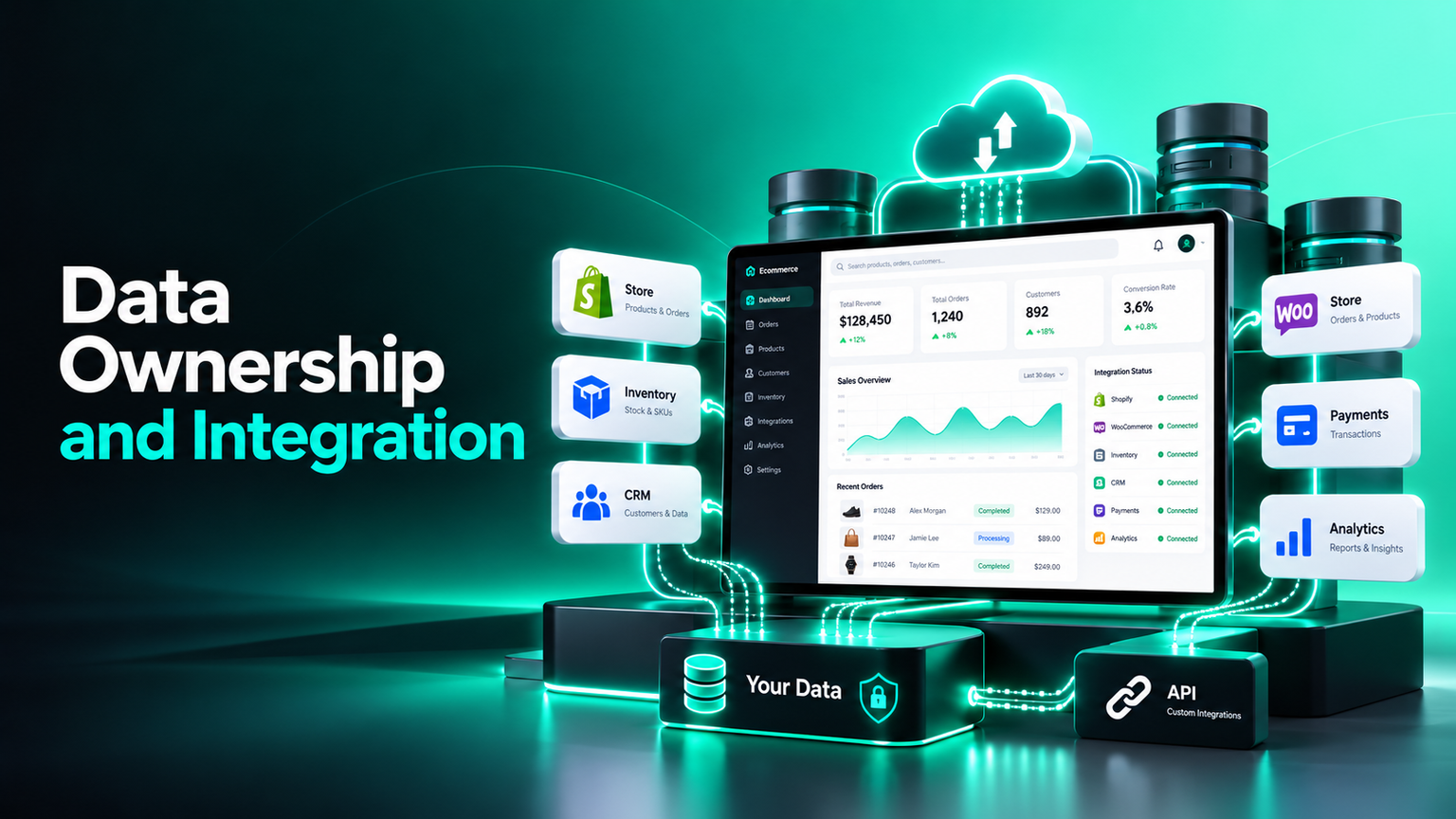
Data is one of the most valuable assets in retail. Customer records, purchase history, inventory movement, and profit data guide better decisions.
With SaaS, data access depends on the platform. Export tools and APIs exist, but deep control may be limited.
With a custom system, the business can design its own data model. It can decide what data to collect, how to store it, and how to use it.
This becomes important when integrating POS, delivery, accounting, CRM, warehouse, and marketing tools.
A custom platform can make these systems read from the same database. That reduces duplicate entry and inconsistent reports.
It also makes it easier to build features such as customer refill reminders, branch-level profit reports, or real-time stock alerts.
For data-driven retailers, this is a major advantage.
Many people think scalability means handling more website visitors. That is only one part of it.
A business also needs to scale operations. It may add branches, staff, suppliers, delivery partners, product categories, and payment methods.
SaaS platforms handle traffic well. They also handle many standard ecommerce workflows well.
But operational scalability can be harder. Every new process may require another app or integration.
A custom system can scale with the business model. It can add branch-level permissions, warehouse rules, credit management, and local payment options.
This is why custom ecommerce vs SaaS is not only a technical debate. It is an operational decision.
A custom system needs people to maintain it. The business needs a developer, agency, or internal technical team.
SaaS reduces this need. The platform provider manages most of the core infrastructure.
This makes SaaS attractive for small teams. It also reduces the risk of relying on one developer.
But custom does not mean unsupported. A good development partner can provide maintenance, monitoring, backups, security updates, and a product roadmap.
Before choosing custom, assess your team. Do you have someone to manage requirements, testing, and ongoing improvements?
If not, choose a partner with a clear support process. A custom system without maintenance becomes a risk.
Choose SaaS when speed, simplicity, and low upfront investment matter most.
It is a strong choice for new online brands. It also works well for businesses with simple products and standard checkout needs.
SaaS is practical when your team has limited technical resources. It is also sensible when you want to test a market before making a larger investment.
A business selling standard products online may not need a custom platform. Shopify can manage products, payments, shipping, and marketing effectively.
The key is honesty about your operations. If your workflows fit the platform, use it.
Choose custom when your business processes are complex or unique.
It makes sense when online and offline sales must share the same inventory. It also makes sense when POS, accounting, delivery, and reporting must work together.
Custom is valuable when you need local payment methods, cash on delivery, credit sales, or mobile-number-based customer identification.
It is also useful when you need batch tracking, expiry dates, branch stock, supplier records, or detailed profit reporting.
If your team spends hours every week exporting data and fixing mismatches, that is a signal. The business may need a connected system, not another app.
Use these questions to decide.
First, how complex are your operations? Simple online selling favors SaaS. Multi-channel retail favors custom.
Second, how important is checkout flexibility? Standard checkout favors SaaS. Local payment behavior may favor custom.
Third, how many systems must work together? Fewer systems favor SaaS. Many systems favor custom.
Fourth, what is your team capacity? Limited technical resources favor SaaS. Available support favors custom.
Fifth, what will the business look like in three years? If you expect branches, complex inventory, and deeper reporting, plan for more control.
Do not choose a platform only because a competitor uses it. Their operations may be very different from yours.
Do not underestimate app costs. Several small monthly fees can become a large annual expense.
Do not choose custom without a maintenance plan. A system needs updates, backups, monitoring, and support.
Do not ignore data migration. Moving products, customers, orders, and inventory takes planning.
Do not treat the website as the whole business. The website is one part of a larger retail operation.
Finally, do not delay the decision forever. Review your workflows, costs, and growth plans regularly.
A platform choice should support the business you are becoming, not only the business you are today.
The custom ecommerce vs SaaS decision should be based on business needs, not trends.
SaaS is excellent for launching quickly and operating simply. Custom ecommerce is powerful for businesses that need control, integration, and long-term flexibility.
Do not choose custom because it sounds advanced. Do not choose SaaS only because it is familiar.
Choose the platform that supports how your business actually operates. Then invest in the system that will make growth easier, not harder.
SaaS means renting a ready-made platform. Custom ecommerce means building a system around your specific business processes and keeping more control.
Custom usually costs more upfront. SaaS can cost more over time through subscriptions, apps, transaction fees, and operational workarounds.
Yes. A custom system can connect POS, inventory, accounting, delivery, and reporting through one shared database.
Yes. Shopify is a SaaS ecommerce platform. It manages hosting, security, updates, and core infrastructure for merchants.
SaaS is often better for a small business with simple needs. Custom becomes more valuable when operations, inventory, or checkout requirements become complex.
Ecommerce total cost of ownership includes more than subscription fees. Compare SaaS and custom platform costs before you choose.
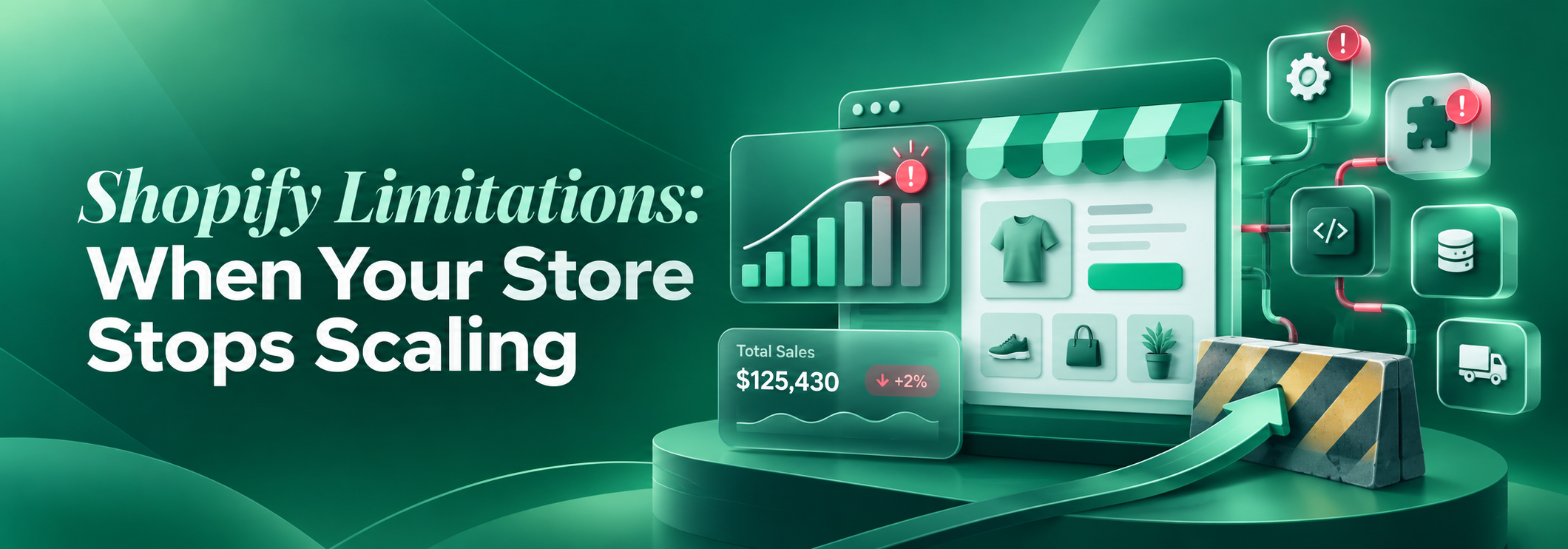
Shopify limitations can slow growing retailers. Learn when a SaaS store is enough and when custom commerce systems make more sense.
Headless ecommerce separates the customer facing experience from commerce back office systems, allowing teams to release faster, personalize journeys, and optimize every device without replacing the core commerce engine.

Ebrahim KhanFounder & CEO
 We’re happy to sign an NDA upon request.