
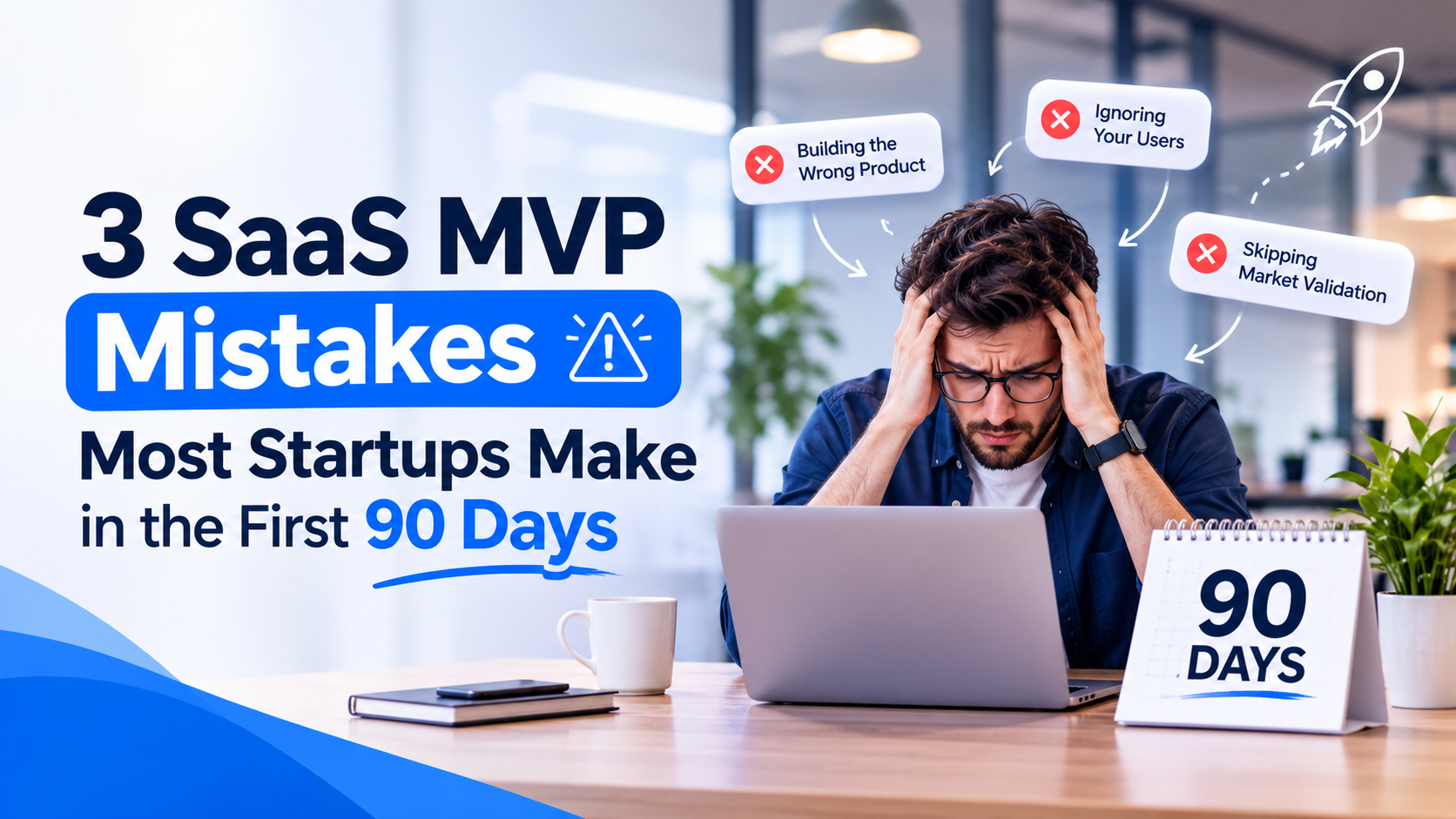
3 SaaS MVP Mistakes Most Startups Make in the First 90 Days
Avoid costly SaaS MVP mistakes in the first 90 days. Learn how to protect your scope, build the right technical foundation, and set up rapid feedback loops.


 By Ebrahim Khan
9 min read
Key Takeaways
A SaaS MVP is the smallest version of your software product that solves one clear customer problem and lets you test demand with real users. Instead of building every feature upfront, you launch a focused product, learn from early usage, and improve it based on evidence. Geekssort helps startups turn ideas into user-tested, scalable SaaS products through product discovery, UX/UI design, and full-stack development.
A SaaS MVP short for Minimum Viable Product—is a working version of a cloud-based software product with only the features required to deliver its core value. For example, a project-management SaaS MVP may need user accounts, project creation, task assignment, and basic notifications, but not advanced reporting, automations, or enterprise integrations.
The purpose is not to launch an incomplete product. It is to launch the minimum complete experience needed to validate a real problem, attract early users, and learn what to build next.
A strong SaaS MVP usually includes:
The MVP stage is where founders learn whether customers will use the product repeatedly, recommend it, and eventually pay for it. Launching early helps teams understand customer needs and whether the product meets them.
Building a full SaaS platform before validating demand can consume months of engineering time and budget on features users may not want. A SaaS MVP reduces that risk by focusing investment on the highest-value workflow first.
| Full Product First | SaaS MVP First |
|---|---|
| Large upfront development cost | Focused, budget-controlled build |
| Many assumptions built into the product | Assumptions tested with real users |
| Long time to market | Faster learning and iteration |
| Broad feature set | One core value proposition |
| Difficult to change direction | Easier to pivot based on feedback |
A well-scoped MVP gives founders evidence, not opinions. It shows whether the product solves a meaningful problem, whether users can reach value quickly, and whether the business model is viable.
Before committing to a full build, review the typical SaaS MVP development cost and timeline so you can plan a realistic launch budget.
Many SaaS products fail not because the idea lacks potential, but because the team builds the wrong thing, adds too much too soon, or ignores early user behavior. The most common SaaS MVP mistakes are predictable—and avoidable.
The biggest mistake is developing a product around an assumption rather than a validated customer problem. Founders may hear that users “like the idea,” but liking an idea is not the same as needing a solution badly enough to change behavior or pay.
Before development begins, validate the problem through customer interviews, competitor research, and a clear definition of the user’s current workaround. Look for evidence such as manual processes, expensive tools, lost revenue, compliance risks, or wasted time.
How to avoid it:
Launching early and learning directly from users is a core principle of effective startup development. Emphasizes launching, talking to users, and improving based on real feedback.
An MVP is not a smaller version of the final product. It is a focused experiment designed to prove one core hypothesis.
Adding dashboards, integrations, admin panels, mobile apps, AI features, and complex permissions too early increases cost, delays launch, and makes it harder to understand what users actually value. A simple MVP with one core workflow, basic authentication, and limited integrations is often enough to begin learning.
How to avoid it:
Users decide quickly whether a SaaS product is worth their time. If they cannot understand the product, complete setup, or reach a meaningful result early, they may leave before experiencing its value.
Onboarding should guide users toward their first success—not simply show them a list of features. A clear activation event, such as creating a first project, generating a first report, or completing a first workflow, gives you a measurable signal that users are getting value.
How to avoid it:
Signups, demo bookings, and website traffic are useful acquisition metrics, but they do not prove that your SaaS MVP works. The stronger signals are whether users return, complete the core workflow, invite teammates, and show willingness to pay.
Scaling paid acquisition before retention improves can turn a product problem into an expensive growth problem. Fix the user experience and retention first, then invest more aggressively in marketing.
How to avoid it:
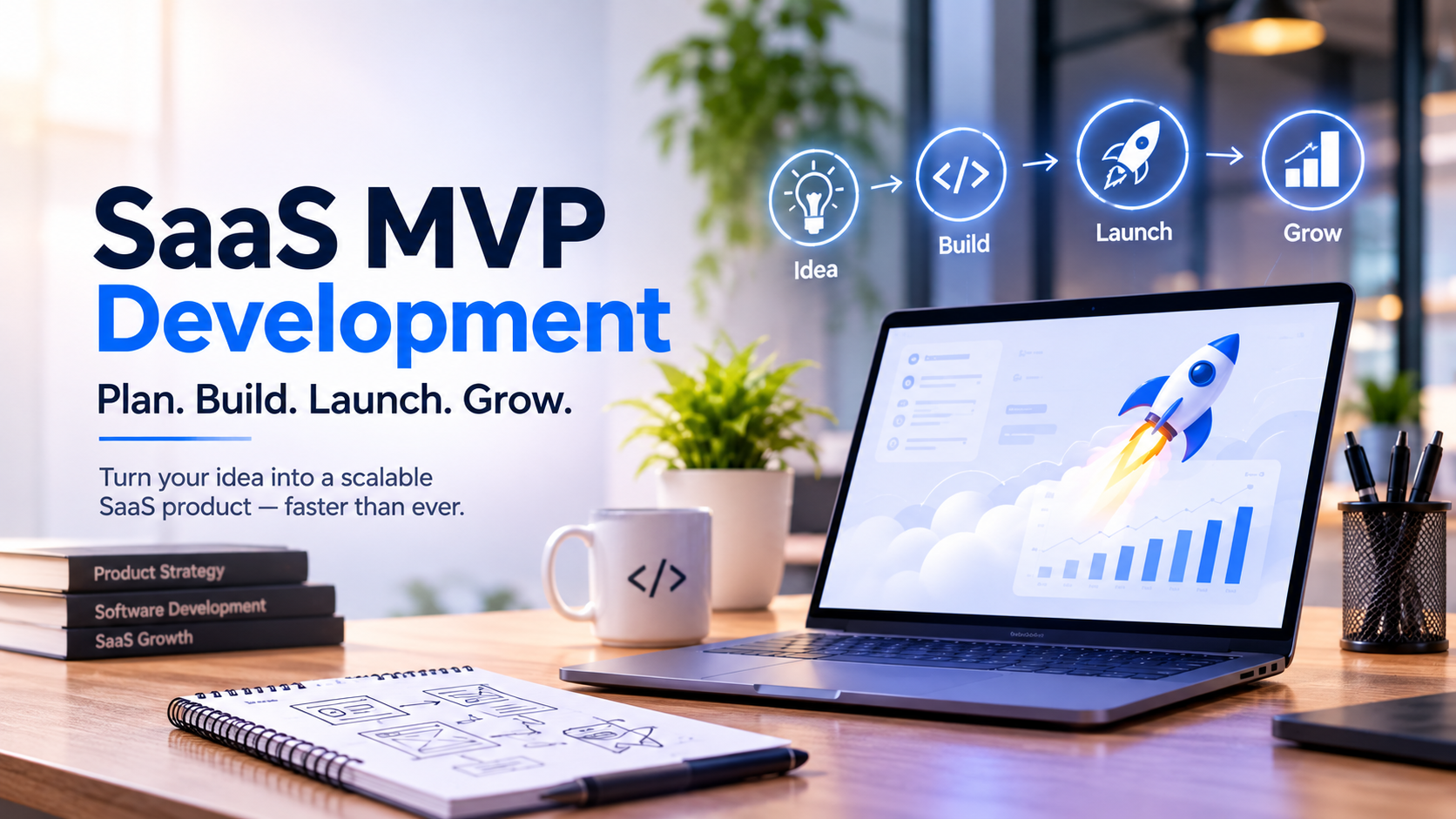
A successful SaaS MVP follows a simple loop: validate, build, launch, measure, and improve. The goal is to make decisions based on user behavior rather than assumptions.
Start with a specific customer segment and a specific problem. “Small businesses need better software” is too broad. “Independent gyms need an easier way to manage memberships, attendance, payments, and class schedules” is much more actionable.
Define:
Choose the one workflow that delivers the primary value. Everything else can wait.
For a fitness-management SaaS, the core workflow may be enrolling a member, scheduling a class, tracking attendance, and processing payment. For a B2B analytics platform, it may be connecting a data source, creating a report, and sharing it with a team.
Good SaaS MVP design is not about adding visual complexity. It is about helping users understand what to do next and reach value with minimal effort.
UX research, wireframes, prototypes, usability testing, and conversion-focused design help reduce confusion before expensive development begins. Geekssort’s product design approach includes UX research, UI design, wireframing, prototyping, usability testing, and product strategy.
Use a modular, scalable architecture so the product can grow without requiring a complete rebuild. Focus on security, performance, maintainable code, and clean integrations from the beginning.
A practical MVP scope often includes:
After launch, your job changes from building features to learning. Review activation, retention, support requests, user interviews, and conversion data every week.
Then prioritize improvements based on evidence:
Geekssort helps startups and established companies move from idea to a functional, user-centered SaaS product. The team combines product strategy, UX/UI design, and software engineering to build MVPs that are ready to test, launch, and scale.

Before writing code, Geekssort helps clarify the product vision, user flows, feature priorities, and technical requirements. This reduces scope creep and ensures the MVP focuses on the workflow that matters most.
A product discovery sprint can turn an initial idea into user flows, a prioritized feature set, and a prototype that can be shown to potential customers.
Geekssort’s custom software development services combine strategy, design, and engineering to turn early ideas into testable products.
Geekssort designs intuitive SaaS interfaces that make the core workflow easy to understand. The team focuses on user research, wireframes, prototypes, design systems, and usability testing to reduce friction and improve conversion.
This matters because a SaaS MVP does not only need to work—it needs to help users quickly understand why it is valuable.
Geekssort provides full-stack web development, custom software engineering, SaaS application development, API and backend integration, and cloud infrastructure support.
That means founders can work with one team across product design, frontend development, backend development, integrations, and deployment rather than coordinating multiple disconnected vendors.
A good SaaS MVP should be simple now but prepared for growth later. Geekssort builds with modern architecture, secure development practices, and integration-ready systems so teams can add features, users, and third-party services as the product matures.
Geekssort supports SaaS product development with the design, engineering, and infrastructure needed to grow beyond the first release.
For SaaS products that need intelligent workflows, Geekssort also provides AI integration, AI agents, workflow automation, predictive analytics, NLP, and custom AI solutions.
This can be useful when AI is central to the product’s value proposition—but it should still be introduced only when it supports a validated user need.
Geekssort is a strong fit if you are:
You can review Geekssort’s case studies to see how the team has approached real product and development challenges.
A SaaS MVP is not about building less because you lack ambition. It is about building the right thing first.
Validate the problem, focus on one core workflow, design a fast path to value, and measure what users actually do. Avoid the common traps of overbuilding, weak onboarding, and scaling acquisition before retention is proven.
If you want to build a SaaS MVP with a clear product strategy, intuitive UX, and scalable engineering foundation, Geekssort can help you move from idea to launch with confidence.
For more practical guidance, explore Geekssort’s SaaS articles and guides.
A SaaS MVP is a minimum viable version of a software-as-a-service product. It includes only the essential features needed to solve a specific user problem and test whether customers find the solution valuable.
The timeline depends on scope and complexity. A simple SaaS MVP with one core workflow may take around 4–6 weeks, while a more complex product with integrations and custom architecture can take longer.
Cost varies widely based on design, features, integrations, security requirements, and team structure. Geekssort scopes each engagement around the client’s actual budget, timeline, and product requirements rather than using a generic package.
A SaaS MVP should include the core workflow, essential user accounts, basic security, an intuitive interface, core data functionality, analytics, and a way to collect user feedback. Advanced features should wait until early users validate the need.
Yes. Geekssort can support SaaS teams beyond the first release through product improvements, UI/UX redesign, additional development, cloud and DevOps support, AI integration, and dedicated engineering capacity.
Turn your idea into a product users can understand, use, and grow with. Geekssort helps startups and businesses plan, design, develop, and launch SaaS products with a clear path to market.
Contact Geekssort today to discuss your SaaS idea, plan your MVP scope, and build a software product designed for rapid user adoption and scalable growth.

Avoid costly SaaS MVP mistakes in the first 90 days. Learn how to protect your scope, build the right technical foundation, and set up rapid feedback loops.

Looking for the best travel software development in UAE? Learn how custom booking portals, itinerary builders, supplier API integrations, and CRM tools transform travel agencies.

Discover how custom travel agency software helps modern agencies automate flight and hotel bookings, manage holiday packages, build dynamic itineraries, and scale online.

Ebrahim KhanFounder & CEO
 We’re happy to sign an NDA upon request.