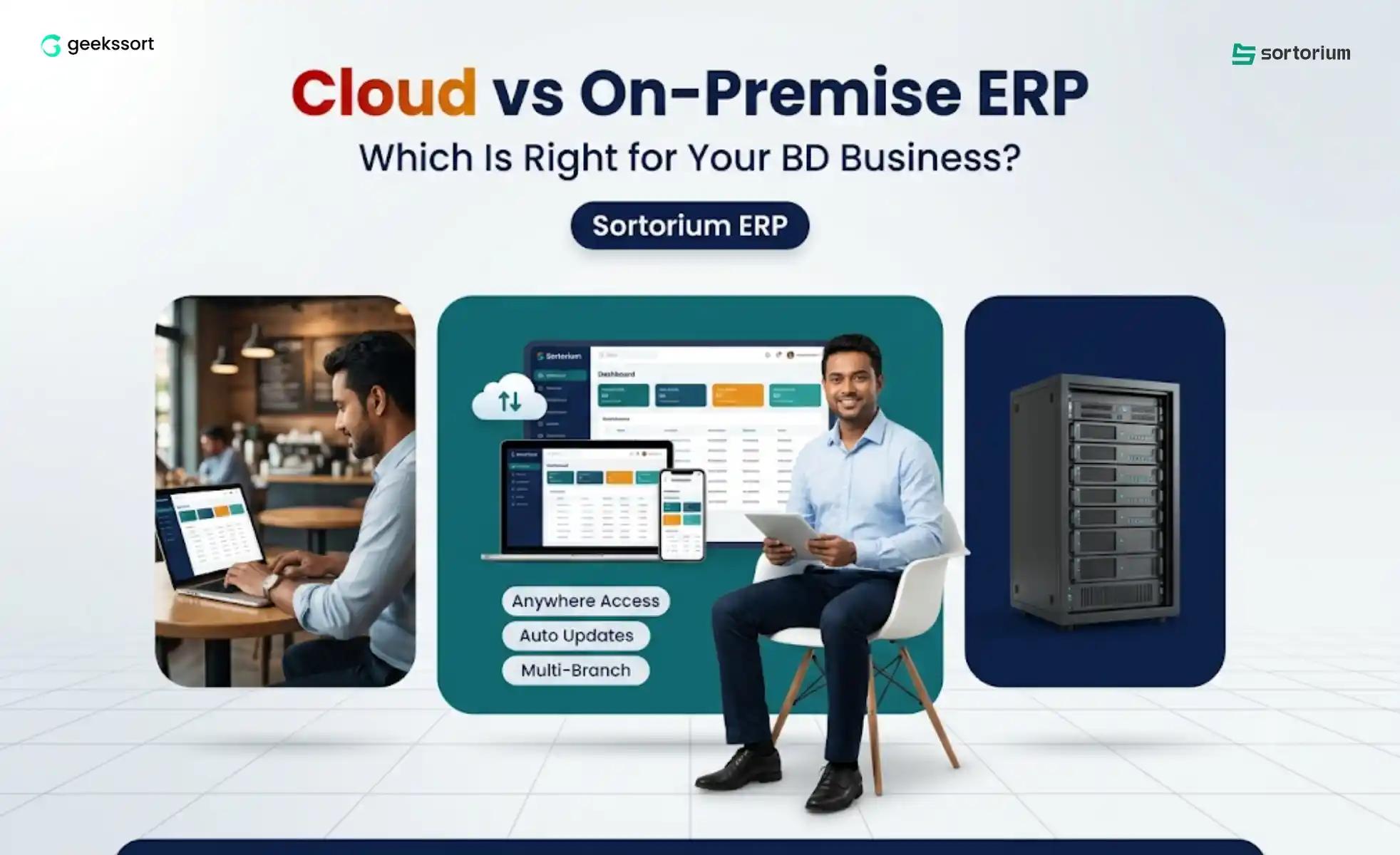
Cloud ERP or on-premise? The choice shapes your cost, security, and flexibility. Here is a clear comparison of cloud ERP in Bangladesh to help you decide in 2026.
Before you pick an ERP, you have to pick where it lives. That single choice shapes your cost, your flexibility, and how fast you can grow. For most Bangladeshi businesses in 2026, cloud ERP in Bangladesh has become the default, but on-premise still fits a few specific cases. This guide compares cloud ERP and on-premise ERP clearly, so you choose the right deployment for your business.
Cloud ERP vs On-Premise ERP: The Short Answer for BD Businesses
Cloud ERP runs on the provider’s servers and you access it over the internet, paying a subscription. On-premise ERP runs on your own servers, which you buy and maintain. Cloud ERP wins on speed, cost, and access for most SMEs. On-premise suits businesses with very specific control or connectivity needs. The rest of this guide explains why.
What Is Cloud ERP, and Why BD Businesses Choose It
Cloud ERP is delivered as a service. There is no server to buy, the provider handles updates and backups, and you log in from any device, anywhere. For a Bangladeshi SME, that means going live in days, predictable monthly cost, and the freedom to check your business from your phone.
The Advantages of Cloud ERP in Bangladesh
Upfront Cost in Cloud ERP
No expensive server hardware. You pay a subscription, so cloud ERP fits an SME budget from day one.
Updates in Cloud ERP
The provider updates and secures the system, so you always run the latest version with no IT project.
Access in Cloud ERP
Log in from the shop, home, or another branch, on any device, which is the biggest day-to-day advantage of cloud ERP.
Data Backup in Cloud ERP
Automatic backups protect your data, so a broken computer never means a lost business.
What Is On-Premise ERP? The Other Side of Cloud ERP
On-premise ERP runs on servers you own and manage on site. You control the hardware and the data physically, but you also carry the cost of buying, securing, updating, and backing it all up. It can suit businesses with strict data-control rules or very poor internet, but for most it is heavier and slower than cloud ERP.
Cloud ERP vs On-Premise: Key Differences at a Glance
Here is the cloud ERP versus on-premise comparison in one view.
Factor
Cloud ERP
On-Premise ERP
Upfront cost
Low, subscription
High, buy servers
Setup time
Days
Weeks to months
Updates
Automatic
Manual, your IT
Access
Anywhere, any device
Mostly on site
Backups
Automatic
Your responsibility
Best for
Most SMEs
Strict-control cases
Which Should Your Bangladeshi Business Choose: Cloud ERP or On-Premise?
Cloud ERP for Small and Growing BD Businesses
If you want low upfront cost, fast setup, and access from anywhere, cloud ERP is the clear choice. This covers the large majority of Bangladeshi SMEs, shops, restaurants, and distributors.
On-Premise ERP for Specific BD Cases
If you have strict internal rules requiring data to stay physically on site, or operate where reliable internet simply is not available, on-premise ERP may fit, accepting the higher cost and maintenance.
Why Sortorium Is Cloud ERP Built for Bangladesh
Sortorium is delivered as cloud ERP, so there is no server to buy and no IT project to manage. You go live in under 48 hours, get automatic updates and backups, and access your business from any device, switching branches from one dashboard. It is built for Bangladesh, with VAT and mobile banking ready out of the box, and backed by a local Dhaka support team. For the overwhelming majority of Bangladeshi SMEs, that is exactly what cloud ERP should deliver.
Cloud ERP in Bangladesh: Frequently Asked Questions
Is cloud ERP safe for a Bangladeshi business?
Yes. Reputable cloud ERP providers secure data and run automatic backups, usually better than a small business could on its own server. Sortorium handles security and backups for you.
Is cloud ERP cheaper than on-premise in Bangladesh?
Usually, yes, especially upfront. Cloud ERP avoids server hardware and IT staff, which is why most Bangladeshi SMEs choose it.
Can I use cloud ERP without strong internet?
Cloud ERP needs a reasonable connection. Where internet is unreliable, some systems offer offline-capable POS that syncs later. For most urban and semi-urban areas, cloud ERP works well.
How fast can cloud ERP go live?
Much faster than on-premise. Sortorium cloud ERP is usually live in under 48 hours, with branches configured and data migrated.
The Bottom Line on Cloud ERP vs On-Premise in Bangladesh
For most Bangladeshi businesses, cloud ERP in Bangladesh wins on cost, speed, access, and safety, while on-premise suits a few strict-control cases. Weigh your budget, your internet, and your need for control, then pick the deployment that lets you focus on the business, not the servers.
Want cloud ERP that is live in days and accessible anywhere?
The Netherlands has near-universal English fluency and a persistent shortage of senior engineers in AI, MLOps and cloud infrastructure. Here is why Dutch companies are moving to remote development teams, and what to verify before committing.
HIPAA and GDPR overlap on security controls but diverge on consent, individual rights and breach notification timing. Here is the technical crosswalk, PHI handling architecture, BAA process and AI governance one dual-compliance HealthTech platform needs.
The quote on your desk is not the price of the software. This guide splits the real cost of custom software into CapEx vs OpEx treatment, annual maintenance benchmarks by software type, and a 3-year TCO model to build before a CFO signs off.






 We’re happy to sign an NDA upon request.