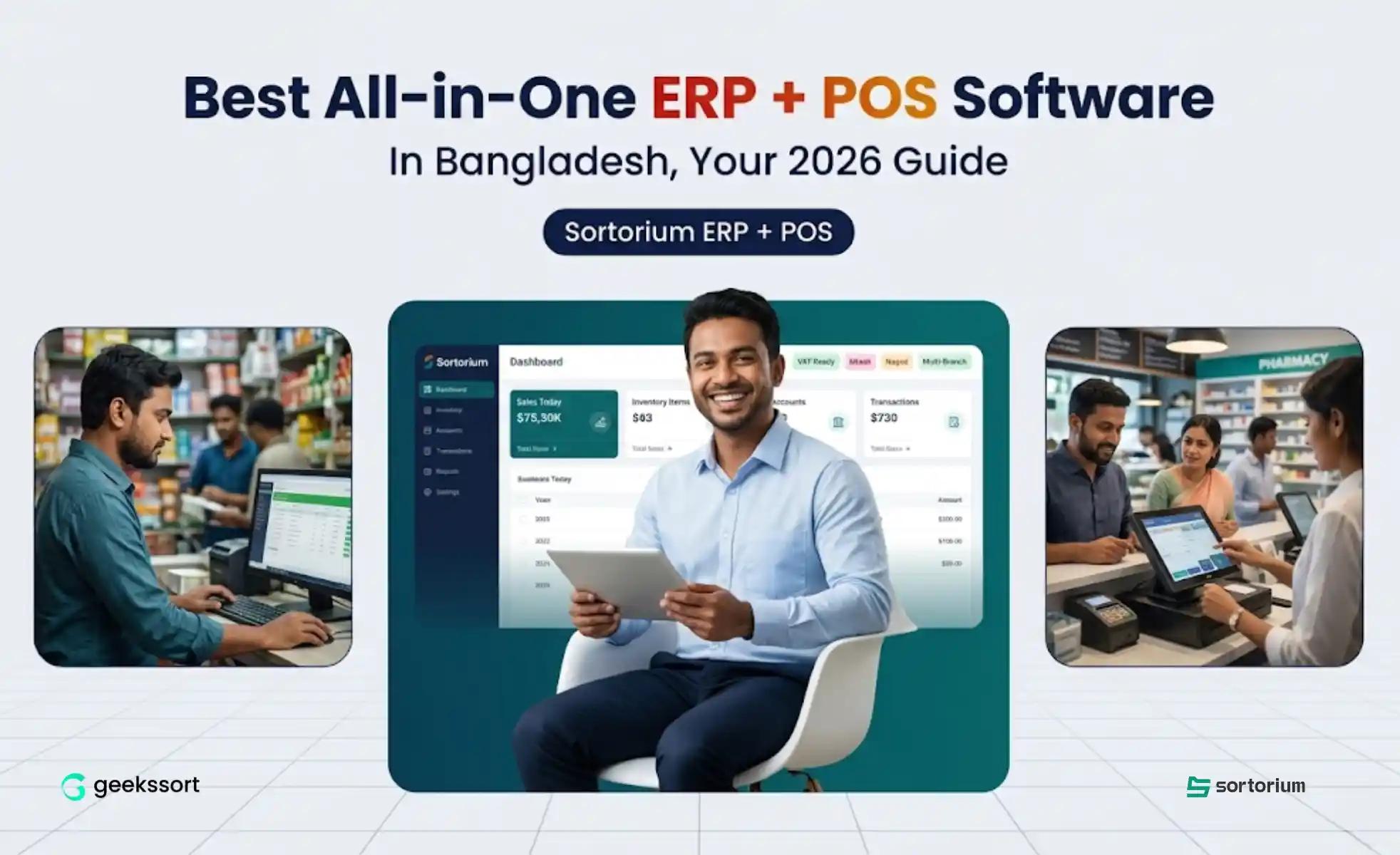
The best ERP and POS software in Bangladesh handles VAT, bKash, multi-branch, and local support. This 2026 guide shows what to compare and how to choose.
Choosing the best ERP and POS software in Bangladesh in 2026 means more than comparing feature lists. It means finding a system that handles local VAT rules, accepts bKash, Nagad, and Rocket, works across multiple branches, and comes with a support team in your timezone. Get it right and your shop, restaurant, pharmacy, or chain runs on one clear platform. Get it wrong and you are back to spreadsheets and reconciliation headaches. This guide walks through what all-in-one ERP and POS software does, the features that matter for Bangladesh, how the options compare, and how to choose.
What All-in-One ERP and POS Software in Bangladesh Means
All-in-one means one platform that handles both the sale at your counter and the entire business behind it. In true ERP and POS software, there is no integration step and no double-entry. A sale instantly updates stock, posts to the ledger, and reflects in your reports, while a separate POS and a separate accounting tool would need daily manual reconciliation.
The Modules Inside All-in-One ERP and POS Software
Sales and POS in Your ERP and POS Software
A fast counter checkout with billing, discounts, VAT, and mobile banking that feeds every sale into the rest of the system.
Inventory in Your ERP and POS Software
Live stock, low-stock and expiry alerts, and multi-warehouse views so you never guess what is on the shelf.
Accounts in Your ERP and POS Software
An automated ledger, profit and loss, and VAT-ready reports that stay current with every transaction.
HR in Your ERP and POS Software
Staff records, attendance, payroll, and role-based access, all in the same platform.
Why Bangladeshi Businesses Are Switching to Unified ERP and POS Software
The market for ERP and POS software in Bangladesh is expanding fast as SMEs digitise, and the wider software market has grown sharply over recent years. The reasons are practical.
VAT and NBR compliance is easier when sales and accounts share one VAT-ready system.
Mobile payments through bKash, Nagad, and Rocket reconcile automatically, not by hand.
Multi-branch growth needs one dashboard across every outlet.
Owners want fewer subscriptions, not a stack of tools that never agree.
Must-Have Features in ERP and POS Software for Bangladesh
Do not get distracted by feature lists from systems built for other countries. For ERP and POS software in Bangladesh, focus on what matters locally.
VAT Compliance in Your ERP and POS Software
Your ERP and POS software should calculate VAT and produce NBR-ready reports with no manual reworking.
bKash and Nagad in Your ERP and POS Software
Mobile money is how many customers pay, so your ERP and POS software must take bKash, Nagad, and Rocket and match each payment to the right invoice automatically.
Multi-Branch ERP and POS Software
Choose ERP and POS software that runs every branch from one dashboard, even if you start with a single outlet.
Fast Onboarding ERP and POS Software
Look for ERP and POS software that goes live in days, with the provider configuring branches and migrating data for you.
Local Support for Your ERP and POS Software
Pick ERP and POS software backed by a local team in your timezone, so help arrives fast when a sale is on the line.
How Leading ERP and POS Software Options Compare in Bangladesh
The local market has several kinds of ERP and POS software, and each fits a different buyer. Enterprise suites are feature-rich but priced and timed for large groups. Open-source ERP is flexible but needs heavy customisation and offers no local support. POS-only tools handle the counter but lack full accounting and HR. The clear gap is a unified, SME-priced platform built for Bangladesh. Here is how the core capabilities line up.
Feature
Enterprise suite
Open-source
POS only
SME all-in-one
ERP + POS unified
Yes
Yes
No
Yes
BD VAT compliance
Yes
Partial
Limited
Yes
bKash / Nagad / Rocket
Yes
No
Yes
Yes
SME-friendly pricing
Partial
Yes
Yes
Yes
Local support team
Yes
No
Yes
Yes
Onboarding under 48 hrs
No
No
Partial
Yes
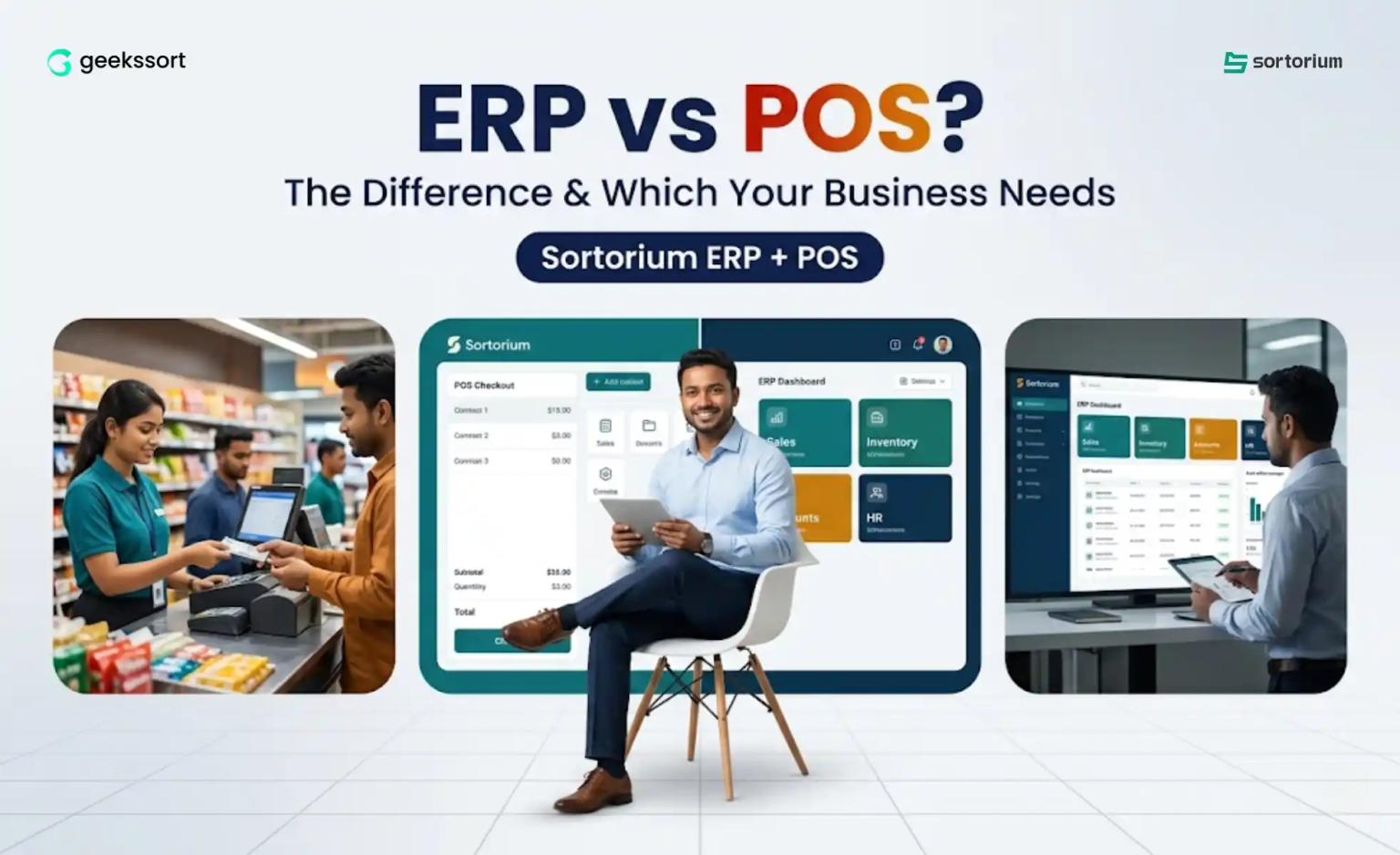
Sortorium: where the ERP vs POS question is solved by one unified platform.
How Much Does ERP and POS Software Cost in Bangladesh?
Pricing for ERP and POS software in Bangladesh depends on features, branches, users, and hosting. Here is a 2026 reference.
Business size
Estimated cost (BDT)
What to expect
Single shop
10,000 – 30,000
Billing, inventory, VAT, mobile banking
Restaurant / pharmacy
20,000 – 70,000
Specialised POS, stock, compliance
Wholesale / distribution
40,000 – 1,50,000+
Multi-warehouse, ledger, suppliers
Multi-branch SME
80,000 – 2,50,000+
Central dashboard, roles, HR, POS
Sortorium (SME plan)
SME-friendly pricing
Unified ERP + POS, all of the above
How to Choose the Right ERP and POS Software in Bangladesh
Use this short process to cut through the marketing and pick the right ERP and POS software.
List your non-negotiables: VAT, mobile payments, and multi-branch for most SMEs.
Ask for a specific onboarding time in days, and who does the data migration.
Confirm the pricing model and watch for per-outlet fees that scale as you grow.
Test support by sending a question before you buy.
Insist on a live demo using your own products and branches.
Confirm the ERP and POS software is genuinely unified, sharing one database.
Why Sortorium Is the All-in-One ERP and POS Software Built for Bangladesh
Sortorium was built for the SME all-in-one gap. It is unified ERP and POS software made for Bangladeshi businesses, with VAT, bKash, Nagad, and Rocket, and a Bangla UI option configured out of the box. Its modules cover Inventory, Sales, Accounts, HR, Billing, and Transactions on one live database.
Pricing is sized for SMEs, onboarding is usually under 48 hours with the team configuring branches and migrating data, and support comes from a local Dhaka team. It is multi-branch ready from day one, whether you run one outlet or one hundred.
ERP and POS Software in Bangladesh: Frequently Asked Questions
What is the best ERP and POS software in Bangladesh?
The best depends on your size. Large groups may need an enterprise suite, while most SMEs are better served by unified, SME-priced ERP and POS software with local VAT, bKash, and fast onboarding. Sortorium is built for that segment.
How much does ERP and POS software cost in Bangladesh?
It ranges from around BDT 10,000 for a single shop to BDT 2,50,000 or more for a multi-branch SME. Confirm whether the ERP and POS software scales per outlet before you commit.
Can one platform really handle both ERP and POS?
Yes. Unified ERP and POS software includes the POS as one module inside the ERP, so sales feed straight into inventory and accounts with no double-entry.
How long does ERP and POS software take to set up?
Enterprise and open-source systems can take months. ERP and POS software built for Bangladesh, like Sortorium, can be live in under 48 hours.
The Bottom Line on ERP and POS Software in Bangladesh
The best ERP and POS software in Bangladesh is the one that fits your size and is built for the local market: VAT-ready, mobile-payment-friendly, multi-branch, and backed by support in your timezone. Match the category to your business, demand a real demo with your own data, and confirm it is genuinely unified before you buy.
Want an all-in-one ERP and POS platform built for Bangladeshi SMEs? Book a free Sortorium demo with your own products and branches.
The Netherlands has near-universal English fluency and a persistent shortage of senior engineers in AI, MLOps and cloud infrastructure. Here is why Dutch companies are moving to remote development teams, and what to verify before committing.
HIPAA and GDPR overlap on security controls but diverge on consent, individual rights and breach notification timing. Here is the technical crosswalk, PHI handling architecture, BAA process and AI governance one dual-compliance HealthTech platform needs.
The quote on your desk is not the price of the software. This guide splits the real cost of custom software into CapEx vs OpEx treatment, annual maintenance benchmarks by software type, and a 3-year TCO model to build before a CFO signs off.




 We’re happy to sign an NDA upon request.