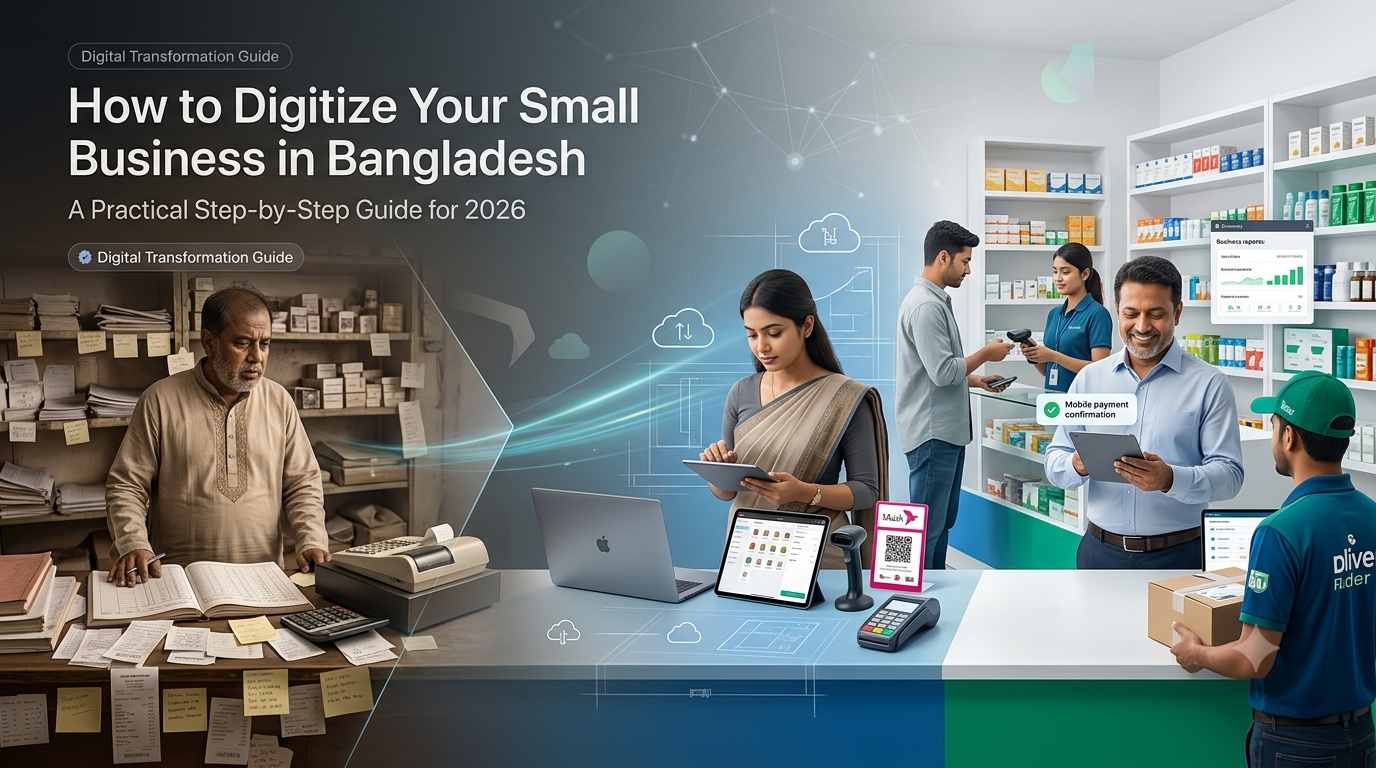
Going digital sounds daunting, but it does not have to be. Here is a practical, step-by-step guide to digitize your small business in Bangladesh in 2026, without the overwhelm.
For many Bangladeshi owners, the word digital sounds expensive, complicated, and meant for someone else. It is none of those things. To digitize your small business in Bangladesh simply means replacing paper registers, scattered spreadsheets, and guesswork with connected software that does the heavy lifting for you. Done right, it saves hours, cuts errors, and shows you exactly how your business is doing. This step-by-step guide makes the path clear, practical, and achievable, whatever you sell and however small you are today.
You do not need to be technical, and you do not need to change everything at once. Follow the steps in order, and you will move from paper to a connected digital business without the overwhelm so many owners fear.
What It Really Means to Digitize Your Small Business in Bangladesh
To digitize your small business in Bangladesh is to put your core operations, sales, stock, payments, accounts, and staff, into software that connects them. Instead of a sale written in a notebook, stock counted by hand, and accounts pieced together at month-end, a digital business records everything once and updates it everywhere automatically.
The goal is not technology for its own sake. It is a business that runs more smoothly, leaks less money, and tells you the truth about itself in real time. That is what digitising actually delivers, and it is within reach for the smallest shop.
Why Digitize Your Small Business in Bangladesh Now?
The timing has never been better. Customers expect to pay by bKash and Nagad, cloud software has made digital tools cheap, and government momentum behind Smart Bangladesh is pushing the whole economy online. Owners who digitise now gain an edge while it still sets them apart.
There is also a cost to waiting. Every month on paper is a month of stock that does not match the shelf, cash that does not reconcile, and decisions made on guesswork. To digitize your small business in Bangladesh is to stop paying those silent costs and start compounding the benefits instead.
Signs Your Small Business in Bangladesh Is Ready to Digitize
Not sure if it is time? These signs mean you are ready to digitize your small business in Bangladesh.
• Your stock count never matches what is actually on the shelf.
• Month-end accounting eats days of your time.
• You reconcile bKash and cash by hand every night.
• You cannot quickly answer what your real profit was last month.
• Important information lives in one person’s head or one paper register.
• Opening a second branch feels impossible to control.
The Step-by-Step Guide to Digitize Your Small Business in Bangladesh
Here is the practical roadmap. Take the steps in order, and resist the urge to do everything at once.
Step 1: Map Your Manual Processes Before You Digitize
Start by writing down how your business actually works today: how a sale happens, how stock is tracked, how payments are recorded, how accounts are kept. This simple map shows you what to digitise and in what order, and it stops you from buying software that does not fit how you really operate.
Step 2: Choose the Right Software to Digitize Your Small Business
Pick one connected platform rather than several disconnected apps. To digitize your small business in Bangladesh well, choose software that is built locally, includes NBR VAT and mobile payments, is priced for an SME, and comes with local support. A unified ERP and POS covers everything in one place.
Step 3: Digitize Sales and Payments First
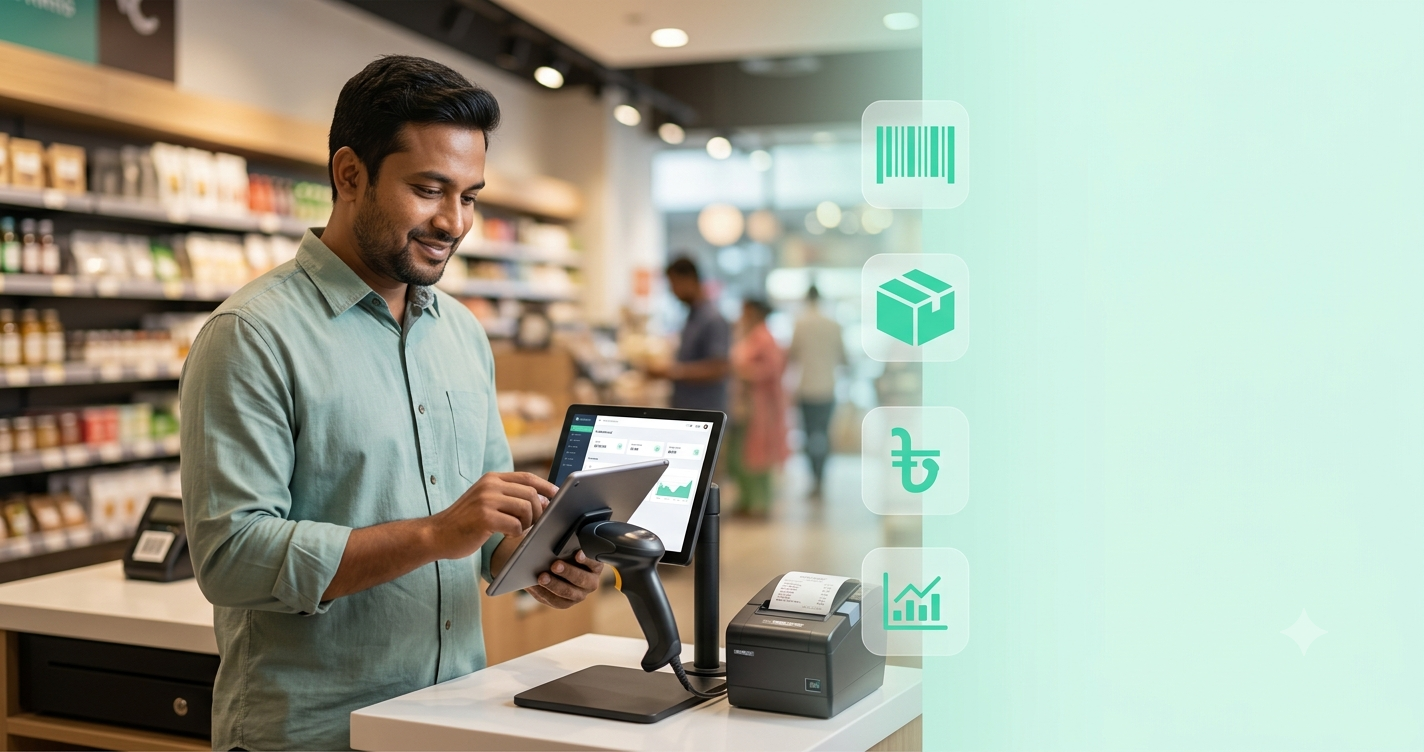
The counter is where digitising pays off fastest. Move your sales onto a POS that bills quickly, accepts cash, card, and mobile banking, and records every transaction automatically. This single step ends the notebook, speeds up service, and gives you accurate daily sales from day one.
Step 4: Digitize Inventory and Stock
With sales digital, your stock can update itself on every sale. Set up your products, add cost and selling prices, and set reorder points so low-stock alerts work for you. Now your shelf count matches reality, and you reorder what you need instead of guessing.
Step 5: Digitize Accounts and VAT
Because sales and stock now feed your books, accounting becomes continuous instead of a month-end ordeal. VAT is calculated automatically on every sale, and reports are ready when you need them. To digitize your small business in Bangladesh fully, this step turns compliance from a stress into a non-event.
Step 6: Digitize HR and Payroll
As your team grows, bring staff onto the system too. Digital attendance, leave, and one-click payroll remove disputes and save a day of manual work each cycle. With HR inside the same platform, your salary cost sits right next to your revenue and profit.
Step 7: Train Your Team and Go Live
Software only works if people use it. Show your staff the basics, run a few real transactions together, and go live with your provider on hand for the first day. Good onboarding makes this quick, and within days the digital way becomes simply the way you work.
Common Mistakes When You Digitize a Small Business in Bangladesh
Avoid these traps as you digitize your small business in Bangladesh, and the journey stays smooth.
• Buying several disconnected apps instead of one connected platform.
• Trying to digitise everything in a single day instead of step by step.
• Choosing global software that needs custom work for VAT and bKash.
• Skipping staff training, so the system is half-used.
• Picking the cheapest tool with no local support.
• Not migrating your existing data, so you lose your history.
How Much Does It Cost to Digitize Your Small Business in Bangladesh?
Cost is the first worry for most owners, and the good news is that it is lower than expected. Here is a realistic 2026 reference for what it costs to digitize your small business in Bangladesh with a unified platform.
Business size
Estimated monthly (BDT)
What it usually includes
Single small shop
1,000 – 4,000
POS, inventory, VAT, mobile banking
Growing small business
4,000 – 12,000
Multi-user, accounts, reports, HR
Multi-branch small business
12,000 – 40,000
Branches, roles, full ERP + POS
Sortorium (SME plan)
SME-friendly pricing
All-in unified platform
Set against the cost of staying manual, lost sales, dead stock, wasted hours, and VAT stress, the price to digitize your small business in Bangladesh usually pays for itself within months. It is an investment that returns, not just a cost.
The Bangladesh Context for Digitising a Small Business
Digitising works best when the tools fit the country. To digitize your small business in Bangladesh, the software should speak your language with a Bangla option, handle NBR VAT and bKash natively, suit local SME budgets, and come with support in your timezone. Global tools that ignore these realities create more work, not less.
Local context also means understanding how Bangladeshi businesses really run, from cash-and-mobile payments to credit trade to multi-branch markets. A platform built for Bangladesh anticipates these, which makes the path to going digital far smoother for an SME.
Why Sortorium Makes It Easy to Digitize Your Small Business in Bangladesh
Sortorium was built to digitise Bangladeshi SMEs without the pain. It unifies sales, inventory, accounts, HR, and POS on one live database, with NBR VAT and bKash, Nagad, and Rocket native, a Bangla UI option, and SME-friendly pricing. The team configures everything, migrates your existing data, and gets you live in under 48 hours, with a local Dhaka team for support. You take the steps in this guide once, and your business is digital.
Because it is one platform rather than many apps, Sortorium removes the biggest mistake owners make when they digitise, ending up with disconnected tools. Everything talks to everything, which is the whole point of going digital.
Sortorium: the all-in-one ERP and POS software in Bangladesh for SMEs.
A Real Example: A Dhaka Shop Digitises in 48 Hours
Consider a small general store in Mirpur that ran entirely on a paper register and a calculator. Sales were written by hand, stock was a guess, and the owner spent every evening reconciling cash and bKash from memory. Month-end took the better part of a week, and a planned second branch felt impossible to control from where he stood.
To digitize your small business in Bangladesh does not require a long, painful project, and this store is a good example of why. On day one, the platform was set up with its products, prices, and VAT, and the existing stock list was migrated by the provider. Staff were shown how to bill on the POS and take mobile money. By day two, the shop was live, selling through the system, with stock dropping automatically on every sale and payments reconciling themselves at the counter.
Within a week, the owner could see daily profit on his phone, knew exactly which products sold and which sat, and trusted the stock count for the first time in years. The dreaded month-end shrank to an afternoon review. The second branch, once unthinkable, became a realistic plan, because the system could run both outlets from one dashboard. That is what it looks like in practice to digitize a small business in Bangladesh, and it is well within reach for an ordinary shop.
What Changes After You Digitize Your Small Business in Bangladesh
The benefits of digitising are not abstract promises; they show up in daily life almost immediately. Once you digitize your small business in Bangladesh, the change is felt across the whole operation, from the counter to the back office.
• Sales are faster and never lost to a slow, manual counter at peak hours.
• Stock matches the shelf, ending both embarrassing stockouts and cash-draining dead inventory.
• Mobile money and cash reconcile automatically, freeing up your evenings.
• Real profit and best sellers are visible from your phone, any time, anywhere.
• VAT is handled by default, so filing season stops being a source of stress.
• Growth to a second branch becomes manageable from a single dashboard.
Each of these removes a daily friction that used to cost you time, money, or peace of mind. Together, they explain why owners who digitise rarely look back, and why the decision to digitize your small business in Bangladesh tends to pay for itself faster than most people expect when they first weigh the cost.
How to Keep Your Team Onboard When You Digitize
Technology only helps if people actually use it, so bringing your team along matters as much as the software itself. When you digitize your small business in Bangladesh, involve your staff early, explain how the system makes their day easier rather than harder, and train them first on the few tasks they will do most, like billing and taking payments.
Start simple, celebrate small wins in the first days, and lean on your provider’s support whenever a question comes up. Most staff adapt within a week, especially when the system is designed to be straightforward and available in a language they are comfortable with. A team that feels supported, not replaced, becomes the engine that makes digitising stick for the long term.
Growing Your Digital Small Business Beyond the Basics
Digitising is a beginning, not an end. Once the basics are running smoothly, you can build on them: add analytics to spot trends before competitors do, sell across online channels from the same stock, introduce loyalty to bring customers back, and open new branches that plug straight into the system. To digitize your small business in Bangladesh is to lay a foundation you keep building on for years.
Because everything sits on one connected platform, each new capability strengthens the whole rather than adding another disconnected tool to juggle. That is the long-term payoff of doing it right: a business that does not just go digital once, but keeps getting smarter, leaner, and more capable as it grows.
Why One Platform Beats Many Apps When You Digitize
The single most expensive mistake owners make is to digitize your small business in Bangladesh with a pile of disconnected apps: one tool for billing, another for stock, a spreadsheet for accounts, and a separate note for salaries. On the surface each app looks cheap, but they do not talk to each other, so you end up re-entering the same data several times and reconciling between them by hand. The result is often more work than the paper system you left behind.
A unified platform solves this at the root. When you digitize your small business in Bangladesh on one connected system, a single sale updates stock, accounts, and VAT together, with nothing to copy across. There is one login, one source of truth, and one place to look for an answer. This is why the most successful digital transformations start with the decision to choose one platform rather than assembling a patchwork that quietly recreates the old chaos in digital form.
It also makes everything that comes later easier. Adding HR, a second branch, an online channel, or analytics is simply switching on more of the same system, not bolting on yet another disconnected app. Choosing one platform from the start is the quiet decision that determines whether digitising feels like relief or like a new headache.
Digitize Your Small Business in Bangladesh: Frequently Asked Questions
What does it mean to digitize a small business in Bangladesh?
It means moving your core operations, sales, stock, payments, accounts, and HR, into connected software, so everything updates automatically instead of being tracked on paper or in spreadsheets.
Is it expensive to digitize a small business in Bangladesh?
Less than most expect. A unified SME platform can start from a modest monthly fee and usually pays for itself through saved time and fewer errors.
Where should I start when I digitize my small business?
Start with sales and payments on a POS, then inventory, then accounts and VAT, then HR. Taking it step by step keeps the change manageable.
Do I need to be technical to digitize my small business?
No. With a platform like Sortorium, the provider handles setup and migration, and the system is designed to be simple for non-technical owners.
Will I lose my existing data when I digitize?
No. Good providers migrate your existing records as part of onboarding, so you start digital with your history intact.
How long does it take to digitize a small business in Bangladesh?
With a cloud platform like Sortorium, usually under 48 hours, including setup, data migration, and basic training.
Does digitising handle VAT and bKash?
The right platform does both natively. Sortorium builds NBR VAT and bKash, Nagad, and Rocket into the core.
Can I digitise just one part of my business first?
Yes. Many owners start with sales and payments, then add inventory, accounts, and HR over time, all on the same platform.
The Bottom Line on How to Digitize Your Small Business in Bangladesh
To digitize your small business in Bangladesh is simpler, cheaper, and more rewarding than most owners imagine. Map your processes, choose one connected platform built for Bangladesh, and digitise sales, inventory, accounts, and HR step by step. The result is a business that saves time, leaks less money, and shows you the truth in real time. The first step is the only hard one, and it is easier than another year on paper.
Ready to digitize your small business the easy way?
Poor retail visibility hides lost sales. Learn how a connected retail POS system brings sales, stock, customers, and branches into one view, and which daily checks turn those reports into decisions.
Learn how to build an MVP that investors will actually fund by validating key assumptions with real user data, focusing on traction instead of unnecessary features.
Looking for the best POS software in Bangladesh? This guide compares the top POS systems for retail stores, restaurants, pharmacies, supermarkets, wholesalers, and gyms. Explore key features, pricing, VAT/Mushak compliance, offline functionality, and industry-specific recommendations to choose the right POS solution for your business in 2026.





 We’re happy to sign an NDA upon request.