Find the best Restaurant POS software in Bangladesh with pricing, inventory management, QR ordering, payment integration, and key features.
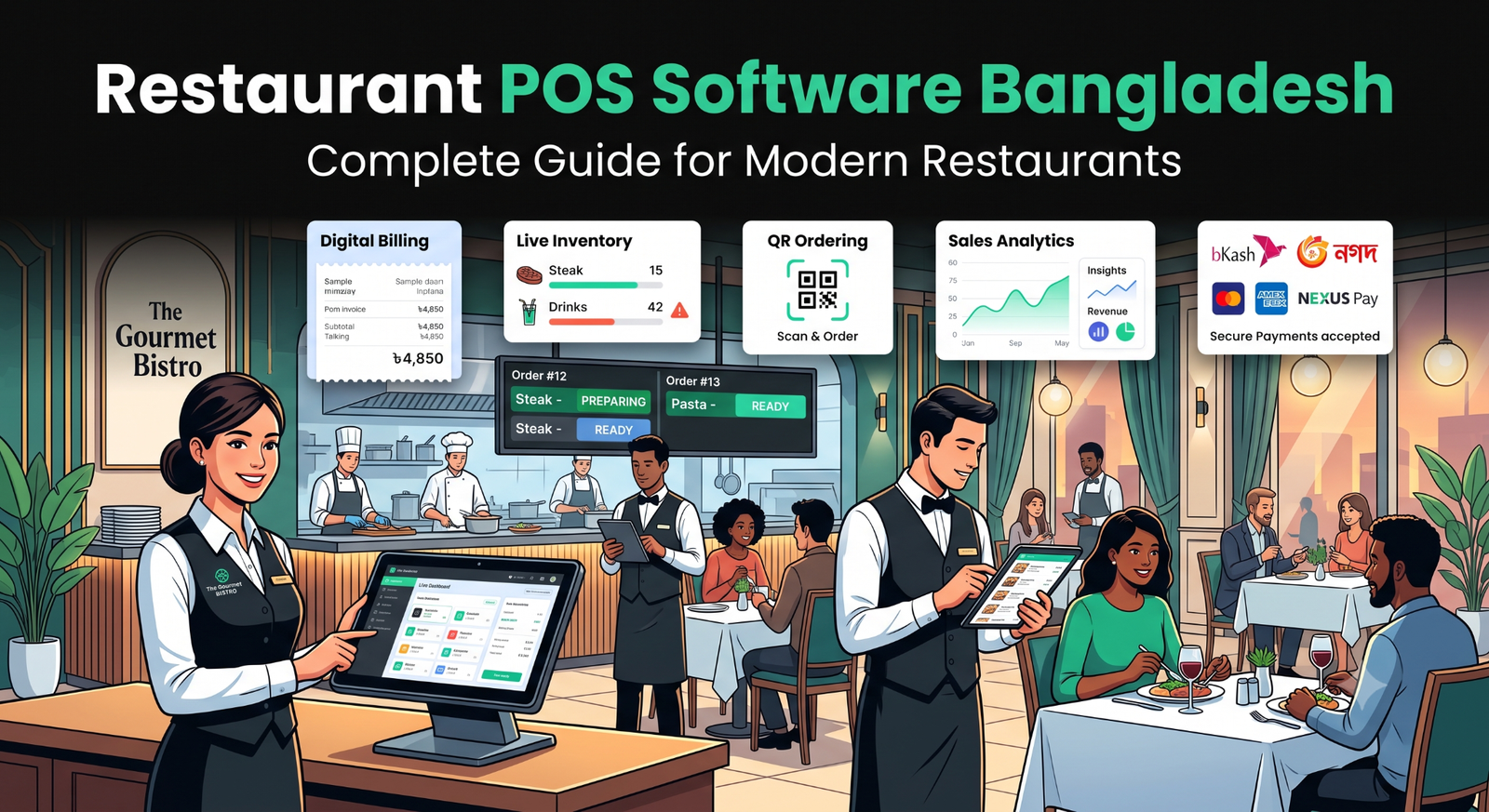
Running a successful restaurant today involves much more than serving great food. Restaurant owners must manage orders, billing, inventory, staff, customer service, online deliveries, and financial reporting—all while maintaining fast service and reducing operational errors. This is where Restaurant POS Software Bangladesh becomes essential.
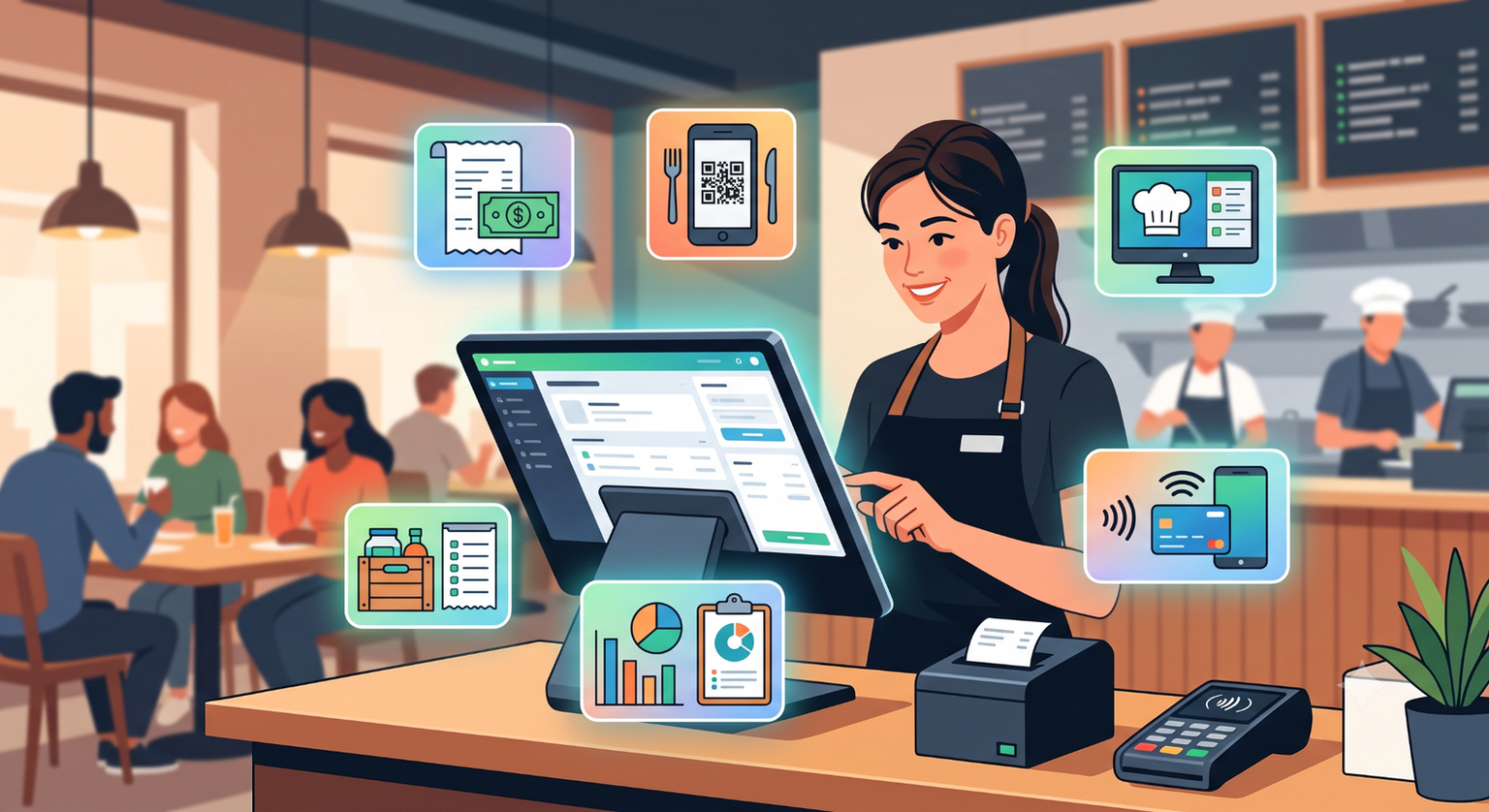
A modern restaurant POS system combines billing, order management, kitchen communication, inventory tracking, digital payments, reporting, and customer management into a single platform. Whether you operate a café, fast-food outlet, cloud kitchen, fine dining restaurant, or multi-branch chain, the right POS software helps improve efficiency, reduce costs, and deliver a better customer experience.
When choosing Restaurant POS Software Bangladesh, restaurant owners should evaluate features such as cloud access, offline mode, QR ordering, Kitchen Display System (KDS), inventory management, bKash and Nagad integration, NBR/VAT compliance, reporting, and scalability. This guide explains everything you need to know—from selecting the right POS solution to understanding pricing, integrations, and the features that matter most for restaurants in Bangladesh.
Understanding Restaurant POS Software
Restaurant POS (Point of Sale) software is more than a billing application. It is a complete restaurant management platform that connects every stage of restaurant operations—from the moment a customer places an order until sales reports are generated at the end of the day.
Unlike traditional cash registers, a modern POS system automates multiple business processes, helping restaurants improve speed, accuracy, and profitability.
A typical restaurant POS solution includes:
Digital billing and invoicing
Table and reservation management
Kitchen Display System (KDS)
Inventory management
Waiter order management
Customer database
Sales analytics
Employee management
Multi-payment support
Cloud reporting
Instead of using multiple disconnected systems, restaurants can manage their entire operation through a single dashboard.
Why Restaurants Need POS Software
Many restaurants still rely on handwritten orders, manual inventory tracking, and traditional cash registers. While these methods may work for very small businesses, they often lead to operational inefficiencies as customer demand increases.
A restaurant POS system helps solve many everyday challenges, including:
Long billing queues during busy hours
Incorrect kitchen orders caused by handwritten tickets
Inventory shortages and food wastage
Difficulty tracking daily sales and expenses
Employee fraud or unauthorized discounts
Poor coordination between waiters and kitchen staff
Errors in online delivery orders
Manual VAT calculations and reporting
By automating these tasks, restaurants can serve customers faster, reduce errors, and make better business decisions using real-time data.
Common Challenges Faced by Restaurants in Bangladesh
Restaurant businesses in Bangladesh operate in a highly competitive environment. Customer expectations continue to rise, while labor costs, food prices, and operational complexity increase.
Some of the most common challenges include:
Slow Billing Process
Manual billing increases waiting time and reduces customer satisfaction, especially during peak hours.
Order Miscommunication
Handwritten orders may be difficult to read, leading to incorrect meals being prepared and unnecessary food waste.
Inventory Mismanagement
Without real-time inventory tracking, restaurants often experience stock shortages, over-purchasing, or ingredient wastage.
Managing Multiple Payment Methods
Today’s customers expect flexible payment options, including cash, cards, bKash, Nagad, and QR payments.
Limited Business Insights
Without accurate reports, restaurant owners struggle to identify their best-selling items, monitor staff performance, or understand profit margins.
A modern POS system addresses these challenges by bringing every aspect of restaurant operations into one centralized platform.
Types of Restaurant POS Systems
Not every restaurant has the same operational requirements. The right POS system depends on your restaurant size, budget, and business model.
POS Type
Best For
Advantages
Cloud POS
Most modern restaurants
Access data anywhere, automatic backups, easy updates
Desktop POS
Single-location restaurants
Operates locally with minimal internet dependency
Tablet POS
Cafés, food trucks, outdoor dining
Portable, space-saving, faster order taking
Mobile POS
Small restaurants & delivery staff
Flexible, convenient, low hardware cost
Hybrid POS
High-volume restaurants
Combines offline reliability with cloud synchronization
Cloud-based POS systems have become the preferred choice for most restaurants in Bangladesh because they support remote management, real-time reporting, and automatic software updates.
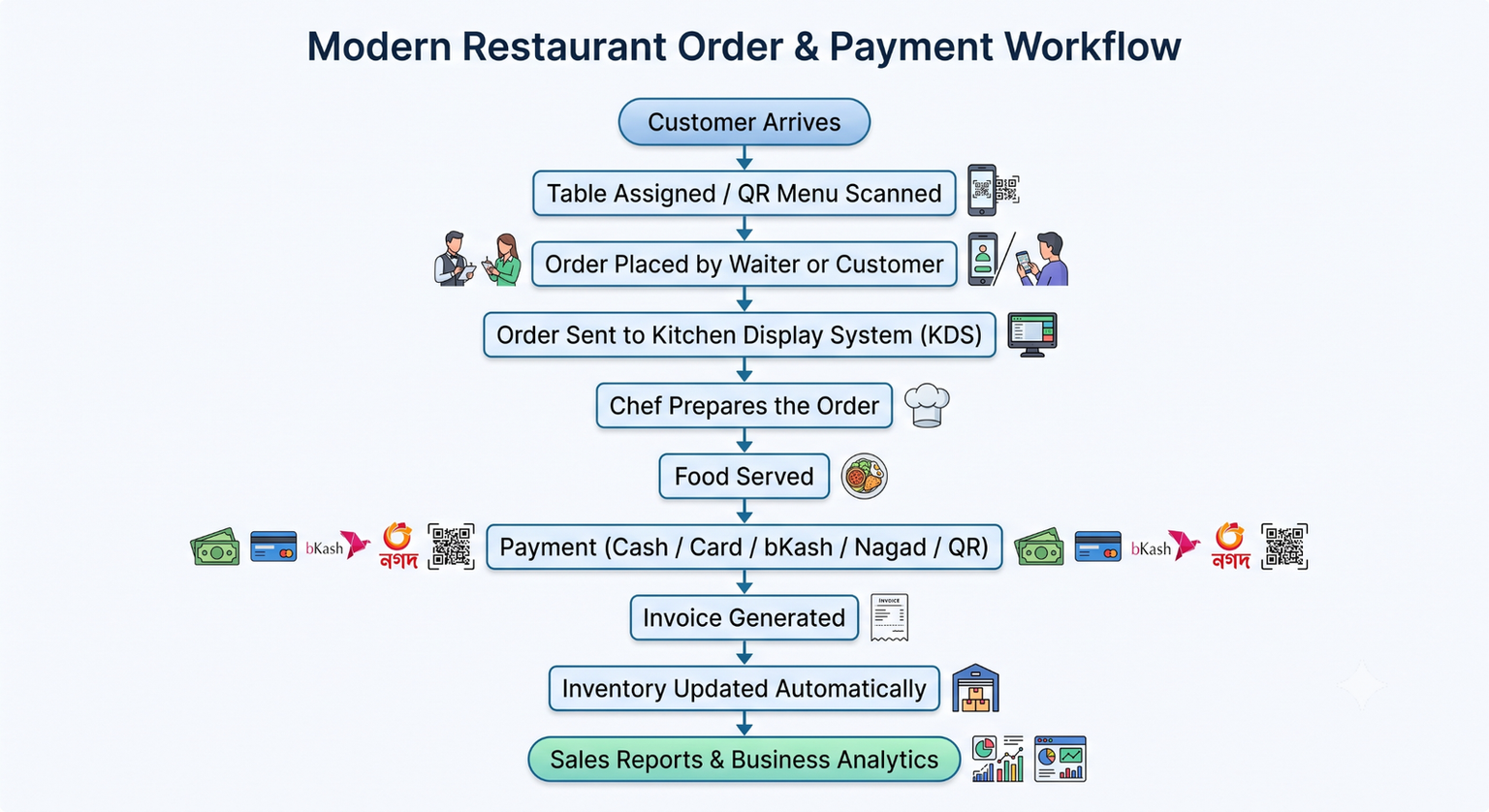
Restaurant Workflow: How a Modern Restaurant POS System Works
A Restaurant POS system connects every stage of restaurant operations into one seamless workflow. Instead of relying on handwritten orders or disconnected systems, it synchronizes the front desk, kitchen, billing, inventory, and reporting in real time.
The workflow below illustrates how a customer order moves through a modern cloud-based Restaurant POS Software Bangladesh solution.
With every order automatically tracked, restaurant owners gain complete visibility into daily operations while minimizing manual work and human error.
Restaurant POS Software by Business Type
Different restaurants operate differently. A café has different needs than a cloud kitchen, while a multi-branch restaurant requires more advanced reporting than a single-location eatery. Choosing the right POS system depends on your business model and daily operations.
Restaurant POS Software for Fine Dining Restaurants
Fine dining establishments focus on exceptional customer service, table management, reservations, and personalized dining experiences.
Common Challenges
Managing table reservations
Coordinating multiple-course meals
Tracking VIP customers
Preventing billing mistakes
Monitoring waiter performance
Recommended Features
Advanced table management
Reservation system
Split billing
Customer loyalty program
Kitchen Display System (KDS)
Digital menu management
Detailed sales reports
Benefits
A restaurant POS helps fine dining restaurants deliver faster service, reduce billing errors, and enhance the overall guest experience while maintaining operational efficiency.
Restaurant POS Software for Cafés
Cafés typically serve a high volume of customers with relatively small orders. Speed and convenience are essential for maximizing sales during busy hours.
Common Challenges
Long queues
Fast order processing
Loyalty management
Mobile payments
Peak-hour congestion
Recommended Features
Quick billing
QR ordering
Customer loyalty system
Mobile POS
Inventory management
Digital receipts
Benefits
With faster order processing and integrated payments, cafés can reduce waiting times and serve more customers during peak periods.
Restaurant POS Software for Coffee Shops
Coffee shops often process hundreds of small transactions each day while offering customized beverages and takeaway services.
Common Challenges
Drink customization
Combo offers
Repeat customers
Fast takeaway service
Digital payment handling
Recommended Features
Modifier options
Combo pricing
Customer profiles
QR payment
Mobile ordering
Promotional discounts
Benefits
A modern POS enables coffee shops to improve customer service, encourage repeat visits, and efficiently manage high transaction volumes.
Restaurant POS Software for Fast Food Restaurants
Fast-food businesses rely on speed, consistency, and efficient kitchen communication.
Common Challenges
High order volume
Kitchen delays
Wrong orders
Peak-hour rush
Delivery coordination
Recommended Features
Kitchen Display System (KDS)
Express billing
Self-order kiosk integration
QR ordering
Delivery management
Real-time order tracking
Benefits
Automating order flow between the cashier and kitchen minimizes errors and significantly improves service speed during busy hours.
Restaurant POS Software for Food Courts
Food court restaurants often operate in limited spaces while serving customers quickly and managing takeaway orders efficiently.
Common Challenges
Limited seating
High customer turnover
Quick billing
Shared dining areas
Payment processing
Recommended Features
Compact POS interface
Fast billing
QR ordering
Kitchen display
Digital payment integration
Sales reporting
Benefits
Restaurant POS software allows food court operators to process orders faster while maintaining accurate inventory and sales records.
Restaurant POS Software for Cloud Kitchens
Cloud kitchens operate entirely through online orders, making order aggregation and delivery management their highest priorities.
Common Challenges
Managing multiple delivery platforms
Order synchronization
Kitchen workflow
Inventory control
Delivery status tracking
Recommended Features
Online order integration
Kitchen Display System
Cloud reporting
Inventory automation
Delivery dashboard
Multi-channel order management
Benefits
A centralized POS system consolidates orders from different platforms into one dashboard, reducing missed orders and improving kitchen efficiency.
A modern Restaurant POS Software Bangladesh solution doesn’t just simplify billing—it streamlines the entire restaurant operation, enabling owners to improve efficiency, reduce costs, and make data-driven decisions.
Restaurant POS Software for Bakeries
Bakeries handle a wide variety of products with different production schedules, ingredient requirements, and shelf lives. Unlike standard restaurants, they also manage packaged items, custom orders, and seasonal products.
Common Challenges
Tracking daily production
Managing perishable inventory
Handling custom cake orders
Monitoring ingredient consumption
Managing retail and takeaway sales
Recommended Features
Product and recipe management
Batch production tracking
Inventory management
Barcode support
Customer order management
Daily sales reports
Benefits
A modern POS helps bakeries reduce ingredient wastage, improve production planning, and accurately track daily sales while ensuring popular products remain in stock.
Restaurant POS Software for Sweet Shops
Sweet shops experience fluctuating demand during festivals, holidays, and special occasions. Managing inventory and high customer traffic becomes essential during these peak periods.
Common Challenges
Seasonal demand spikes
Product expiry management
Bulk customer orders
Fast billing
Inventory shortages
Recommended Features
Inventory tracking
Barcode billing
Customer database
Promotional pricing
Digital payment support
Sales analytics
Benefits
POS software enables sweet shops to process high volumes of sales efficiently while maintaining accurate stock records and improving customer service.
Restaurant POS Software for Buffet Restaurants
Buffet restaurants focus less on individual menu items and more on guest counts, reservations, and package-based pricing.
Common Challenges
Managing reservations
Tracking guest counts
Package billing
Large group payments
Peak-hour operations
Recommended Features
Reservation management
Fixed-price billing
Group payment handling
Table management
Sales reporting
Customer database
Benefits
Restaurant POS software simplifies buffet operations by streamlining reservations, improving billing accuracy, and providing real-time occupancy insights.
Restaurant POS Software for Hotel Restaurants
Hotel restaurants often integrate with hotel management systems, allowing guests to charge meals directly to their rooms.
Common Challenges
Room charge management
Multiple dining outlets
Guest billing
Reservation coordination
Centralized reporting
Recommended Features
Hotel PMS integration
Room billing
Table reservation
Multi-outlet management
Inventory management
Business analytics
Benefits
A centralized POS improves operational efficiency by connecting restaurant operations with hotel services and providing unified financial reporting.
Restaurant POS Software for Multi-Outlet Restaurant Chains
Managing multiple restaurant branches requires centralized control while allowing each location to operate independently.
Common Challenges
Monitoring multiple branches
Standardizing menus
Inventory synchronization
Staff management
Consolidated reporting
Recommended Features
Cloud-based management
Multi-branch reporting
Centralized menu updates
Branch-wise inventory
Role-based access
Real-time dashboards
Benefits
Cloud Restaurant POS Software Bangladesh enables restaurant owners to monitor every branch from a single dashboard, improving consistency, reducing administrative work, and supporting business expansion.
How Restaurant POS Software Solves Common Restaurant Problems
Restaurant owners often face operational issues that reduce efficiency and impact customer satisfaction. A modern POS system addresses these challenges through automation and real-time data management.
Restaurant Challenge
POS Solution
Long billing queues
Fast digital billing with one-click checkout
Wrong kitchen orders
Kitchen Display System (KDS) with real-time order updates
Food wastage
Inventory tracking and ingredient monitoring
Inventory shortages
Automatic stock updates and low-stock alerts
Manual accounting
Automated sales reports and financial summaries
Employee theft
Role-based permissions and audit logs
Slow table turnover
Faster ordering and payment processing
Lost or duplicate orders
Digital order management and tracking
Delivery order confusion
Centralized online order management
VAT and tax compliance
Automated tax calculation and invoice generation
Instead of reacting to problems after they occur, restaurant owners can monitor operations in real time and make proactive business decisions.
How to Choose Restaurant POS Software in Bangladesh
Choosing the right Restaurant POS Software Bangladesh requires more than comparing prices. The ideal solution should support your current operations while remaining flexible enough to grow with your business.
Before making a decision, evaluate the following factors:
Ease of Use
Restaurant staff should be able to learn the system quickly with minimal training. A simple interface improves efficiency and reduces operational errors.
Kitchen Management
A built-in Kitchen Display System (KDS) improves communication between servers and kitchen staff by replacing handwritten tickets with digital order displays.
QR Ordering
Modern restaurants increasingly offer QR code menus that allow customers to browse the menu and place orders directly from their smartphones.
Offline Mode
Internet outages should never stop restaurant operations. A reliable POS system should continue processing orders offline and automatically synchronize data once the connection is restored.
Cloud Backup
Cloud-based backup protects business data against hardware failures while enabling owners to access reports remotely from any location.
Mobile Application
A mobile app allows restaurant owners to monitor sales, inventory, and daily operations even when they are away from the restaurant.
Reporting & Analytics
Comprehensive reports help restaurant owners analyze:
Daily sales
Best-selling menu items
Peak business hours
Staff performance
Inventory consumption
Profit margins
These insights support smarter business decisions and long-term growth.
Third-Party Integrations
A good POS solution should integrate seamlessly with:
Payment gateways
Accounting software
Food delivery platforms
Customer loyalty systems
SMS and email notifications
Customer Support
Reliable local support ensures issues are resolved quickly, minimizing downtime during busy restaurant hours.
Scalability
As your restaurant grows, your POS system should support additional branches, users, and features without requiring a complete system replacement.
Restaurant POS Evaluation Checklist
Use this checklist before selecting a Restaurant POS Software Bangladesh solution.
Feature
Essential
Recommended
Fast Billing
✅
Kitchen Display System (KDS)
✅
Inventory Management
✅
Cloud Backup
✅
Offline Mode
✅
QR Ordering
✅
Customer Loyalty Program
✅
Mobile App
✅
Multi-Branch Management
✅
Business Analytics
✅
Digital Payments
✅
NBR/VAT Compliance
✅
Selecting software with these capabilities ensures your restaurant remains efficient, scalable, and prepared for future growth.
Restaurant POS Comparison Guide
With numerous POS solutions available in Bangladesh, choosing the right one can be challenging. Understanding the differences between deployment models, hardware options, and feature sets will help you invest in a system that supports your restaurant both today and as it grows.
Cloud POS vs Desktop POS
One of the first decisions restaurant owners need to make is whether to choose a cloud-based POS or a traditional desktop system.
Feature
Cloud POS
Desktop POS
Internet Requirement
Yes (Offline mode available)
No
Data Access
Anywhere
Single Location
Automatic Updates
Yes
Manual
Data Backup
Cloud Backup
Local Backup
Multi-Branch Support
Excellent
Limited
Initial Cost
Lower
Higher
Scalability
Excellent
Moderate
Which One Should You Choose?
A Cloud Restaurant POS Software Bangladesh solution is ideal for restaurants that want remote access, centralized reporting, automatic backups, and easier expansion. Desktop POS systems may still be suitable for small, single-location restaurants with minimal operational complexity.
Restaurant POS vs Retail POS
Although both systems process sales, restaurant operations require specialized features that standard retail POS software cannot provide.
Feature
Restaurant POS
Retail POS
Table Management
✔
✘
Kitchen Display System (KDS)
✔
✘
Menu Modifiers
✔
✘
Split Billing
✔
Limited
Inventory
Ingredient-Based
Product-Based
Reservations
✔
✘
QR Ordering
✔
Limited
Recommendation: Restaurants should always choose software designed specifically for food service operations rather than adapting a retail POS.
Tablet POS vs Traditional POS
Tablet-based POS systems are becoming increasingly popular due to their flexibility and mobility.
Feature
Tablet POS
Traditional POS
Portability
Excellent
Fixed Counter
Space Requirement
Minimal
Larger
Customer Service
Faster Tableside Ordering
Counter-Based
Hardware Cost
Lower
Higher
Ease of Installation
Easy
Moderate
For cafés, food courts, and quick-service restaurants, tablet POS systems often provide a more efficient workflow.
QR Ordering vs Waiter Ordering
Digital ordering has become a preferred option for many restaurants because it reduces waiting time and improves order accuracy.
Feature
QR Ordering
Waiter Ordering
Customer Convenience
High
Moderate
Order Accuracy
Excellent
Depends on Staff
Labor Requirement
Lower
Higher
Upselling Opportunities
Automated
Manual
Peak Hour Efficiency
Excellent
Moderate
Many restaurants now combine QR ordering with traditional waiter service to offer customers greater flexibility.
Single Branch vs Multi-Branch POS
Restaurant owners planning future expansion should choose software that supports centralized management.
Feature
Single Branch POS
Multi-Branch POS
Number of Locations
One
Multiple
Central Reporting
No
Yes
Inventory Synchronization
Limited
Real-Time
Staff Management
Local
Centralized
Menu Updates
Manual
Automatic Across Branches
If you plan to open additional outlets, investing in a multi-branch solution from the beginning can save significant migration costs later.
Basic POS vs Complete Restaurant Management System
Some businesses only require digital billing, while others need an end-to-end restaurant management platform.
Feature
Basic POS
Restaurant Management System
Billing
✔
✔
Inventory
Basic
Advanced
Kitchen Display
Optional
✔
QR Ordering
Optional
✔
CRM & Loyalty
✘
✔
Multi-Branch Management
✘
✔
Business Analytics
Basic
Advanced
Employee Management
Limited
✔
A complete restaurant management system is recommended for growing restaurants that need operational visibility beyond billing.
Restaurant POS Pricing Guide in Bangladesh
The cost of implementing a Restaurant POS system depends on several factors, including software licensing, hardware requirements, deployment model, and business size. Rather than focusing only on the initial price, restaurant owners should consider the total cost of ownership over the long term.
Software Costs
Cloud-based POS systems typically operate on a monthly or annual subscription model, while desktop solutions often require a one-time license fee with optional maintenance plans.
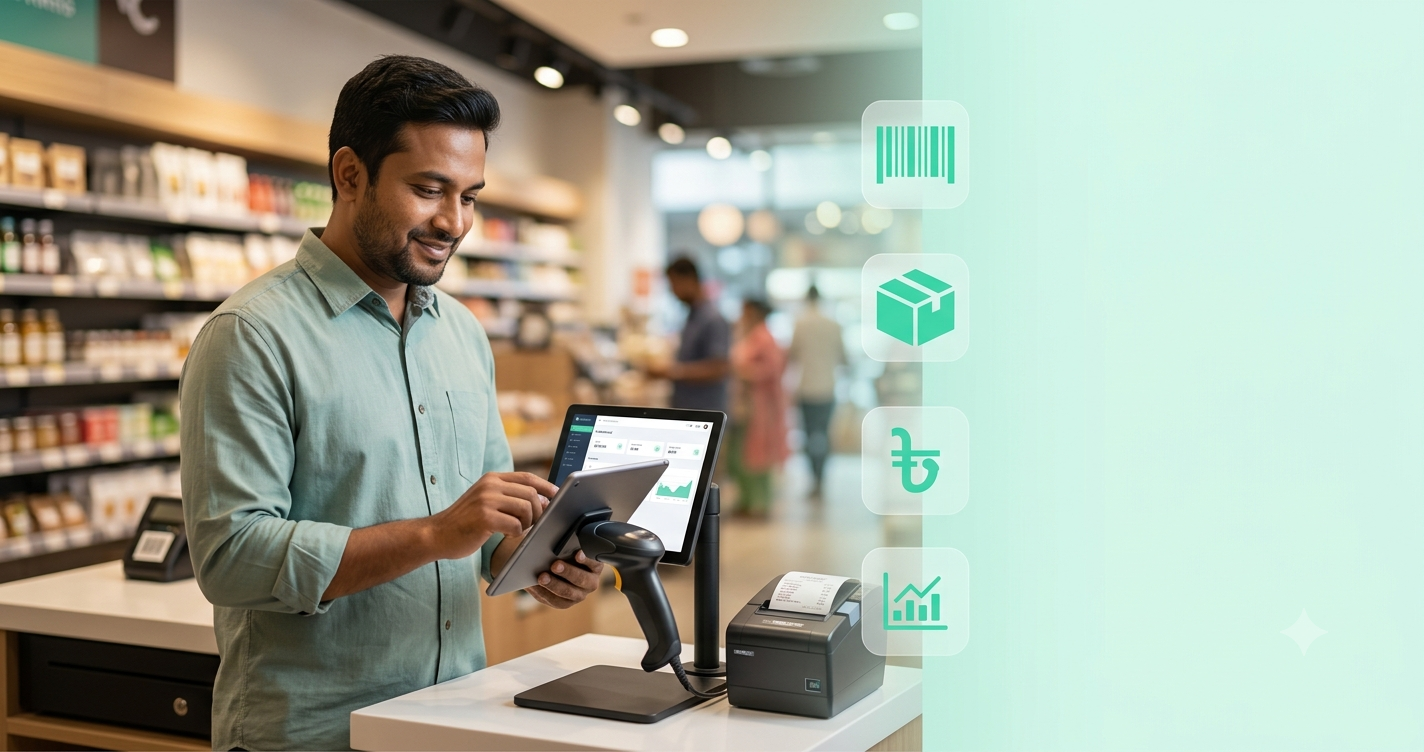
POS Hardware
Most restaurants require dedicated hardware to operate efficiently.
Common hardware includes:
Touchscreen POS terminal
Tablet or handheld ordering device
Receipt printer
Cash drawer
Barcode scanner
Kitchen Display System (KDS)
Customer display
Network router
The exact hardware requirements depend on the size and workflow of your restaurant.
Implementation & Setup
Implementation costs may include:
Software installation
Initial configuration
Menu setup
Staff account creation
Payment gateway integration
Data migration (if replacing an existing system)
Proper implementation ensures the POS system is configured according to your restaurant’s operational requirements.
Staff Training
Even the best software requires proper user training. Staff should understand how to:
Process orders
Manage tables
Handle payments
Issue refunds
Generate reports
Update inventory
Well-trained employees improve operational efficiency and reduce user errors.
Annual Maintenance & Support
Ongoing support is essential to keep the system secure and up to date.
Maintenance services may include:
Software updates
Security patches
Feature enhancements
Technical support
Cloud backup management
Choosing a provider with responsive local support can significantly reduce operational downtime.
Payment Integrations for Restaurants in Bangladesh
Modern restaurants must support multiple payment methods to meet customer expectations and streamline financial reconciliation.
A modern Restaurant POS Software Bangladesh solution should integrate with:
Integrated payment processing also minimizes the need for manual data entry, reducing accounting mistakes.
Delivery & Online Ordering Integrations
Online food delivery continues to grow across Bangladesh. Restaurants benefit from a centralized system that manages orders from multiple channels without requiring staff to monitor several devices.
A comprehensive Restaurant POS solution should support integration with:
Food delivery applications
Restaurant website ordering
Facebook ordering
WhatsApp ordering
QR menu ordering
Telephone order management
By consolidating all incoming orders into a single dashboard, restaurants can improve order accuracy, reduce missed orders, and simplify kitchen operations.
Why Integration Matters
Without integrations, restaurant staff often switch between different devices, manually re-enter orders, and reconcile payments at the end of the day. This increases the likelihood of mistakes and slows down operations.
An integrated Restaurant POS Software Bangladesh platform creates a seamless workflow by connecting billing, kitchen operations, inventory, payment processing, and online ordering into one centralized system.
Real-World Success Stories
Choosing the right Restaurant POS Software Bangladesh can significantly improve restaurant efficiency, reduce operational costs, and enhance customer satisfaction. Below are examples of how different types of restaurants can benefit from implementing a modern POS system.
Case Study 1: Café Reduced Billing Time by 40%
A busy café experienced long queues during breakfast and evening rush hours. Manual billing and handwritten orders slowed service and reduced customer satisfaction.
Challenge
Solution
The café implemented a cloud-based Restaurant POS system with:
Tablet-based order taking
QR menu ordering
Digital payment integration
Fast billing
Results
40% faster billing process
Reduced customer waiting time
Improved order accuracy
Increased daily customer capacity
Case Study 2: Restaurant Improved Kitchen Accuracy
Challenge
Kitchen staff frequently prepared incorrect meals because handwritten order tickets were difficult to read.
Solution
The restaurant introduced a Kitchen Display System (KDS) connected directly to the POS.
Results
Significant reduction in kitchen errors
Faster food preparation
Improved communication between waiters and chefs
Higher customer satisfaction
Case Study 3: Fast Food Outlet Managed Peak-Hour Rush
Challenge
During lunch and dinner hours, staff struggled to manage a large number of takeaway and dine-in orders simultaneously.
Solution
The restaurant implemented:
QR ordering
Express billing
Kitchen Display System
Centralized order management
Results
Faster order processing
Reduced queues
Better peak-hour performance
Increased daily sales capacity
Case Study 4: Multi-Branch Restaurant Centralized Operations
Challenge
The owner managed four restaurant branches using separate billing systems, making it difficult to monitor sales and inventory.
Solution
A cloud-based multi-branch Restaurant POS platform was deployed across all locations.
Results
Real-time branch monitoring
Centralized inventory management
Unified sales reports
Improved management decisions
Easier business expansion
Common Restaurant POS Problems and Solutions
Even the best Restaurant POS system may occasionally encounter operational issues. Understanding common problems and knowing how to resolve them helps minimize disruptions.
Problem
Possible Cause
Recommended Solution
Printer not printing KOT
Printer offline or incorrect configuration
Check printer connection, network settings, and restart the printer.
Orders not reaching the kitchen
Network interruption or KDS synchronization issue
Verify the local network, restart the Kitchen Display System, and check order routing settings.
Inventory mismatch
Manual stock adjustments or incorrect item mapping
Perform a stock audit, review inventory transactions, and enable automatic inventory updates.
Internet outage
ISP downtime
Continue using Offline Mode and synchronize data automatically when the connection is restored.
Duplicate bills
Multiple submissions or user error
Review transaction logs and enable duplicate bill protection within the POS settings.
Payment not synchronized
Payment gateway communication delay
Verify payment status, reconnect the payment service, and synchronize pending transactions.
Wrong table assignment
Incorrect waiter selection
Allow staff to transfer tables through the POS before finalizing the order.
Delayed sales reports
Background synchronization pending
Refresh the reporting dashboard or allow cloud synchronization to complete.
Routine maintenance, software updates, and staff training can prevent most operational issues before they affect customers.
Selecting the right technology partner is just as important as choosing the right software. GeeksSort develops modern Restaurant POS solutions designed specifically for the operational needs of restaurants in Bangladesh.
Our Restaurant POS Solutions Include:
Cloud-based Restaurant POS
Fast and accurate billing
Kitchen Display System (KDS)
QR Menu & QR Ordering
Table & Reservation Management
Inventory & Stock Control
Customer Loyalty Programs
Multi-Branch Management
Real-time Reports & Analytics
Mobile Management Dashboard
Offline Mode
bKash, Nagad & Card Payment Integration
NBR/VAT Ready Billing
Staff Training & Local Technical Support
Whether you operate a single café or a nationwide restaurant chain, our solutions are designed to grow alongside your business.
Ready to Modernize Your Restaurant?
A modern Restaurant POS Software Bangladesh solution does far more than process payments—it helps you streamline operations, improve customer service, reduce costs, and make smarter business decisions.
From digital billing and inventory management to kitchen automation and cloud reporting, the right POS system becomes the central hub of your restaurant’s daily operations.
As customer expectations continue to evolve, investing in reliable restaurant management software is no longer a luxury—it’s a competitive advantage.
LOOKING FOR THE BEST RESTAURANT POS SOFTWARE IN BANGLADESH?
GeeksSort helps restaurants, cafés, cloud kitchens, bakeries, food courts, and multi-outlet chains streamline operations with modern cloud-based POS solutions. From billing and inventory management to QR ordering, Kitchen Display Systems (KDS), and digital payment integration, we build restaurant technology that improves efficiency and supports long-term business growth.
Restaurant POS (Point of Sale) software is a complete restaurant management system that handles billing, order management, inventory, kitchen communication, payments, reporting, and customer management from a single platform.
Which restaurants should use POS software?
Restaurant POS software is suitable for cafés, coffee shops, fast-food outlets, fine dining restaurants, cloud kitchens, bakeries, sweet shops, hotel restaurants, food courts, and multi-branch restaurant chains.
Does Restaurant POS Software support bKash and Nagad?
Yes. Modern Restaurant POS systems can integrate with bKash, Nagad, card terminals, QR payments, and other digital payment methods to simplify transactions and financial reconciliation.
Can Restaurant POS work without the internet?
Yes. Many cloud-based Restaurant POS solutions include Offline Mode, allowing restaurants to continue billing and processing orders even during internet outages. Data automatically synchronizes once connectivity is restored.
What is a Kitchen Display System (KDS)?
A Kitchen Display System replaces handwritten kitchen order tickets with digital displays, allowing chefs to receive real-time orders, reduce mistakes, and improve food preparation efficiency.
How much does Restaurant POS Software cost in Bangladesh?
Pricing depends on several factors, including software features, deployment model (cloud or desktop), hardware requirements, number of users, branches, implementation services, and ongoing support. Most providers offer subscription-based or one-time licensing options.
Can Restaurant POS manage multiple branches?
Yes. Cloud-based Restaurant POS software enables restaurant owners to monitor sales, inventory, employees, and reports across multiple branches through a centralized dashboard.
Is Restaurant POS Software suitable for small restaurants?
Absolutely. Small restaurants benefit from faster billing, improved inventory control, digital payment support, and accurate reporting, while larger restaurants gain additional advantages through multi-branch management and advanced analytics.
Poor retail visibility hides lost sales. Learn how a connected retail POS system brings sales, stock, customers, and branches into one view, and which daily checks turn those reports into decisions.
Learn how to build an MVP that investors will actually fund by validating key assumptions with real user data, focusing on traction instead of unnecessary features.
Looking for the best POS software in Bangladesh? This guide compares the top POS systems for retail stores, restaurants, pharmacies, supermarkets, wholesalers, and gyms. Explore key features, pricing, VAT/Mushak compliance, offline functionality, and industry-specific recommendations to choose the right POS solution for your business in 2026.





 We’re happy to sign an NDA upon request.