ERP timelines range from days to many months. This 2026 guide gives an honest look at ERP implementation in Bangladesh and how to go live faster.
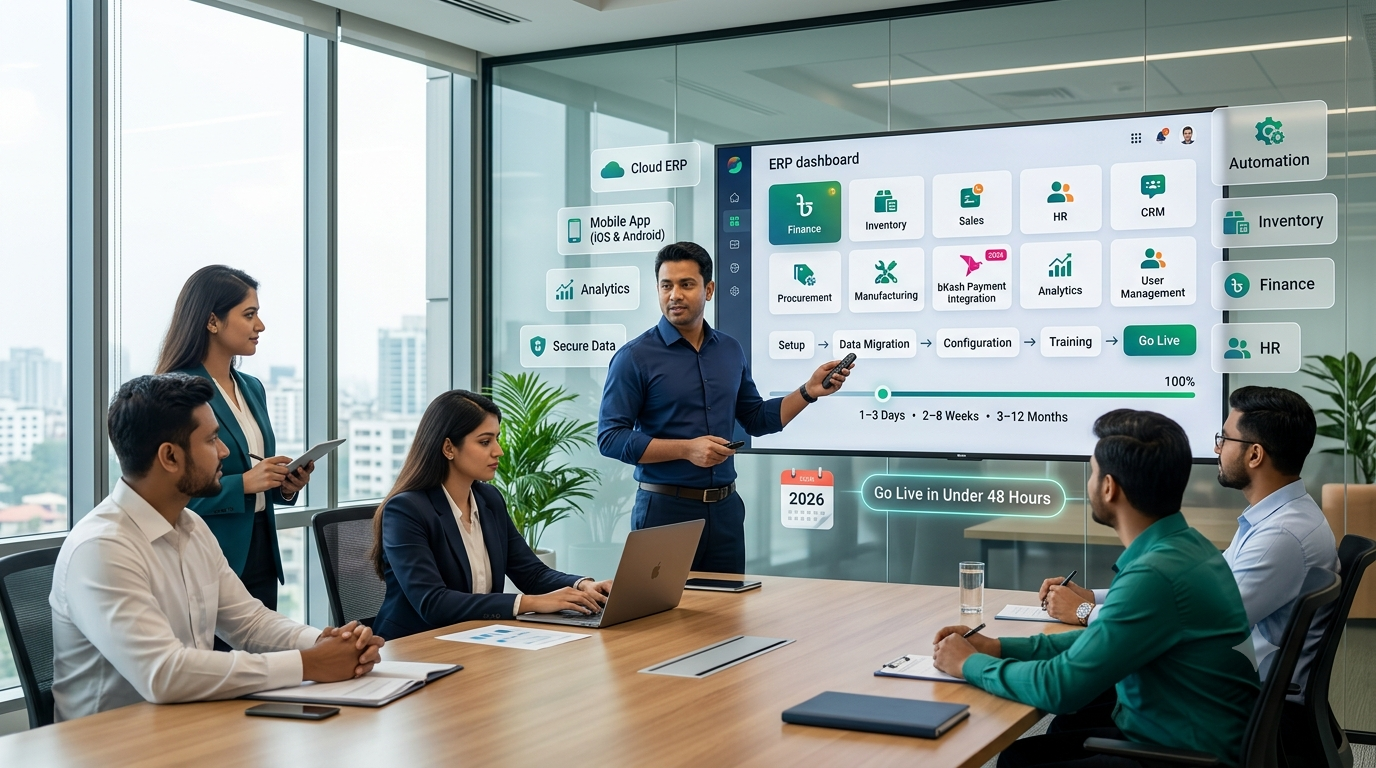
The honest answer to how long ERP implementation in Bangladesh takes is: anywhere from a couple of days to the better part of a year, depending on the system you choose and how you run the project. That huge range is exactly why owners get nervous. Pick the wrong path and you pay for months before seeing value; pick the right one and you are live this week. This 2026 guide gives you realistic timelines by system type, the real causes of delay, and a practical plan to go live as fast as possible.
Knowing what drives the timeline lets you set expectations, ask the right questions, and avoid the traps that turn a quick rollout into a stalled project.
What ERP Implementation in Bangladesh Actually Involves
Before timelines make sense, here is what ERP implementation in Bangladesh includes: setting up your company, branches, and users; configuring VAT, payments, and workflows; migrating your existing data; training your team; and going live. Some systems pack all of this into a couple of days; others stretch each step into weeks. The difference is the system and the support, not magic.
Realistic ERP Implementation Timelines in Bangladesh
Here is a realistic 2026 view of ERP implementation in Bangladesh by system type.
System type
Typical timeline
Why
SME cloud platform
1 – 3 days
Pre-built, localised, vendor-configured
Mid-tier ERP
2 – 8 weeks
More configuration and training
Open-source self-hosted
Weeks to months
Install, customise, localise yourself
Enterprise / global ERP
3 – 12 months
Partner-led, complex, custom
Sortorium
Under 48 hours
Done-for-you, built for Bangladesh
The pattern is clear: the more a system is pre-built and localised for Bangladesh, and the more the vendor does for you, the faster the ERP implementation. The more you must configure and customise, the longer it takes.
What Causes Delays in ERP Implementation in Bangladesh
Most slow rollouts are not the software’s fault alone; they are the result of avoidable causes. Watch for these.
• Messy source data that must be cleaned before migration.
• Unclear requirements, so the project keeps changing scope.
• Heavy customisation instead of using proven defaults.
• Localisation work for VAT and bKash on systems not built for Bangladesh.
• Slow internal decisions and approvals.
• Poor vendor support or an overstretched implementation partner.
• Trying to launch every module at once instead of starting with the essentials.
How to Speed Up ERP Implementation in Bangladesh
You have more control over the timeline than you think. To make ERP implementation in Bangladesh as fast as possible, do this.
1. Choose a platform already localised for Bangladesh, so VAT and bKash are not custom work.
2. Pick a vendor that does the setup and migration for you.
3. Tidy your data before migration, or ask the vendor to help clean it.
4. Start with core modules and add the rest after go-live.
5. Assign one internal decision-maker to keep approvals fast.
6. Resist unnecessary customisation; use proven defaults first.
Sortorium: the all-in-one ERP and POS software in Bangladesh for SMEs.
Why Sortorium Makes ERP Implementation in Bangladesh Fast
Sortorium is engineered for speed. Because it is built for Bangladesh, with NBR VAT and bKash, Nagad, and Rocket already inside, there is no localisation project. The team configures your branches, migrates your data, and trains your staff, so ERP implementation in Bangladesh is usually complete in under 48 hours. You start with the modules you need now and expand later, which keeps the launch quick and the risk low.
For a typical SME on a fast platform, the ERP implementation in Bangladesh looks like this. Day one: company, branches, users, VAT, and payments configured, and data migration started. Day two: data checked, staff shown the basics, and the business goes live, with the vendor on hand for the first real transactions. Larger or more complex businesses take longer, but the principle holds: the right system compresses weeks into days.
ERP Implementation in Bangladesh: Frequently Asked Questions
How long does ERP implementation in Bangladesh take?
Anywhere from a couple of days on an SME cloud platform to several months on an enterprise system. Sortorium is usually live in under 48 hours.
Why do some ERP implementations take months?
Complexity, heavy customisation, localisation work, messy data, and partner-led rollouts all add time. Pre-built, localised platforms avoid most of this.
Can ERP really go live in 48 hours?
For an SME on a platform built for Bangladesh, yes. Sortorium routinely completes ERP implementation in Bangladesh in under 48 hours, with setup and migration done for you.
What slows down ERP implementation the most?
Messy data and unnecessary customisation. Clean your data and start with proven defaults to keep the timeline short.
Should I launch all modules at once?
No. Start with core modules, go live, then add the rest. This speeds up ERP implementation and lowers risk.
Does data migration take a long time?
Not on a good platform. Sortorium migrates your data as part of the under-48-hour onboarding.
The Bottom Line on ERP Implementation in Bangladesh
ERP implementation in Bangladesh can take days or months, and the difference is mostly in the system you pick and how you run the project. Choose a platform built and localised for Bangladesh, let the vendor do the heavy lifting, start with core modules, and keep decisions fast. Do that, and going live becomes a matter of days, not a project that drags on while you pay and wait.
Poor retail visibility hides lost sales. Learn how a connected retail POS system brings sales, stock, customers, and branches into one view, and which daily checks turn those reports into decisions.
Learn how to build an MVP that investors will actually fund by validating key assumptions with real user data, focusing on traction instead of unnecessary features.
Looking for the best POS software in Bangladesh? This guide compares the top POS systems for retail stores, restaurants, pharmacies, supermarkets, wholesalers, and gyms. Explore key features, pricing, VAT/Mushak compliance, offline functionality, and industry-specific recommendations to choose the right POS solution for your business in 2026.





 We’re happy to sign an NDA upon request.